

Prohibiting Anticompetitive Mergers Act of 2022 This bill prohibits certain business mergers, modifies the procedures for reviewing mergers, and establishes procedures for reversing certain mergers. Specifically, the bill prohibits mergers that (1) are valued at more than $5 billion in total assets, (2) result in the acquiring entity having a market share of greater than 33% (or a share of a labor market as an employer of greater than 25%), or (3) result in market concentration levels that exceed specified thresholds. The bill also expands the authority of the Federal Trade Commission (FTC) and the Antitrust Division of the Department of Justice (DOJ) to review pending mergers, including whether a merger is likely to harm the competitive process and the effect of a merger on relevant labor markets. Finally, the bill authorizes the FTC and the Antitrust Division of the DOJ to retroactively unwind mergers that are prohibited under the bill or that meet certain other anticompetitive criteria such as a merger that results in a greater than 50% share of a relevant market.
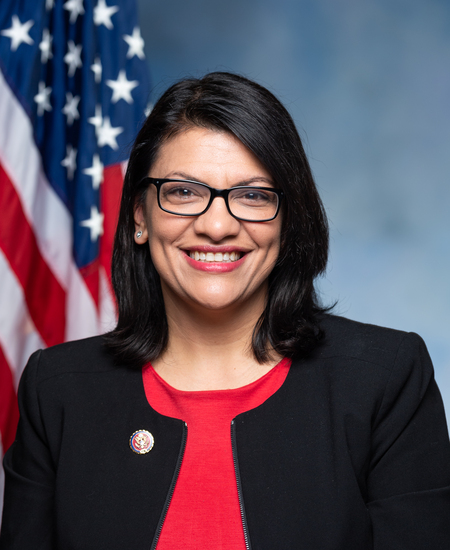
Rep. Rashida Tlaib
Sponsored bills
SESTA/FOSTA Examination of Secondary Effects for Sex Workers Study Act or the SAFE SEX Workers Study Act This bill requires the Department of Health and Human Services (HHS) and the Department of Justice (DOJ) to study the impacts of the reduction in access to certain websites and other interactive computer services resulting from the Allow States and Victims to Fight Online Sex Trafficking Act of 2017 on individuals engaged in adult, consensual sex work. Specifically, HHS must study the impacts of the reduction on the health and safety of individuals engaged in transactional sex while DOJ must study the impacts of the reduction on human trafficking investigations and prosecutions.
Latonya Reeves Freedom Act of 2022 This bill prohibits government entities and insurance providers from denying community-based services to individuals with disabilities that require long-term service or support that would enable such individuals to live in the community and lead an independent life. Specifically, these entities may not discriminate against such individuals in the provision of community-based services by such actions as imposing prohibited eligibility criteria, cost caps, or waiting lists or failing to provide a specific community-based service. Additionally, community-based services must be offered to individuals with such disabilities prior to institutionalization. Institutionalized individuals must be notified regularly of community-based alternatives. The bill requires the Department of Justice to issue regulations requiring government entities and insurance providers to offer community-based long-term services to individuals with such disabilities who would otherwise qualify for institutional placement. Government entities must ensure sufficient availability of affordable, accessible, and integrated housing that is not a disability-specific residential setting or a setting where services are tied to tenancy. Regulations shall also (1) require government entities and insurance providers to perform self-evaluation on current services, policies, and practices and concerning compliance with requirements of this bill; and (2) require government entities to submit a transition plan. The bill provides funds for FY2022 for the Department of Health and Human Services to provide technical assistance with respect to transition plans. The bill allows civil actions by individuals subjected to, or about to be subjected to, a violation of its requirements.
End Prison Gerrymandering Act This bill requires the Department of Commerce, beginning with the 2030 decennial census, to attribute an individual incarcerated in a correctional center to the individual's last place of residence before incarceration. Further, a state must treat such an individual's last place of residence in the state before incarceration as the individual's place of residence for purposes of congressional redistricting.
Climate Resilience Workforce Act This bill sets forth provisions to establish a climate resilience workforce, a national climate resilience action plan, an Office of Climate Resilience within the White House, and related efforts and entities.
Comprehensive Addiction Resources Emergency Act of 2021 This bill establishes programs, grants, and other activities to address substance use disorders. Specifically, the Department of Health and Human Services (HHS) must establish a program for purchasing and distributing opioid overdose reversal drugs for states and Indian tribes. HHS must also award grants for and otherwise support addressing substance use, particularly in states, tribes, territories, and localities with disproportionately high drug overdose rates; increasing access to preventive, medical, recovery, and related services; developing innovative models of delivering treatment and harm reduction services; and expanding the treatment capacity of Medicaid providers. In addition, HHS must issue model standards of care for treatment services and recovery residences and may award grants for training health care professionals. The bill also supports prevention and treatment services for workers, addiction and pain management research, and data collection on substance use disorders. Further, dispensers, distributors, and manufacturers of schedule II controlled substances (e.g., oxycodone), with the exception of opioid treatment programs, must certify that they maintain effective drug diversion controls. Violators are subject to specified civil and criminal penalties. Collected penalties shall be used for the grant programs and other substance use disorder activities established under the bill.
Family Unity Act of 2021 This bill modifies the scope of a statutory prohibition against the judicial review of claims involving the removal of a non-U.S. national ( alien under federal law). Currently, a court is barred from reviewing any claim by a non-U.S. national arising from a decision by the Department of Justice (DOJ) to commence proceedings, adjudicate cases, or execute removal orders against a non-U.S. national. Under this bill, a court is only barred from reviewing a claim by a non-U.S. national challenging a discretionary decision by DOJ to take such actions.
Fair and Independent Experts in Clemency Act or the FIX Clemency Act This bill establishes the independent U.S. Clemency Board, which shall review applications and recommend individuals for clemency directly to the President. It also abolishes the Office of the Pardon Attorney of the Department of Justice and transfers its functions, assets, and personnel to the board.
Bivens Act of 2021 This bill provides individuals with a statutory right to sue and recover damages from federal officials for violations of their constitutional rights. Currently, individuals have a statutory right to bring such suits against state or local officials (e.g., law enforcement), commonly known as Section 1983 suits or Bivens actions. Although the statute does not explicitly authorize such suits against federal officials, the Supreme Court has found this right to be inferred from the Constitution in certain situations (e.g., Fourth Amendment violations committed by federal law enforcement officers).
Lebanon TPS Act of 2021 This bill permits nationals of Lebanon to qualify for temporary protected status, which prevents their removal from the United States and allows them to obtain employment and travel authorization. Such status shall be available to qualifying nationals of Lebanon for 18 months starting from this bill's enactment. To qualify, an individual must meet various requirements, such as not having been convicted for certain crimes.