

Maddy summaryThe Saracini Enhanced Aviation Safety Act of 2023 requires the Federal Aviation Administration (FAA) to mandate secondary cockpit barriers on all commercial passenger aircraft operating under standard airline regulations. Specifically, it directs the FAA to issue an order requiring installation of these barriers within 18 months of the law's enactment. This applies to most major airlines operating scheduled passenger flights in the U.S. The key provision is the new safety requirement for barriers to prevent unauthorized cockpit access during flights. The law directly affects commercial airlines and their aircraft, focusing on a concrete operational safety change without specifying cost or implementation details.
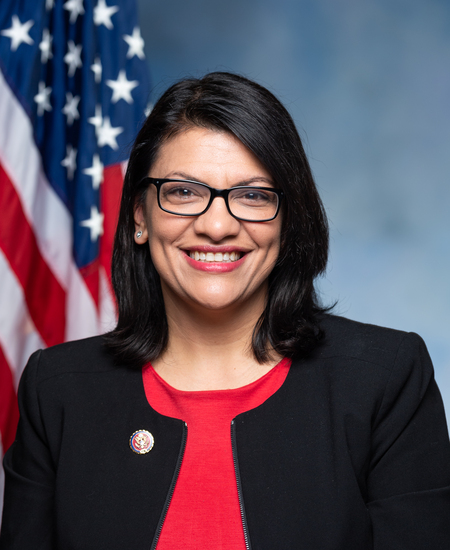
Rep. Rashida Tlaib
Sponsored bills
Maddy summaryHR 782 prohibits state officials from interfering with abortion services provided across state lines. It specifically blocks states from restricting: (1) out-of-state patients traveling for legal abortions, (2) providers offering such services, (3) assistance for travel or care, or (4) the interstate shipment of FDA-approved abortion drugs. The bill allows the federal Attorney General or affected individuals to sue violators for injunctions, damages, and attorney fees. It directly affects patients seeking care in other states, healthcare providers, transportation services, and pharmacies handling FDA-approved abortion medications. The law focuses on preventing state laws from blocking access to legally permitted abortion services.
Maddy summaryHR 927, the Supreme Court Ethics Act, establishes new ethics rules and oversight for Supreme Court justices. It requires the Judicial Conference to create a binding code of conduct within one year and mandates the appointment of an Ethics Investigations Counsel to receive public complaints, investigate potential violations, and issue annual public reports. The bill also requires justices to publicly disclose their reasons for recusing themselves or denying recusal motions in cases. These provisions directly affect Supreme Court justices by creating a formal process for handling ethics concerns and increasing transparency around their conduct.
Maddy summaryThe Child Care for Every Community Act establishes a federal program to provide universal, high-quality child care and early learning services for all young children not yet required to attend school. It provides 90% federal funding for most programs (100% for migrant/seasonal farmworkers and Native American children) with a sliding fee scale based on family income (maximum 7% of income). The bill requires states, tribes, and localities to develop comprehensive plans ensuring services are accessible, culturally appropriate, and meet national quality standards. It specifically focuses on serving low-income children, children with disabilities, dual language learners, homeless children, and children in foster care. The program emphasizes coordination with schools and other community services to support children's development and school readiness.
Maddy summaryHR 926 would require the Supreme Court to establish a code of conduct for justices within 180 days of enactment, along with procedures for handling ethics complaints against them. The bill mandates minimum disclosure standards for gifts, income, and reimbursements received by justices and their law clerks, and requires justices to recuse themselves when they or their family received gifts from parties in a case. It would also require parties and amici curiae to disclose gifts given to justices and lobbying contacts related to justices' nominations, and establish a judicial investigation panel to review complaints against justices. The legislation aims to increase transparency in Supreme Court ethics processes and provide clearer recusal standards for justices.
Maddy summaryThis bill makes significant changes to US corporate tax rules to prevent tax avoidance through foreign operations. It requires corporations to calculate foreign income tax liabilities country-by-country, limits interest deductions for large international financial reporting groups, and modifies rules for "inverted corporations" (where US companies move tax residence abroad). The bill also creates new rules treating foreign corporations managed primarily in the US as domestic corporations for tax purposes. These changes aim to close tax loopholes related to outsourcing and foreign tax planning.
Maddy summaryHR 951, the PERIOD Act, prohibits U.S. federal funding for educational institutions (including K-12 schools and colleges) that require students to provide menstrual cycle information as a condition of attendance or services. The bill directly affects all schools receiving federal education funds by banning the collection of this specific health data. Key provisions state that no federal money can be allocated to institutions mandating such disclosures, with definitions covering elementary schools, secondary schools, and higher education institutions under existing federal education laws. This policy change mandates privacy protections for students' health information in educational settings funded by the federal government.
Maddy summaryHR 932 repeals two key congressional authorizations for military force in Iraq: the 1991 resolution (Public Law 102-1) and the 2002 resolution (Public Law 107-243). This bill removes the legal foundation that has permitted U.S. military operations in Iraq for over two decades. It directly affects the executive branch’s authority to conduct military actions under these specific resolutions, requiring future operations to seek new congressional approval. The repeal is a procedural change that would end the statutory basis for ongoing military engagement in Iraq without altering other laws or policies.
Maddy summaryHR 905 expands federal protections for survivors of domestic violence and stalking by updating key definitions in U.S. Code. It broadens the definition of "intimate partner" to explicitly include current and former dating partners, and adds protections for people sharing a residence regardless of family ties. The bill also creates a new federal definition for "misdemeanor crime of stalking," requiring that such offenses involve harassment causing fear for a person, their family, cohabitant, intimate partner, or their pet/service animal. This change would trigger firearm restrictions for individuals convicted of qualifying stalking offenses, ensuring those protections apply more consistently across jurisdictions.
Maddy summaryHR 971, the Black History Matters Act, directs the Director of the National Museum of African American History and Culture to study Black history education in public elementary and secondary schools. The 3-year study will identify which schools require Black history curriculum, assess teaching quality through discussions and materials, and analyze how schools measure student understanding. It does not change school requirements but will produce a report for Congress on the current state of Black history education, including coverage of topics like slavery, Reconstruction, and systemic racism. The bill specifically defines "Black history education" as teaching the history of African Americans, including struggles against racism and discrimination. This is a procedural study bill, not a policy requiring new educational mandates.