This resolution expresses support for (1) equal rights and protections for all people, regardless of actual or perceived sexual orientation, gender identity, or sex characteristics; and (2) the designation of LGBTQI+ Equality Day to commemorate Supreme Court decisions handed down on June 26 in 2003, 2013, and 2015. The resolution also acknowledges the need for further legislation to ensure that people in the United States are free from all forms of discrimination on the basis of actual or perceived sexual orientation, gender identity, or sex characteristics.
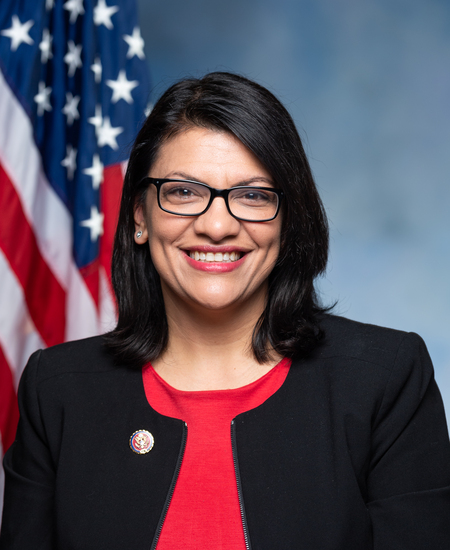
Rep. Rashida Tlaib
Sponsored bills
This resolution expresses that the House of Representatives (1) demonstrates solidarity with and support for members of the community of Islam in the United States and throughout the world, (2) recognizes the importance of the Islamic faith, and (3) wishes Muslim Americans and Muslims around the world who observe Eid al-Adha a prosperous holiday.
Equal Access to Reproductive Care Act This bill includes assisted reproduction as a tax deductible medical expense. It defines assisted reproduction as any methods, treatments, procedures, and services for effectuating a pregnancy and bringing it to term, and treats it as medical care of the taxpayer, the taxpayer's spouse, or a dependent to the extent that they intend to take legal custody or responsibility for any children born as a result of such assisted reproduction.
Customer Non-Discrimination Act This bill prohibits discrimination based on sex, sexual orientation, and gender identity with respect to public accommodations and facilities. Specifically, the bill defines and includes sex, sexual orientation, and gender identity among the prohibited categories of discrimination or segregation. The bill expands the definition of public accommodations to include places or establishments that provide (1) exhibitions, recreation, exercise, amusement, gatherings, or displays; (2) goods, services, or programs; and (3) transportation services. Protections against discrimination based on race, color, religion, sex, sexual orientation, gender identity, or national origin shall include protections against discrimination based on (1) an association with another person who is a member of such a protected class; or (2) a perception or belief, even if inaccurate, that an individual is a member of such a protected class. The bill prohibits the Religious Freedom Restoration Act of 1993 from providing a claim, defense, or basis for challenging such protections. The bill prohibits an individual from being denied access to a shared facility, including a restroom, a locker room, and a dressing room, that is in accordance with the individual's gender identity. The bill also prohibits the provision of less favorable treatment with respect to pregnancy, childbirth or related medical conditions as compared to other physical conditions.

Maddy summaryHRES 551 is a non-binding House resolution (not a bill) introduced in June 2023 that calls for action to address U.S. child poverty. It recommends making permanent the expanded Child Tax Credit (which lifted nearly 3 million children out of poverty in 2021), establishing a federal council to coordinate child-focused policies, and increasing federal investment in children’s programs like early education and nutrition assistance. The resolution highlights that child poverty rebounded sharply after the 2021 tax credit expansion expired, affecting over 4 million children, and emphasizes the need for equitable access to benefits for immigrant families, children in Puerto Rico, and children with disabilities. It does not create new laws but urges Congress and federal agencies to prioritize these policy changes.
Maddy summaryHR 4325, the Historically Underserved Veterans Inclusion Act of 2023, expands the Department of Veterans Affairs' Center for Minority Veterans to include "historically underserved" veterans and modifies its advisory committee. The bill broadens the definition of "covered veterans" to include veterans facing barriers based on sexual orientation, gender identity, English language proficiency, citizenship, religion, or other factors identified through a biennial review. Key provisions require the VA Secretary to conduct biennial reviews of benefit disparities and submit reports to Congress, while the expanded advisory committee must advise on improving benefits, health care, homelessness services, and outreach for these veterans. The bill directly affects veterans who experience systemic barriers in accessing VA services, aiming to make VA programs more inclusive through concrete policy adjustments.
Maddy summaryHR 4335, the VA Loan Informed Disclosure Act of 2023, requires mortgage lenders to include specific information about VA home loan programs in standard mortgage disclosures. The bill amends the National Housing Act to mandate that lenders provide details on VA loans (guaranteed under Title 38) alongside other loan options, including assumptions about prevailing interest rates. This change directly affects lenders processing VA-guaranteed mortgages, ensuring borrowers receive clearer comparisons between VA loans and other financing. The law does not require lenders to verify borrower eligibility for VA loans, only to include the specified disclosure language.
Maddy summaryThe PRIDE Act of 2023 amends the Internal Revenue Code to replace gender-specific terms like "husband and wife" with gender-neutral language such as "married couple" or "spouses" across numerous tax code sections. This bill affects all legally married couples who file federal tax returns by updating language in over 30 sections of the tax code related to filing status, deductions, credits, and other tax matters. The bill is a language update that makes the tax code more inclusive without changing existing tax treatment for married couples. It does not alter tax rates, benefits, or policies, but ensures all provisions apply equally regardless of gender.
Protect Sexual and Reproductive Health Act of 2023 This bill requires the Department of Health and Human Services (HHS) to undertake activities to promote access to sexual and reproductive health and well-being. The bill renames HHS's Office of Population Affairs as the Office of Sexual and Reproductive Health and modifies its responsibilities. Among other activities, the office must develop and implement a strategy to promote sexual and reproductive health and well-being. This strategy must include recommendations to integrate sexual and reproductive health equity and reproductive justice into federal programs. HHS must also award grants for improving access to sexual and reproductive health care to nonprofit or community-based organizations that assist individuals seeking abortion services through programs that are unbiased and medically and factually accurate. Additionally, HHS and the Director of the White House Gender Policy Council must jointly establish an interagency task force to coordinate and promote federal programs and activities related to sexual and reproductive health and well-being.
Maddy summaryHR 3756, the Environmental Justice in Recreation Permitting Act, requires federal land management agencies to submit a report to Congress within one year of enactment. The report must analyze how special recreation permits - used by outfitters, guides, or event organizers serving environmental justice communities - are currently accessed, identify barriers to access for these communities, and recommend improvements. It specifically focuses on communities with significant representation of people of color, low-income residents, or Tribal/indigenous groups facing disproportionate environmental health impacts. The report will be based on voluntary data from recreation service providers, not mandatory participation. This is a procedural bill focused on data collection, not new policy changes.