

Guaranteed Income Pilot Program Act of 2023 This bill directs the Department of Health and Human Services (HHS) to establish and implement a three-year pilot program to provide a guaranteed monthly income to individual taxpayers between the ages of 18-65. HHS must consult with the Internal Revenue Service and certain nonpartisan and nonprofit agencies or academic institutions with expertise in social science experimentation to develop and award income subsidies to eligible taxpayers and to conduct a study on the outcomes of the program.
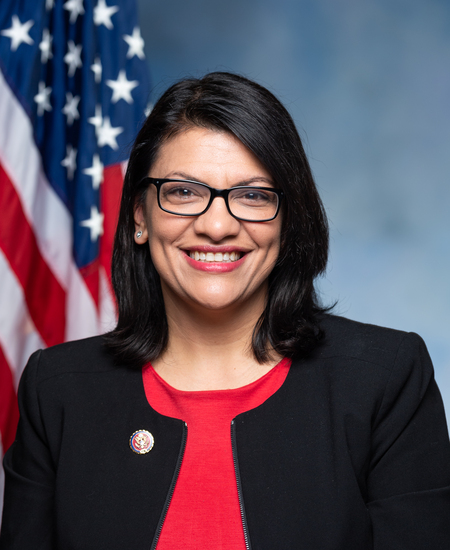
Rep. Rashida Tlaib
Sponsored bills
Maddy summaryThe WIC for Kids Act expands eligibility for the Special Supplemental Nutrition Program for Women, Infants, and Children (WIC) by adding new qualifying pathways. It allows children to qualify if they live in households where someone receives Head Start, Indian reservation food assistance, or Puerto Rico/Northern Mariana Islands nutrition block grants, and streamlines documentation by permitting states to use existing records. The bill extends certification periods for children from one to two years and automatically enrolls infants born to current WIC participants. This directly affects low-income families with children who qualify for related assistance programs but previously faced barriers to WIC access.
Maddy summaryHRES 702 is a symbolic House resolution (not a binding law) expressing the House's "sense" that the federal government should develop a "restaurant workers' bill of rights." It does not create new policies but calls for future legislation to address systemic issues affecting restaurant workers, including low wages, lack of healthcare access, discrimination, unsafe conditions, and inadequate leave. The resolution outlines five key areas for such future legislation: ensuring fair pay and economic security, paid leave and predictable schedules, safe workplaces, healthcare access (including reproductive care), and protections for organizing and voting. It specifically references existing bills (like the LIFT the BAR Act and EACH Act) as potential models for this future framework. The resolution directly affects the 12.5 million U.S. restaurant workers, who face disproportionate poverty, discrimination, and workplace hazards.
EITC Age Parity Act of 2023 This bill modifies the age requirement for the earned income credit. Under current law, an individual taxpayer must have attained age 25, but not age 65, to claim the credit. This bill reduces the base year to age 18 and eliminates the age 65 cap on the credit.
Maddy summaryThis bill requires federal agencies to mandate that auto manufacturers bidding on vehicle assembly contracts disclose detailed workforce information for each plant involved. Specifically, contractors must provide average and range of hourly wages, temporary worker counts, and any OSHA or National Labor Relations Act violations at each manufacturing location. It also requires written agency permission - and additional disclosures - if a contractor seeks to shift production to a new plant, with notification to affected labor unions. The law directly affects auto manufacturers competing for federal vehicle assembly contracts and aims to increase transparency around labor practices.
Maddy summaryThe Agricultural Worker Justice Act (HR 4978) improves working conditions for agricultural and meatpacking workers through several key provisions. It requires USDA to only purchase from entities paying prevailing wages (based on local rates and collective bargaining agreements), prohibits stock buybacks by USDA-funded companies, and creates a list of companies with labor violations that would be ineligible for USDA contracts. The bill establishes new safety standards for meatpacking plants including restrictions on line speeds (requiring safety inspections before increases), requirements for toilet facilities, and enhanced protections for workers reporting safety concerns. It also mandates a GAO report on racial disparities in meatpacking employment and authorizes $400 million for local food purchase programs. The bill directly affects meatpacking facilities, agricultural businesses receiving USDA funds, and the workers employed in these industries.
Maddy summaryThis bill amends the Higher Education Act to require all U.S. colleges and universities receiving federal financial aid to create detailed anti-harassment policies covering physical, online, and institution-sponsored settings. It mandates policies prohibiting harassment based on race, sex (including sexual orientation and gender identity), disability, religion, and other protected characteristics, including harassment via institutional email, computers, or electronic messaging. The bill also establishes a $50 million annual grant program to fund colleges developing prevention programs, victim support services, and training for students and staff on recognizing and addressing harassment. These policies and grants must comply with existing civil rights laws like Title IX but add specific requirements for reporting and prevention.
Maddy summaryHR 5606, the Future Generations Protection Act, prohibits new fossil fuel infrastructure and exports to accelerate the transition to clean energy. It bans greenhouse gas emissions from new fossil fuel power plants, blocks approvals for new LNG terminals (with limited emissions-reduction exceptions), and prohibits hydraulic fracturing by 2027. The bill also bans most exports of domestically produced crude oil and natural gas, except for limited cases involving Canada and Mexico. These provisions directly affect energy companies, LNG developers, and oil/gas producers, aiming to reduce fossil fuel reliance while prioritizing environmental justice and worker transitions.
Maddy summaryHRES 703 is a symbolic resolution supporting the designation of September 2023 as "National Voting Rights Month" to raise awareness about voting access. It encourages all U.S. citizens to uphold voting rights, urges Congress to pass specific voting rights legislation (like the Freedom to Vote Act and Democracy Restoration Act), and recommends that schools teach about voting history and current voter access issues. The resolution does not create new laws or directly affect specific groups, but it aims to promote broader public engagement with voting rights through education and advocacy. As a non-binding resolution, it expresses support for these goals without implementing any concrete policy changes.
Maddy summaryHR 5566, the *Supreme Court Tenure Establishment and Retirement Modernization Act of 2023*, establishes an 18-year term limit for all Supreme Court justices. It requires the President to nominate one new justice every two years (during first and third years after presidential elections), with Senate confirmation within 90 days, and prohibits lifetime appointments. Current justices are automatically retired in order of service length as new justices are appointed, while retired justices may temporarily fill vacancies through a randomized process. The bill directly affects all sitting and future Supreme Court justices by restructuring appointments and retirement timelines.