

Maddy summaryThe Climate Displaced Persons Act establishes a new admission pathway for individuals displaced by climate-related environmental disasters, defining "climate-displaced persons" as those compelled to leave their homes due to climate events like floods, droughts, or sea level rise who cannot safely return or integrate locally. The bill sets a minimum annual admission goal of 100,000 climate-displaced persons to the United States beginning in fiscal year 2024, requires the government to collect and analyze data on climate displacement, and mandates the creation of a Global Climate Change Resilience Strategy to address climate impacts on vulnerable populations. It also requires training for U.S. diplomats and immigration officers on climate displacement and establishes procedures for applications, including exemptions for unaccompanied children and cases of changed circumstances. The legislation aims to provide a structured humanitarian response to climate-driven displacement while acknowledging the U.S. historical responsibility for climate change.
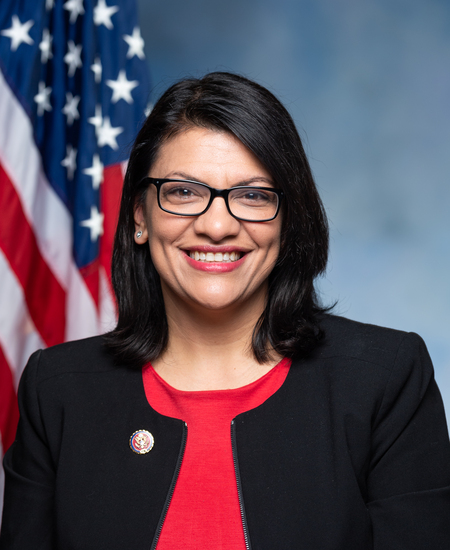
Rep. Rashida Tlaib
Sponsored bills
Maddy summaryH.J. Res. 102 would block a specific U.S. defense export to Israel by prohibiting the issuance of a license for "Spice Family Gliding Bomb Assemblies" along with related technical data and defense services. The bill targets a proposed transfer certified to Congress on October 31, 2023, intended for use by Israel's Ministry of Defense. This resolution directly prevents the export without requiring additional congressional action beyond passing the bill. It affects the U.S. government's ability to issue the export license and Israel's access to these defense articles.
Maddy summaryThe TREES Act of 2023 establishes a federal grant program to fund tree planting projects that reduce residential energy use. It provides 90% federal funding (up to $50 million annually) for projects in neighborhoods with high energy burdens, low tree canopy, or vulnerable populations like seniors and low-income households. Eligible applicants - including state/local governments, tribes, nonprofits, and power companies - must demonstrate how planting specific tree species will cut cooling and heating costs through shade and wind protection. The program aims to plant at least 300,000 trees yearly, prioritizing projects that maximize energy savings for households spending a high percentage of income on energy bills.
Maddy summaryHR 6296, the HCBS Relief Act of 2023, increases federal funding for Medicaid home and community-based services (HCBS) by boosting the Federal Medical Assistance Percentage (FMAP) by 10 percentage points for participating states during fiscal years 2024-2025. States must apply to use these funds to raise wages and improve working conditions for direct care workers (like home health aides), reduce waiting lists for services, and help individuals transition from nursing facilities back to community care. The bill requires states to spend funds by 2027 on specific activities, including paid leave, hazard pay, and supporting family caregivers, while reporting on outcomes like service access and beneficiary outcomes. It directly affects Medicaid beneficiaries receiving HCBS and the providers who serve them across participating states.
Health Share Transparency Act of 2023 This bill requires a health care sharing ministry (HCSM) to disclose specific information to individuals enrolling in the HCSM and to designated government agencies. (An HCSM is a faith-based organization with members who share a common set of ethical or religious beliefs and who contribute regular payments to cover the medical expenses of other members.) The bill requires an HCSM to disclose to an enrolling individual information such as (1) the average out-of-pocket expenses an enrollee incurs, (2) how to file a complaint or appeal a coverage determination, and (3) a list of the HCSM's non-reimbursable items and services. The bill also requires that an HCSM submit annual financial disclosures and program information to the Department of Health and Human Services (HHS), the Internal Revenue Service, and the Consumer Financial Protection Bureau. HHS is required to publicly post this information. Additionally, health insurance brokers contracting with an HCSM are required to provide an enrolling individual with information about health insurance coverage that is available through Medicare, Medicaid, or a health insurance exchange, as appropriate. HHS may apply civil monetary penalties to an HCSM that fails to comply with the bill's requirements. Further, the bill requires the Federal Trade Commission to publicly disclose information about consumer complaints regarding HCSMs.
Maddy summaryThe Advanced Coursework Equity Act aims to increase access to advanced courses like AP, STEM programs, and Algebra I for students in under-resourced schools, particularly focusing on historically underrepresented groups including Black, Latino, Native American students, students with disabilities, English learners, and low-income students. The bill establishes a federal grant program requiring states and schools to implement either "open enrollment" (allowing any student to enroll in advanced courses without academic prerequisites) or "universal screening" (systematically screening all students for advanced courses based on objective measures) to improve equitable access. It mandates data collection and reporting on enrollment and performance by student subgroups (race, disability, socioeconomic status, etc.) and sets specific 3-year equity goals for each subgroup. The grant program provides funding to states and schools to support these changes, with requirements for staff training, advisory councils, and communication with families about advanced course opportunities.
Maddy summaryHR 6293, the Fair Wages for Incarcerated Workers Act of 2023, would extend the Fair Labor Standards Act (FLSA) to require that incarcerated workers in public or privately operated correctional facilities receive fair wages. The bill directly affects individuals working in prisons or related programs (like UNICOR or work release) by prohibiting deductions for board, lodging, or court-imposed fees from their wages. Key provisions amend the FLSA to define "incarcerated worker" and explicitly state that such workers must be paid at least the minimum wage, with costs for facilities and court fees excluded from their earnings. This would ensure incarcerated workers keep more of their earnings from prison labor programs.
Maddy summaryThis resolution expresses the U.S. House of Representatives' support for designating October 2023 as "National Co-Op Month" to commend the cooperative business model. It highlights how member-owned cooperatives - spanning agriculture, utilities, credit unions, housing, and food systems - create jobs, strengthen rural communities, and provide economic benefits like lower costs and democratic member control. The resolution specifically acknowledges cooperatives' role in supporting farmers, rural infrastructure (like electricity and broadband), and affordable housing. It does not create new laws or funding but formally recognizes cooperatives' positive societal impact.
Maddy summaryThe SMOKE Act establishes new federal workplace safety standards to protect employees from wildfire smoke exposure. It requires employers to monitor PM2.5 air quality (AQI ≥151), implement engineering controls (like filtered buildings), provide respirators, and communicate risks when smoke levels are hazardous. Employees at risk of health harm from smoke can take up to 12 weeks of unpaid leave per year, with job protection upon return. The law excludes emergency responders and workplaces with certified filtered air systems (e.g., closed vehicles or buildings with filtered ventilation). OSHA must finalize these standards within 42 months of enactment.
Maddy summaryThe MOMMIES Act (HR 6004) extends Medicaid and CHIP coverage for pregnant and postpartum individuals from 60 days to 1 year after pregnancy (or longer, at state's election), ensuring continuous health coverage during this critical period. The bill requires states to provide full medical benefits, including oral health services, to pregnant and postpartum individuals for the entire coverage period. It establishes a 5-year demonstration project to fund maternity care home models in at least 10 states, focusing on improving care for underserved populations and reducing racial and health disparities in maternal outcomes. The legislation also includes requirements for states to maintain current coverage levels, enhanced federal funding for these services, and mandates reports on coverage gaps and access to services like doulas and telehealth.