

Maddy summaryThe Affordable Connectivity Program Extension Act of 2024 allocates $7 billion in funding for the Affordable Connectivity Program (ACP) during fiscal year 2024. The ACP provides subsidies to low-income households to help cover the cost of internet service and connected devices like laptops or tablets. This funding ensures the program can continue supporting eligible households throughout the year, with the money remaining available until fully spent. The bill extends existing program funding without changing eligibility criteria or service requirements.
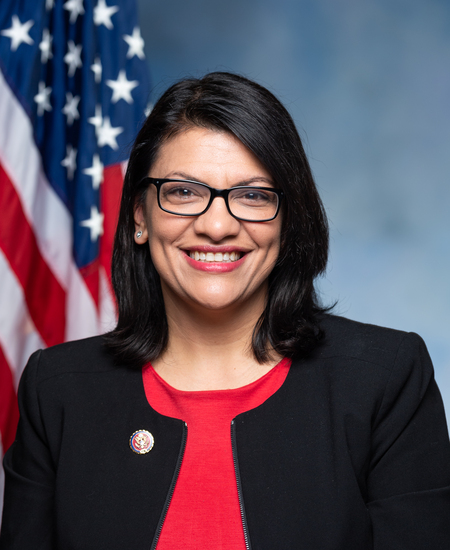
Rep. Rashida Tlaib
Sponsored bills
Maddy summaryHRES 953 is a formal resolution congratulating the University of Michigan Wolverines football team for winning the 2024 NCAA Division I College Football Playoff National Championship. It specifically recognizes their undefeated 15-0 season, 12th national title in school history, and three-peat Big Ten Conference championship. The resolution directs the House to invite the team to the U.S. Capitol for an honor and sends copies to university leadership (President, Athletic Director, and Head Coach) for display. This is a ceremonial resolution with no policy changes or direct impact beyond expressing congressional recognition.
Maddy summaryThis bill requires large AI model providers (those generating over 100,000 monthly outputs or serving 30,000+ users) to disclose specific transparency details about their foundation models. Covered entities must submit to the FTC and make public information about training data sources, model composition, safety evaluations for high-risk areas (like healthcare, hiring, and finance), and performance metrics. The FTC will establish regulations within 9 months, mandating standardized disclosures on websites and a central FTC portal, using machine-readable formats. Enforcement treats violations as unfair/deceptive practices under the FTC Act, with annual updates to the standards.
Maddy summaryHCONRES 81 is a symbolic concurrent resolution recognizing the anniversaries of multiple United Nations-designated international days focused on peace, such as the International Day of Peace (September 21), International Day of Non-Violence (October 2), and others. It commemorates specific milestones, including the 42nd anniversary of the International Day of Peace and the 5th anniversary of the International Day of Living Together in Peace. The resolution encourages U.S. citizens to observe these days and supports activities promoting peace, nonviolence, and cooperation throughout the year. As a non-binding resolution, it does not create new laws or requirements but expresses congressional support for global peace efforts.
Maddy summaryHRES 942 is a symbolic House resolution honoring Wadee Alfayoumi, a 6-year-old Palestinian Muslim-American boy murdered in a hate crime in Illinois on October 16, 2023. The resolution recognizes that Wadee was stabbed 26 times by a perpetrator who yelled "All Muslims should die" and consumed anti-Muslim rhetoric, and it condemns hate crimes targeting Palestinian, Muslim, and other minority identities. It affirms that elected officials and media should avoid dehumanizing language, upholds freedom of speech, and declares the U.S. has "zero tolerance" for Islamophobia, antisemitism, anti-Palestinian discrimination, and hate crimes. As a non-binding resolution, it does not create new laws but formally honors Wadee’s life and addresses the broader issue of hate-driven violence against minority communities.
Maddy summaryHR 6524, the Federal Cybersecurity Workforce Expansion Act, creates a new federal apprenticeship program to address the cybersecurity workforce shortage by training individuals for cybersecurity roles within federal agencies. The program partners with community colleges, career and technical schools, and other educational institutions to provide training aligned with federal cybersecurity needs. It also establishes a pilot program specifically for veterans and military members transitioning to civilian life, offering cybersecurity training with portable credentials that can be used across the job market. The bill requires coordination with multiple federal agencies and includes reporting requirements to assess program effectiveness and track participant employment outcomes.
Maddy summaryThis bill requires the Environmental Protection Agency (EPA) to list all perfluoroalkyl and polyfluoroalkyl substances (PFAS) with at least one fully fluorinated carbon atom as hazardous air pollutants under the Clean Air Act within 180 days of enactment. It directly affects industries that produce or use PFAS, such as manufacturers of non-stick coatings, firefighting foams, and textiles. The EPA must then revise source categories for these pollutants within 365 days, specifying which facilities (like factories or industrial sites) are subject to emission controls. This creates a regulatory framework for monitoring and reducing PFAS releases into the air.
Maddy summaryThe Baby Food Safety Act of 2023 requires the FDA to establish legal limits for four toxic elements - lead, cadmium, mercury, and inorganic arsenic - in foods for infants and children under two years old, including infant formula. It mandates that the FDA set these limits through administrative orders with specific deadlines (e.g., proposed limits for lead/arsenic/cadmium by December 2025), after public comment periods and scientific review. The law also adds that baby food exceeding these limits becomes "adulterated" and triggers mandatory recalls for non-formula products. This directly affects baby food manufacturers, requiring them to comply with new safety standards by 2027-2030.
Maddy summaryThe Menopause Research and Equity Act of 2023 requires the National Institutes of Health (NIH) to evaluate existing and ongoing research on menopause, perimenopause, and mid-life women’s health, identifying gaps in knowledge and funding over the past five years. The NIH must then develop a strategic plan with health professionals (including specialists like gynecologists and endocrinologists) to address these gaps and guide future research on treatments for menopause symptoms. The bill also mandates new NIH research on causes, symptoms, and treatments for menopause-related health issues, including a study on hormonal treatments. All activities must be funded using existing NIH resources, with no new appropriations authorized. This aims to improve scientific understanding of women’s mid-life health needs.
Maddy summaryThe Public Banking Act of 2023 establishes a federal framework for public banks owned by state, tribal, or community entities. It creates a process for chartering public lending banks (which provide financial services to public entities) and public payment banks (which focus on payment services), while requiring democratic governance with community representation on boards. The bill sets specific lending preferences prioritizing environmental justice communities, quality job creation, and worker protections, while prohibiting loans to fossil fuel companies, private prisons, and tobacco industries. It also creates grant and incubator programs to help establish these banks and establishes public deposit insurance for them, fundamentally changing how public banking institutions operate in the United States.