

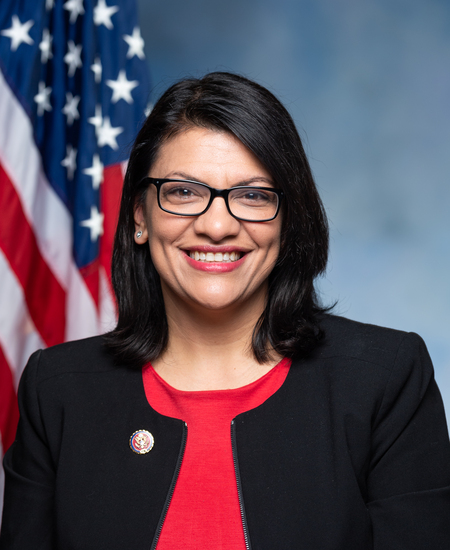
Photo of Rashida Tlaib
D United States House · District 12 · Michigan On the 2026 ballot

Rep. Rashida Tlaib

Compare
Total votes
2,837
all sessions
Attendance
98%
52 missed
Near the chamber average
With party
93%
of cast votes
Lower than 86% of chamber peers
Bipartisan score
4%
crosses aisle rarely
Higher than 85% of chamber peers
Sponsored
2,899
bills & resolutions
Higher than 99% of chamber peers
Committees
4
assignments
2,899 bills and resolutions

Sponsored bills

Total
2,899
Primary
101
Co-sponsor
2,798
Matching
2,899
matching current filters
Co-sponsor HR 4250
Passed · United States House · Co-sponsor
PRESS Act

Maddy summaryThe PRESS Act protects journalists' sources and unpublished materials from government subpoenas. It requires courts to approve any request for a journalist's protected information (like source identities or notes) only if the government proves it is necessary to prevent terrorism or imminent violence threatening life or safety. Service providers (like phone companies or social media platforms) must also obtain court approval before handing over journalists' personal accounts or devices. The law explicitly excludes civil defamation cases and does not shield journalists who are suspects in criminal investigations or terrorism-related cases.

Passed Jan 22, 2024 1 co-sponsor
Co-sponsor HR 7056
In committee · United States House · Co-sponsor
Access to Family Building Act

Maddy summaryHR 7056, the Access to Family Building Act, establishes federal rights for individuals to access assisted reproductive technology (ART) like IVF without unreasonable restrictions, directly affecting patients seeking fertility treatments and health care providers offering ART services. The bill prohibits states from imposing limitations on ART that are more burdensome than those for comparable medical procedures, fail to advance safety, or unduly restrict access, while allowing health and safety regulations that are necessary and least restrictive. It creates federal enforcement mechanisms, including lawsuits by the Attorney General or affected individuals to challenge violating state laws, and preempts conflicting state regulations. The bill explicitly preserves state authority over health/safety regulations and does not alter existing state insurance coverage laws for ART.

In committee Jan 19, 2024 1 co-sponsor
Co-sponsor HR 7041
In committee · United States House · Co-sponsor
Tax Excessive CEO Pay Act of 2024

Maddy summaryHR 7041, the Tax Excessive CEO Pay Act of 2024, imposes a corporate tax penalty on large companies where the CEO's pay exceeds 50 times the average worker's pay. The penalty adds 0.5% to 5% to the corporate tax rate, depending on how much higher the CEO's pay is relative to workers (e.g., 50-100:1 ratio adds 0.5%, over 500:1 adds 5%). It applies only to corporations with over $100 million in average annual revenue, exempting smaller businesses. The law aims to address extreme pay disparities by increasing taxes on companies with the highest CEO-to-worker pay ratios, effective for tax years after 2024.

In committee Jan 18, 2024 1 co-sponsor
Co-sponsor HR 7039
In committee · United States House · Co-sponsor
Stronger Communities through Better Transit Act

Maddy summaryThe Stronger Communities through Better Transit Act establishes a new federal grant program to improve public transportation service. It provides funding to urban areas, states, and Indian tribes to cover up to 50% of public transit operating costs (up to 80% in persistent poverty areas and 100% for Indian tribes), with requirements to report on service frequency, access to jobs, and conduct community surveys. The program mandates that a majority of funds must benefit underserved communities and areas of persistent poverty, defined as census tracts with high poverty rates or minority populations. Recipients must maintain their transit funding levels and report on improvements in access to essential services. The bill authorizes $20 billion annually for fiscal years 2024-2027.

In committee Jan 18, 2024 1 co-sponsor
Co-sponsor HR 6053
In committee · United States House · Co-sponsor
Break Free From Plastic Pollution Act of 2023

Maddy summary# Summary of "Protecting Communities from Plastics Act" (Title II) This comprehensive legislation addresses the environmental, health, and environmental justice impacts of plastics production and use. Key provisions include: ## Environmental Justice Protections - Requires environmental justice assessments for permits of "covered facilities" (plastics manufacturing facilities) - Mandates consultation with "fenceline communities" (communities near facilities) including: * Prompt notification in multiple languages * Public hearings with translation services * Community benefit agreements - Establishes a 45-day waiting period before approving permits after public hearings ## Regulatory Requirements - Amends Clean Air Act to establish new source performance standards for plastics facilities - Requires continuous monitoring of air emissions (benzene, nitrogen oxides, etc.) - Amends Clean Water Act to prohibit discharge of plastic pellets in wastewater - Requires financial assurance for facility closure and emergency response - Prohibits new facility permits within 5 miles of community buildings (schools, hospitals, etc.) ## Research and Monitoring - Requires study of microplastics in food (including fish, meat, fruits, vegetables) - Mandates research on microplastics in human bodies (urine, breastmilk, stool) - Establishes a pilot program to test technologies for microplastic removal - Requires inventory of plastics manufacturing and distribution ## Additional Provisions - Temporary permitting moratorium on new plastics facilities (during "temporary pause period") - Requires listing of discarded polyvinyl chloride as hazardous waste - Limits National Recycling Strategy to exclude chemical recycling technologies - Creates grants to reduce single-use plastics in agricultural packaging - Requires biodegradable alternatives to plastic weed barriers The legislation aims to address the disproportionate environmental and health impacts of plastics production on vulnerable communities while establishing comprehensive regulatory frameworks for plastics manufacturing and disposal.

In committee Jan 18, 2024 1 co-sponsor
Co-sponsor HR 5970
In committee · United States House · Co-sponsor
SNAP Tribal Food Sovereignty Act of 2023

Maddy summaryHR 5970, the SNAP Tribal Food Sovereignty Act of 2023, allows federally recognized tribes to manage their Supplemental Nutrition Assistance Program (SNAP) benefits locally through contracts or compacts with the USDA. Tribes must request this option via a tribal resolution, replacing the current federal administration of SNAP for tribal members. The agreements would follow the same rules as existing tribal self-determination contracts under the Indian Self-Determination Act. This change aims to support tribal self-governance over nutrition assistance programs.

In committee Jan 18, 2024 1 co-sponsor
Co-sponsor HRES 967
In committee · United States House · Co-sponsor
Amending the Rules of the House of Representatives to permit Members to vote by proxy in certain cases, and for other purposes.

Maddy summaryHRES 967 would amend House rules to allow Members who have recently given birth to vote by proxy for up to six weeks after childbirth. Specifically, a new rule permits a Member to designate another Member as their proxy during this period to cast votes on their behalf. The proxy cannot be used to count the Member's presence for quorum purposes in the House or its committees. This change directly affects female Members during their postpartum leave, with no other proxy voting allowed under the amendment.

In committee Jan 16, 2024 1 co-sponsor
Co-sponsor HRES 962
In committee · United States House · Co-sponsor
Honoring Reverend Dr. Martin Luther King, Jr., by Celebrating Diversity, Promoting Tolerance, and Condemning Hate.

Maddy summaryHRES 962 is a ceremonial resolution honoring Reverend Dr. Martin Luther King, Jr.'s legacy, specifically celebrating his 95th birthday on January 15, 2024. It symbolically affirms his teachings by condemning hate, discrimination, and prejudice against Black Americans, Indigenous people, Jewish, Asian-American/Pacific Islander, Muslim, Hispanic/Latino communities, and LGBTQ+ individuals. The resolution does not create new laws or affect any policies - it solely expresses the House's support for Dr. King's values of diversity, tolerance, and equality through non-binding statements. As a symbolic gesture, it has no legal effect or direct impact on any group or individual.

In committee Jan 12, 2024 1 co-sponsor
Co-sponsor HRES 963
In committee · United States House · Co-sponsor
Supporting the goals and ideals of Korean American Day.

Maddy summaryHRES 963 is a symbolic resolution honoring Korean American Day, which commemorates the January 13, 1903 arrival of the first large wave of Korean immigrants to the U.S. It recognizes Korean Americans' contributions to U.S. society, including their economic, cultural, and military impacts, and marks the 121st anniversary of this historic migration. The resolution urges all Americans to observe Korean American Day to appreciate these contributions. As a commemorative measure, it does not create new policies or affect specific groups beyond this ceremonial recognition.

In committee Jan 12, 2024 1 co-sponsor
Co-sponsor HR 6944
In committee · United States House · Co-sponsor
INSURE Act

Maddy summaryThe INSURE Act creates a federal reinsurance program to replace the National Flood Insurance Program, requiring property insurers to offer "all-perils" policies covering specific catastrophe risks like flood, wind, hurricane, wildfire, and eventually earthquake. Insurers participating in the program must implement loss prevention partnerships that encourage investments to reduce catastrophe losses, and will pay quarterly premiums to a Federal Catastrophe Reinsurance Fund. The program will phase in coverage for different perils over eight years, starting with flood coverage (beginning four years after enactment), followed by wind/hurricane (five years), severe storms/wildfire (six years), and earthquake (eight years or when feasibility reports are submitted). The bill also establishes grant programs for states to promote loss prevention investments and provide financial assistance to low-income homeowners struggling with insurance costs.

In committee Jan 10, 2024 1 co-sponsor
Showing 1,531 to 1,540 of 2,899 bills