

Maddy summaryHR 9864, the Keep Food Containers Safe from PFAS Act of 2024, prohibits the sale of food packaging containing intentionally added PFAS chemicals (like those used in non-stick coatings) in interstate commerce. It directly affects food manufacturers and packaging producers who currently use these chemicals. The bill amends federal food safety law to ban such packaging starting January 1, 2025, defining PFAS as man-made chemicals with at least one fully fluorinated carbon atom. This is a concrete policy change to remove specific chemicals from food contact materials.
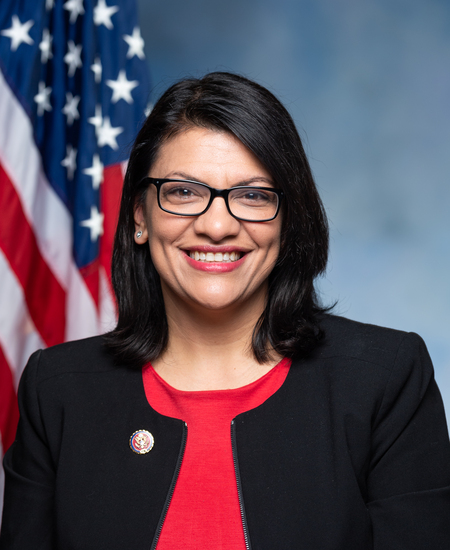
Rep. Rashida Tlaib
Sponsored bills
Maddy summaryThe Child Safety and Well-Being Act of 2024 (HR 9875) establishes a Children's Commission to represent children's interests in federal policymaking. The Commission, composed of 15 diverse members including experts, youth with lived experience, and representatives from various backgrounds, will advise Congress and federal agencies on policies affecting children, particularly marginalized youth defined as those experiencing systemic barriers. The Commission will review agency actions, receive complaints about how children are treated, and publish annual reports with recommendations to improve child well-being policies. It is authorized $5 million annually for operations and must study the feasibility of requiring agencies to create "child impact statements" assessing how policies affect children.
Maddy summaryHCONRES 131 is a symbolic resolution recognizing the wage gap between Latina women and White, non-Hispanic men in the U.S. workforce. It highlights that Latina women working full-time earn 58 cents for every dollar earned by White, non-Hispanic men, with an average lifetime earnings loss of over $1.2 million. The resolution designates October 3, 2024, as "Latina Equal Pay Day" to draw attention to this disparity, citing Bureau of Census data showing the gap has persisted for decades. It does not create new laws or policies but formally acknowledges the economic impact on Latina women and their families.
Maddy summaryHRES 1506 is a symbolic resolution expressing the U.S. House of Representatives' profound sorrow over the death of Alexander Michel Odeh, a Palestinian-born peace activist, Arab-American rights advocate, and ADC director. It commemorates his 1985 murder in a Santa Ana pipe bomb attack (still unsolved) and extends sympathy to his surviving family and the American-Arab Anti-Discrimination Committee. The resolution serves as a formal tribute to his life and work promoting civil rights, without proposing any policy changes or funding. It was introduced in the 118th Congress on September 25, 2024.
Maddy summaryHRES 1515 designates October 1, 2024, as "National Animal Rescue Day" to raise public awareness about animal adoption, promote spaying and neutering to reduce pet overpopulation, and encourage more adoptions nationwide. The resolution supports community events, educational efforts, and charitable activities on that day to assist animal shelters and reduce the number of animals euthanized. It is a non-binding symbolic gesture without legal force, intended to unite communities around animal rescue initiatives.
Maddy summaryThis bill requires global systemically important bank holding companies (the largest, most complex banks) to submit detailed annual reports to the Federal Reserve. The reports must cover specific areas including branch locations, enforcement actions (like labor or safety violations), executive compensation comparisons, climate risk strategies, diversity metrics, and environmental impact related to projects in vulnerable communities. Banks must also disclose their use of forced arbitration, cybersecurity practices, and how they address past environmental harms. The Federal Reserve will make these reports publicly available online, increasing transparency around these institutions' operations and impacts.
Maddy summaryThis bill eliminates a tax credit for using carbon dioxide (CO2) in enhanced oil recovery (EOR) operations. It amends the Internal Revenue Code by removing Section 43 (the EOR credit) and modifying Section 45Q to prohibit the credit for new facilities starting construction after the law's enactment. The primary effect is ending the federal tax incentive for oil companies that inject CO2 to extract more oil from existing wells. This change directly affects oil and gas companies planning new EOR projects using CO2, as they will no longer qualify for this specific tax credit.
Maddy summaryThe Toxic Free Food Act of 2024 requires the FDA to revise its "Generally Recognized As Safe" (GRAS) rule within 180 days of enactment. It mandates that food manufacturers must submit detailed safety data - including cumulative effects, safety factors, and protections for vulnerable groups - before marketing a substance as GRAS or using it in food. The bill also prohibits carcinogens and novel chemicals from being classified as GRAS, requires public posting of all GRAS submissions with a 90-day review period, and bans the use of experts with conflicts of interest in safety assessments. This directly affects food manufacturers, the FDA, and consumers by increasing transparency and safety standards for food additives.
Maddy summaryThis bill requires the Transportation Security Administration (TSA) to develop and update guidance within 90 days (and every five years) to prevent contamination of breast milk, baby formula, and related cooling items during airport security screening. The guidance must be created with input from maternal health organizations and ensure hygienic handling during re-screening or additional testing. It also mandates a DHS Inspector General audit within one year to review compliance and assess how screening technologies affect these items' processing. The bill directly affects breastfeeding parents traveling with infants by standardizing secure handling of essential items.
Maddy summaryHCONRES 130 is a symbolic concurrent resolution commending state and local governments that treat reproductive rights as human rights following the *Dobbs* decision. It recognizes efforts by cities like Austin, Texas, and Montgomery County, Maryland, to expand abortion access and condemn criminalization of pregnancy outcomes. The resolution affirms that reproductive rights are human rights, urges states to repeal restrictive laws, and references U.S. obligations under international human rights treaties. As a non-binding resolution, it does not create new laws or alter existing policies.