

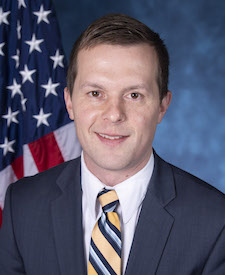
Photo of Jared F. Golden
D United States House · District 2 · Maine

Rep. Jared F. Golden

Compare
Total votes
2,837
all sessions
Attendance
97%
98 missed
Near the chamber average
With party
84%
of cast votes
Lower than 99% of chamber peers
Bipartisan score
8%
crosses aisle rarely
Higher than 98% of chamber peers
Sponsored
716
bills & resolutions
Near the chamber average
Committees
7
assignments
716 bills and resolutions

Sponsored bills

Total
716
Primary
56
Co-sponsor
660
This page
716
matching current filters
Co-sponsor HR 3699
In committee · United States House · Co-sponsor
Energy Choice Act

Maddy summaryThis bill prevents state or local governments from banning or restricting energy connections (like installation, modification, or access) based on the type or source of energy, such as electricity, natural gas, or renewable fuels. It directly affects consumers choosing energy providers and energy companies seeking to offer services. The key provision prohibits local laws, regulations, or policies that limit energy services sold in interstate commerce, covering all energy types listed in the bill’s definitions. It does not create new programs but limits regulatory authority at the state or local level. The law aims to ensure open access to diverse energy sources without source-based restrictions.

In committee Feb 4, 2026 1 co-sponsor
Co-sponsor HJRES 144
In committee · United States House · Co-sponsor
Providing for congressional disapproval under chapter 8 of title 5, United States Code, of the rule submitted by the Department of Veterans Affairs relating to "Reproductive Health Services".

Maddy summaryHJRES 144 is a congressional disapproval resolution targeting a specific rule issued by the Department of Veterans Affairs (VA) on December 31, 2025, which addressed "Reproductive Health Services" (90 Fed. Reg. 61310). This resolution directs Congress to disapprove the VA rule under Chapter 8 of Title 5, U.S. Code, meaning the rule would have no legal effect if passed. The bill directly affects the VA's implementation of reproductive health services for veterans, as it seeks to nullify the agency's existing policy. This is a procedural measure, not a substantive policy change, aimed solely at blocking the VA's rule through congressional action.

In committee Jan 27, 2026 1 co-sponsor
Co-sponsor HR 7199
In committee · United States House · Co-sponsor
Gerald’s Law Act

Maddy summaryHR 7199, the Gerald’s Law Act, expands burial benefits for veterans who die at home while receiving VA hospice care. It adds a new eligibility category allowing burial allowances for veterans who were in VA hospice care at home *only if* they previously received VA hospital or nursing home care. The bill amends existing law to include this scenario under the veterans' burial allowance program. This change directly affects veterans receiving VA hospice care at home after prior VA facility-based care, ensuring they qualify for burial benefits similar to those who die in VA facilities. The policy change takes effect as if included in the 2020 Veterans Health Care Act.

In committee Jan 22, 2026 1 co-sponsor
Co-sponsor HR 7137
In committee · United States House · Co-sponsor
Shutdown Fairness Act

Maddy summaryHR 7137, the Shutdown Fairness Act, requires federal agencies to pay covered employees (including most federal workers and military personnel) and covered contractors their regular pay during government shutdowns. It appropriates funds from the Treasury to cover standard employee compensation and contractor payments for work performed during a lapse in regular appropriations, ensuring pay continues without delay (within 7 days if a shutdown is ongoing at enactment) and aligns with regular pay schedules. The bill applies only to individuals employed or with accepted offers before the shutdown began and mandates that these payments be charged to future appropriations. It does not change agency obligations under existing contracts or authorize new spending beyond the specified shutdown period.

In committee Jan 16, 2026 1 co-sponsor
Co-sponsor HR 7033
In committee · United States House · Co-sponsor
Federal Correctional Officer Paycheck Protection Act of 2026

Maddy summaryThis bill would increase the base pay for Federal Bureau of Prisons correctional officers by 35 percent, replacing their current base rate for all pay calculations (including retirement and locality adjustments). It applies to officers whose duties involve inmate custody, control, or direct custodial contact, including certain supervisory staff and lower-grade Bureau of Prisons employees with similar duties. The pay increase is capped at the Executive Schedule level V rate and would expire after five years unless a Department of Justice Inspector General review finds progress in reducing non-custodial staff use for custodial duties and excessive overtime. The review, required 180 days before expiration, would assess impacts on recruitment, retention, and institutional safety.

In committee Jan 13, 2026 1 co-sponsor
Co-sponsor HR 6476
In committee · United States House · Co-sponsor
Relief for Farmers Hit with PFAS Act

Maddy summaryHR 6476, the Relief for Farmers Hit with PFAS Act, creates a federal grant program to assist farmers and agricultural communities affected by unsafe levels of PFAS (chemicals used in industrial products) in soil or water. Eligible governments (states, tribes, territories) can receive grants to fund specific actions, including compensating farmers for contaminated land or products, covering health monitoring for affected residents, investing in remediation equipment, conducting PFAS research, and developing educational programs. Grants prioritize direct financial assistance to producers experiencing losses due to contamination and require annual reports on fund usage. The program is authorized with $500 million for fiscal years 2026-2029, targeting communities with PFAS-contaminated agricultural land or water used for farm production.

In committee Jan 13, 2026 1 co-sponsor
Co-sponsor HR 4782
In committee · United States House · Co-sponsor
Local Farmers Feeding our Communities Act

Maddy summaryHR 4782, the Local Farmers Feeding our Communities Act, establishes a USDA program to connect local farmers with food distribution networks. It requires eligible entities (like state agriculture agencies) to use funds to purchase unprocessed or minimally processed local foods from covered producers - including at least 25% from small-size, mid-size, beginning, or veteran farmers - while providing technical assistance for food safety and supply chains. The bill allocates $200 million annually (2026-2030) from the Commodity Credit Corporation, mandating 10% for Tribal governments and 1% per state before distributing remaining funds. This directly supports regional food security by boosting economic opportunities for local farmers and improving access to fresh, nutritious food through established distribution channels.

In committee Jan 13, 2026 1 co-sponsor
Co-sponsor HR 909
Passed · United States House · Co-sponsor
Crime Victims Fund Stabilization Act of 2025

Maddy summaryHR 909, the Crime Victims Fund Stabilization Act of 2025, modifies how funds from the False Claims Act are deposited into the Crime Victims Fund. It specifies that from 2025 through 2029, certain False Claims Act proceeds (specifically those for qui tam plaintiff payments and government damage reimbursements) cannot be deposited into the fund. This change directly affects the composition of the Crime Victims Fund by excluding these specific revenue streams during the specified period. The bill does not create new benefits or alter victim services; it only adjusts fund allocation rules for existing False Claims Act revenues.

Passed Jan 13, 2026 1 co-sponsor
Co-sponsor HR 580
In committee · United States House · Co-sponsor
Unfunded Mandates Accountability and Transparency Act of 2025

Maddy summaryHR 580 amends the 1995 Unfunded Mandates Reform Act to strengthen requirements for federal agencies issuing significant regulations. It requires agencies to conduct detailed cost-benefit analyses for "major rules" (those costing $100 million annually or more) before finalizing them, including assessing impacts on state/local governments and small businesses. The bill mandates agencies to consult with affected state/local officials and private sector stakeholders early in the rulemaking process and select the regulatory alternative that maximizes net benefits. These changes directly affect federal agencies, state/local governments, and businesses, particularly small enterprises, by increasing transparency and accountability for major federal regulations.

In committee Jan 13, 2026 1 co-sponsor
Co-sponsor HRES 981
In committee · United States House · Co-sponsor
Expressing the sense of the House of Representatives that the United States should reduce and maintain the Federal unified budget deficit at or below 3 percent of gross domestic product.

This resolution expresses the sense of the House of Representatives that (1) Congress should adopt a fiscal target to reduce the federal budget deficit to 3% of gross domestic product or less as soon as possible and no later than the end of FY2030; and (2) after the target is achieved, Congress should continue to pursue further deficit reduction with the goal of achieving a balanced federal budget.

In committee Jan 7, 2026 1 co-sponsor
Showing 61 to 70 of 716 bills
Previous 1 … 6 7 8 … 72 Next