

Maddy summaryThe REDUCE Act of 2023 imposes an excise tax on virgin plastic resin and certain single-use plastic products, starting at 10 cents per pound in 2024 and increasing to 20 cents per pound by 2026 (with annual inflation adjustments). The tax applies to manufacturers, producers, and importers of plastic products, with exemptions for small businesses producing less than 10 tons annually. Revenue from the tax will fund the Plastic Waste Reduction Fund, which will support recycling infrastructure, reuse systems, and marine debris cleanup efforts. The bill specifically excludes medical products, certain packaging, and hygiene items from the tax requirements.
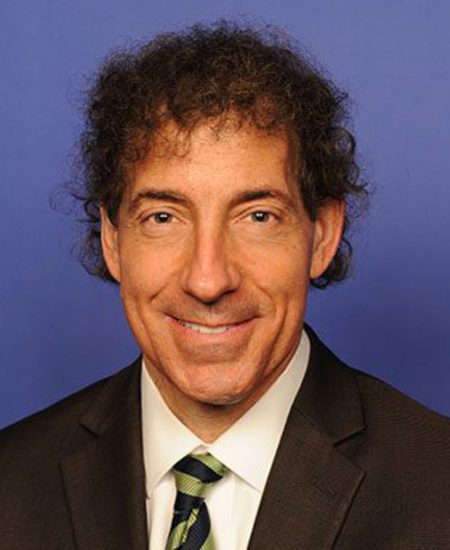
Rep. Jamie Raskin
Sponsored bills
Maddy summaryThe CURE Act prohibits federal agencies from denying security clearances or federal employment based on past or present marijuana use. It requires agencies to review all denials made since 2008 for this reason and reconsider applications within 90 days of a request. Affected individuals can appeal denied reconsiderations to the Merit Systems Protection Board, which must resolve appeals within 120 days. The bill specifically excludes marijuana use from disqualification criteria under existing security clearance rules, applying to all federal job applicants and current employees.
Maddy summaryHRES 703 is a symbolic resolution supporting the designation of September 2023 as "National Voting Rights Month" to raise awareness about voting access. It encourages all U.S. citizens to uphold voting rights, urges Congress to pass specific voting rights legislation (like the Freedom to Vote Act and Democracy Restoration Act), and recommends that schools teach about voting history and current voter access issues. The resolution does not create new laws or directly affect specific groups, but it aims to promote broader public engagement with voting rights through education and advocacy. As a non-binding resolution, it expresses support for these goals without implementing any concrete policy changes.
Maddy summaryHR 5566, the *Supreme Court Tenure Establishment and Retirement Modernization Act of 2023*, establishes an 18-year term limit for all Supreme Court justices. It requires the President to nominate one new justice every two years (during first and third years after presidential elections), with Senate confirmation within 90 days, and prohibits lifetime appointments. Current justices are automatically retired in order of service length as new justices are appointed, while retired justices may temporarily fill vacancies through a randomized process. The bill directly affects all sitting and future Supreme Court justices by restructuring appointments and retirement timelines.
Maddy summaryThis bill would establish the Civilian Climate Corps, a national workforce program that would employ and train 50,000 to 400,000 young adults annually through 2028 to work on climate-related projects. The program would provide participants with a minimum living allowance of $17 per hour, health care benefits, and $25,000 in educational benefits per term of service. It would require 50% of projects to be located in under-resourced communities (with 10% specifically in Indian country) and ensure at least 50% of participants come from these communities. The Corps would focus on climate resilience, clean energy infrastructure, environmental remediation, and creating career pathways in the growing clean economy sector.
Maddy summaryThe Reuniting Families Act reduces family-based visa backlogs by reclassifying spouses, permanent partners, and minor children of legal permanent residents as immediate relatives, allowing them to be processed more quickly. The bill recaptures unused visa numbers from previous years, increasing the total number of available family-based visas without changing the overall annual caps. It expands rights for permanent partners (not just married spouses) and provides relief for orphans, widows, and widowers with pending applications. The legislation also prohibits removal of aliens with pending applications and prioritizes family reunification in refugee resettlement processes.
Maddy summaryHR 5492, the Veteran Families Health Services Act of 2023, provides fertility treatment, counseling, and adoption assistance to military members and veterans with infertility conditions. The bill requires the Department of Defense to offer fertility preservation services like cryopreservation before deployment or hazardous assignments, and to cover fertility treatments including in vitro fertilization for current service members. For veterans, it adds fertility treatment and counseling to VA medical services, allows adoption assistance up to the cost of three adoptions, and mandates coordination between military and VA health systems. These provisions apply regardless of sex, gender identity, sexual orientation, or marital status, and are designed to support military families affected by service-related infertility.
Maddy summaryThis bill establishes the Chesapeake Bay States' Partnership Initiative to help agricultural producers in the Chesapeake Bay watershed implement conservation practices that improve water quality, restore soil resources, and increase climate resilience. It allocates $75 million annually for fiscal years 2024-2027 to support these efforts through targeted enrollment in existing conservation programs, with special consideration for activities that reduce nitrogen and sediment. The bill also creates a pilot program where landowners can enroll in riparian buffer programs without paying costs or submitting additional paperwork, and amends conservation programs to better integrate Chesapeake Bay conservation goals. These provisions directly affect agricultural producers in six states (Delaware, Maryland, New York, Pennsylvania, Virginia, West Virginia) and the District of Columbia that are part of the Chesapeake Bay watershed.
Maddy summaryThe Better CARE for Animals Act of 2023 amends the Animal Welfare Act to strengthen enforcement of animal welfare standards. It gives the Attorney General authority to bring civil cases for violations, including seeking penalties up to $10,000 per day per violation and injunctions to remove or relocate animals. The bill also requires the Secretary of Agriculture and Attorney General to coordinate through a new Memorandum of Understanding, focusing on repeat violators. These changes directly affect dealers, exhibitors, and enforcement agencies by expanding civil enforcement tools and clarifying jurisdiction over rule violations.
Maddy summaryThe John R. Lewis Voting Rights Advancement Act of 2023 would strengthen the Voting Rights Act of 1965 by updating the criteria for which states and localities must obtain federal preclearance before changing voting practices. It would establish new standards for proving vote dilution and vote denial by requiring courts to consider historical discrimination, racial polarization in voting, and whether voting practices disproportionately burden minority voters. The bill would also require states and localities to provide public notice of voting changes and share demographic data about polling locations. These changes would primarily affect jurisdictions with a history of voting rights violations, aiming to prevent discriminatory voting practices before they take effect.