

Goldie's Act This bill expands enforcement provisions under the Animal Welfare Act (AWA). Specifically, the bill directs the Department of Agriculture (USDA) to document and record detailed descriptions of violations of the act observed during inspections and investigations. USDA must provide a copy of all records documenting violations to state, local, and municipal animal control or law enforcement officials within 24 hours of such inspections or investigations. Inspections must be held at least once a year of each research facility, the premises of each animal dealer, and each exhibitor of animals. If violations are found during inspections, then USDA must conduct any necessary follow-up inspections until all the violations are corrected. Inspectors must confiscate or destroy in a humane manner animals found to be suffering physical or psychological harm as a result of failure to comply with the AWA. Violators are subject to civil penalties as outlined in the bill.
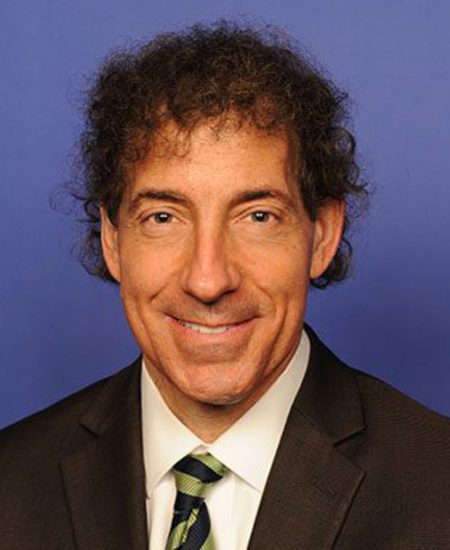
Rep. Jamie Raskin
Sponsored bills
Maddy summaryThe Office of Gun Violence Prevention Act of 2025 would create a new office within the Department of Justice to coordinate federal efforts on reducing gun violence. The office, led by a Director appointed by the Attorney General, would integrate existing DOJ programs, evaluate data gaps, and develop evidence-based recommendations for Congress and the President. It would also establish an advisory council including survivors of gun violence, public health officials, and community representatives to guide its work. The office would produce annual reports detailing gun violence trends and policy proposals, while collaborating with agencies like Health and Human Services and the FBI.
Alternatives to Prevent Addiction In the Nation Act or the Alternatives to PAIN Act This bill reduces cost-sharing and prohibits the imposition of certain utilization requirements under the Medicare prescription drug benefit for certain non-opioid pain management drugs. Specifically, the bill requires such drugs to be covered without a deductible and to be placed on the lowest cost-sharing tier (if any). The bill also prohibits the imposition of prior authorization requirements (i.e., requiring prior approval from a plan) or step therapy requirements (i.e., requiring the use of alternative drugs before a drug is covered under a plan) with respect to such drugs.
Maddy summaryHR 1269, the Honoring Our Fallen Heroes Act of 2025, expands benefits for public safety officers (like police and firefighters) who develop certain cancers linked to their work. It adds 22 specific cancers - including lung, mesothelioma, and breast cancer - to the list of conditions presumed to be "exposure-related" and sustained in the line of duty. This presumption applies if the officer served at least 5 years, was diagnosed with the cancer within 15 years after last active duty, and the cancer directly caused death or permanent disability. The bill also establishes a process for adding new cancers every 3 years based on medical evidence from agencies like NIOSH, and allows claims to be filed within 3 years of the law's enactment.
Maddy summaryHR 1189, the National Plan for Epilepsy Act, creates a coordinated federal strategy to address epilepsy through a National Plan for Epilepsy. The plan requires the Secretary of Health and Human Services to establish an annual assessment, maintain a diverse Advisory Council (including people with epilepsy, caregivers, and experts), and coordinate research and care across federal agencies. Key provisions include annual progress reports to Congress, data sharing between agencies, and recommendations to improve diagnosis, treatment access, and reduce epilepsy-related disparities. The plan expires December 31, 2035, and directly affects the estimated 3.4 million people in the U.S. living with epilepsy and their caregivers.
Maddy summaryThis bill restricts access to Treasury payment systems (including the Bureau of the Fiscal Service) to only Treasury employees with a "fully successful" performance rating and at least one year of civil service, or contractors/outsiders with security clearances, required privacy/cybersecurity training, ethics agreements, and no conflicts of interest. It treats non-government users accessing these systems as government employees for ethics rules and defines specific actions (like stopping payments) as "personal and substantial participation" in government matters. The Treasury Inspector General must investigate any unauthorized access within 30 days and report to Congress, detailing the breach, security risks, and any halted payments. The bill directly affects Treasury staff, contractors, and any external entities accessing federal payment systems.
Alpha-gal Allergen Inclusion Act This bill expands the definition of major food allergen to include galactose-alpha-1,3-galactose (commonly known as alpha-gal ). Under current law, food labels generally must identify each major food allergen found in labeled food products. (Certain tick bites cause an allergic condition known as alpha-gal syndrome that can result in an allergy to the alpha-gal molecule, which is found in red meat and other products made from mammals.)
Maddy summaryThis bill, titled the "Nobody Elected Elon Musk Act," makes the head of the Department of Government Efficiency personally liable for any legal claims against the federal government related to the department's activities. The department leader, defined as a special Government employee, would cover costs for claims arising from violations of labor laws, data privacy laws, security threats, or other federal statutes. This shifts financial responsibility from the government to the department leader for all such claims. The bill does not create new policies but directly imposes personal liability on the department head for the department's actions.
Maddy summaryThe Polluters Pay Climate Fund Act of 2025 imposes a tax on major fossil fuel companies for historical carbon dioxide emissions exceeding 1 billion metric tons during 2000-2023, with payments due by September 2026. The tax revenue will fund a new Climate Fund that must be used for climate resilience, adaptation, and disaster response programs, with 40% specifically directed to environmental justice communities. The bill requires at least $15 billion annually for FEMA climate programs and $6 billion for Clean Air Act climate resilience grants. It explicitly states the fund does not affect existing legal claims against polluters for climate-related harms.
Maddy summaryThis bill expands 529 college savings account flexibility by allowing funds to cover costs for industry-recognized postsecondary credentials, not just traditional degrees. It defines "qualified expenses" to include tuition/fees for recognized credential programs (like certifications or apprenticeships), required testing fees, and continuing education needed to maintain credentials. To qualify, programs must meet specific criteria, such as appearing on state lists under the Workforce Innovation and Opportunity Act or being listed in VA or Defense directories. The change applies to 529 distributions made after the law's enactment, giving families more options to use these accounts for job-focused training.