

Maddy summaryThe Health Share Transparency Act of 2025 requires health care sharing ministries to annually submit detailed financial and operational data - including reserves, claim denial rates, and provider contracts - to federal agencies like the Health and Human Services Department, IRS, and Consumer Financial Protection Bureau. This information must be published on a public website for consumer access. The bill also mandates that ministries provide clear, plain-language disclosures to prospective and current members about coverage limitations, the absence of reimbursement guarantees, and comparisons to traditional health insurance. Additionally, it requires enrollment entities to explain available tax credits and government health program options to potential members, and the Federal Trade Commission must publicly report consumer complaints about these ministries twice yearly.
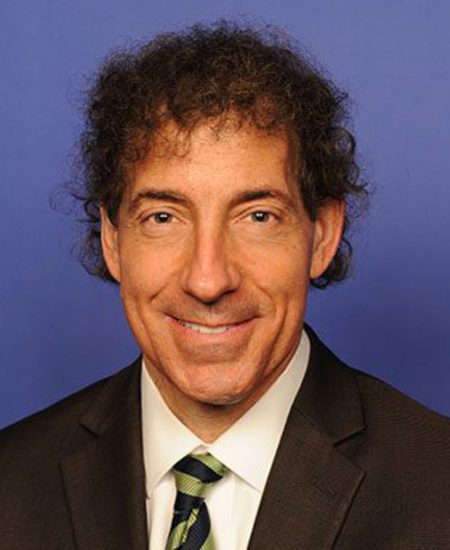
Rep. Jamie Raskin
Sponsored bills
Maddy summaryThe Equality Act (HR 15) amends federal civil rights laws to explicitly prohibit discrimination based on sexual orientation and gender identity in employment, housing, public accommodations, credit, and jury service. It expands existing protections under the Civil Rights Act of 1964 by adding sexual orientation and gender identity as protected characteristics under sex discrimination prohibitions. The bill clarifies that discrimination against LGBTQ people is a form of sex discrimination, consistent with the Supreme Court's Bostock decision, and adds specific definitions for gender identity and sexual orientation. This legislation directly affects businesses, employers, housing providers, financial institutions, and government entities that serve the public. The bill creates a more comprehensive legal framework to address discrimination that LGBTQ people face in multiple aspects of daily life.
Maddy summaryHR 3067, the Arctic Refuge Protection Act, repeals the existing oil and gas program for the Arctic National Wildlife Refuge (ANWR) and designates approximately 1.56 million acres of the refuge's Coastal Plain as wilderness. This directly affects federal management of the ANWR, halting potential oil drilling in the designated area. The bill requires the Secretary of the Interior to administer the newly designated wilderness area under the Wilderness Act, treating it as part of the existing wilderness within ANWR. The change prevents future oil and gas development on this specific portion of the refuge.
Medicare for All Act This bill establishes a national health insurance program that is administered by the Department of Health and Human Services (HHS). Among other requirements, the program must (1) cover all U.S. residents; (2) provide for automatic enrollment of individuals upon birth or residency in the United States; and (3) cover items and services that are medically necessary or appropriate to maintain health or to diagnose, treat, or rehabilitate a health condition, including hospital services, prescription drugs, mental health and substance abuse treatment, dental and vision services, long-term care, gender affirming care, and reproductive care, including contraception and abortions. The bill prohibits cost-sharing (e.g., deductibles, coinsurance, and copayments) and other charges for covered services. Additionally, private health insurers and employers may only offer coverage that is supplemental to, and not duplicative of, benefits provided under the program. Health insurance exchanges and specified federal health programs terminate upon program implementation. However, the program does not affect coverage provided through the Department of Veterans Affairs or the Indian Health Service. The bill also establishes a series of implementing provisions relating to (1) health care provider participation; (2) HHS administration; and (3) payments and costs, including the requirement that HHS negotiate prices for prescription drugs. Individuals who are age 18 or younger, age 55 or older, or already enrolled in Medicare may enroll in the program starting one year after enactment of this bill; other individuals may buy into the program at this time. The program must be fully implemented two years after enactment.
Maddy summaryThis bill requires most private health insurance plans to cover diagnostic and supplemental breast exams with no out-of-pocket costs (like deductibles or copays) for enrolled patients. It specifically covers exams used to evaluate abnormalities found in screenings (diagnostic) or for high-risk screening without abnormalities (supplemental), based on medical guidelines. Plans can still require prior authorization for these exams, and state laws offering stronger protections remain in effect. The rule takes effect for plan years starting January 1, 2026.
Maddy summaryHR 3045, the West Bank Violence Prevention Act of 2025, imposes U.S. sanctions on foreign individuals and entities responsible for violence, displacement, or property destruction in the West Bank. It targets those directly involved in attacks on civilians, forced displacement, or property seizures, including settler leaders or officials of groups engaged in such activities. Key provisions require freezing assets of sanctioned individuals within U.S. jurisdiction and blocking their entry into the United States via visa restrictions. The law applies to foreign nationals meeting specific criteria outlined in the bill, not U.S. citizens or entities.
Maddy summaryHR 2880 provides due process protections for federal employees who are promoted to career positions (in the competitive service, excepted service, or Senior Executive Service) and serve under a probationary period. It requires these employees to be covered by existing federal employment laws, including special protections for Department of Veterans Affairs staff. The bill also allows employees removed from such positions between January 20, 2025, and the law's enactment to be reinstated to their former or equivalent role with backpay. Political appointees are excluded from these protections and reinstatement provisions.
Maddy summaryHR 2906, the SERVICE Act, requires federal agencies to submit a detailed report to Congress and the Government Accountability Office (GAO) before reducing their workforce by more than 5% in a fiscal year. The report must analyze financial impacts (including pay, benefits, and replacement costs), mission effects on specific offices/services, and the agency’s analytical basis for the reduction. The GAO must then review the report within 180 days and assess whether it includes all required elements and credible supporting data. This 210-day review period applies to all agencies covered under the law, directly affecting federal workforce planning decisions. The bill aims to ensure transparency and evidence-based decision-making around federal staffing changes.
Maddy summaryHR 2905, the Ensuring Agency Service Quality Act, requires federal executive agencies and military departments to maintain specific staffing levels as defined by law, overriding prior provisions. It mandates that agency heads notify Congress within seven days if they cannot meet these required staffing levels, providing an explanation for the shortfall. The bill directly affects all executive agencies and military departments covered under Title 5 of the U.S. Code. Its key mechanism is the new staffing requirement combined with the mandatory noncompliance reporting process to Congress.
Maddy summaryHRES 317 is a non-binding resolution urging the U.S. government to lead global efforts to halt and reverse the nuclear arms race. It calls on the President to pursue negotiations with nuclear-armed states to reduce arsenals, end the U.S. policy allowing first use of nuclear weapons, eliminate immediate launch readiness, stop developing new weapons, and support communities affected by nuclear programs. The resolution emphasizes diplomatic action over military modernization to reduce nuclear risks and prevent catastrophic conflict.