

Access to Birth Control Act This bill requires pharmacies to comply with certain rules related to ensuring access to contraceptives. Specifically, pharmacies must provide without delay a customer with any contraceptive or related medication that is in stock. If the contraceptive is not in stock, the pharmacy must immediately inform the customer and either order the contraceptive or refer the customer to a pharmacy that has it in stock. Laws in some states provide pharmacists with the right to refuse to dispense contraceptive-related drugs on religious or conscience grounds. Pharmacies may refuse to provide a contraceptive to a customer (1) if the customer lacks a valid prescription for a prescription contraceptive or is unable to pay for the contraceptive, or (2) based on a pharmacy employee's professional clinical judgment. The bill also establishes a private cause of action and civil monetary penalties for violations of the bill.
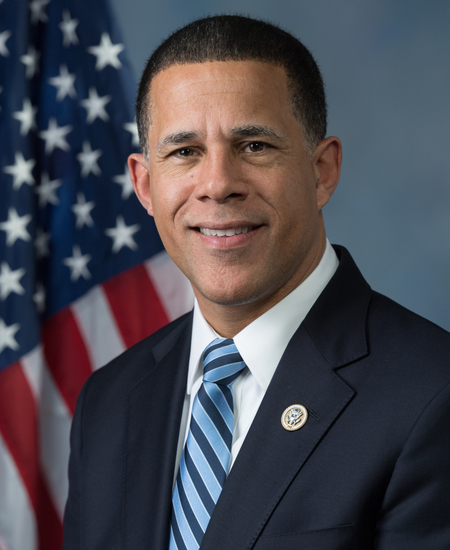
Rep. Anthony G. Brown
Sponsored bills
Original Slavery Remembrance Day Resolution This joint resolution designates a Slavery Remembrance Day annually and condemns slavery and its progenies.
Bringing Registered Apprenticeships to Veterans Education Act or the BRAVE Act This bill requires the Department of Labor, in the implementation of the Transition Assistance Program, to provide information concerning apprenticeship programs to members of the Armed Forces who are separating from active duty. The bill also requires Labor, in coordination with the Department of Veterans Affairs (VA), to establish a publicly accessible and user-friendly website on which veterans can find specified information about apprenticeship programs that are approved under VA education benefit provisions.
This concurrent resolution declares that Congress should not impose any new performance fee, tax, royalty, or other charge relating to the public performance of sound recordings on a local radio station for broadcasting sound recordings over the air, or on any business for such public performance of sound recordings.
Partner with Korea Act This bill creates an E-4 treaty trader visa category for up to 15,000 nationals of South Korea each fiscal year who are coming to the United States solely to perform specialty occupation services, subject to various requirements. The 15,000 limit shall only apply to principal aliens and not the spouses or children of such aliens. (A specialty occupation is one that requires the theoretical and practical application of highly specialized knowledge and a bachelor's degree or higher.)
Untraceable Firearms Act of 2021 This bill establishes a federal statutory framework to regulate the manufacture, sale, offer to sell, transfer, purchase, and receipt of ghost guns (i.e., guns without serial numbers). Additionally, the bill revises the federal statutory framework regulating the manufacture, possession, sale, import, shipment, delivery, receipt, and transfer of undetectable firearms. Among the revisions, the bill defines undetectable firearm as a firearm without a major component wholly made of detectable material.
Raise the Age Act This bill establishes new restrictions on the sale or transfer of certain semiautomatic firearms to individuals under 21 years of age. Specifically, this bill makes it unlawful for a licensed gun dealer, importer, manufacturer, or collector to sell or deliver a semiautomatic center-fire rifle that has (or has the capacity to accept) an ammunition feeding device with a capacity of more than five rounds to an individual who the licensee knows or has reasonable cause to believe is under age 21. The prohibition does not apply if the individual under age 21 is a full-time law enforcement officer or active-duty member of the Armed Forces. The bill also requires the Federal Bureau of Investigation to report on the operation of its public access line, including a description of information sharing protocols and recommendations for improving such protocols.
Commission to Study the Stigmatization, Criminalization, and Ongoing Exclusion and Inequity for LGBTQ Servicemembers and Veterans Act This bill establishes the Commission to Study the Stigmatization, Criminalization, and Ongoing Exclusion and Inequity for LGBTQ Servicemembers and Veterans. The Commission must identify and compile information about the history of military policy regarding homosexuality from 1778 onward, including regarding lesbian, gay, bisexual, transgender, and queer (LGBTQ) sexual orientation and gender identity. The Commission must hold public hearings, gather public testimony, examine lasting and disparate impacts of the discriminatory policies on the physical and mental well-being of members of the Armed Forces, and make recommendations on appropriate remedies.
Ending the Monopoly of Power Over Workplace Harassment through Education and Reporting Act or the EMPOWER Act This bill makes it an unlawful labor practice for an employer to enter into, or attempt to enforce, a contract with an employee or job applicant that contains a nondisparagement or nondisclosure clause that covers workplace or sexual harassment, including retaliation for participating in a workplace harassment proceeding. The bill exempts certain settlement or separation agreements from such prohibition. The bill also requires the Securities and Exchange Commission to promulgate a regulation that requires any issuer of securities to submit a report for the most recent five-year period with respect to workplace and sexual harassment. The commission must provide for the development and dissemination of training programs and information regarding workplace and sexual harassment. The bill denies a tax deduction for amounts related to judgments and expenses in connection with litigation related to workplace or sexual harassment. It also excludes from gross income, for income tax purposes, any amount received in connection with a claim or settlement related to workplace or sexual harassment, or other unlawful discrimination.
Service Education Reallocation for Vacant Elected offices Act of 2021 or the SERVE Act of 2021 This bill modifies the authority to make nominations for cadets or midshipmen to the military service academies in situations where a Member of Congress has not submitted a nomination due to death, resignation from office, or expulsion from office and no successor member has been sworn in to office. Specifically, in the event a Senator does not make a nomination for one of the specified reasons, the nominations must be made by the other Senator from the state concerned. In the event a Representative does not make a nomination for one of the specified reasons, the Senators from the state of the congressional district concerned must make the nomination, with nominations divided equally among Senators and any remainder going to the senior Senator from the state.