

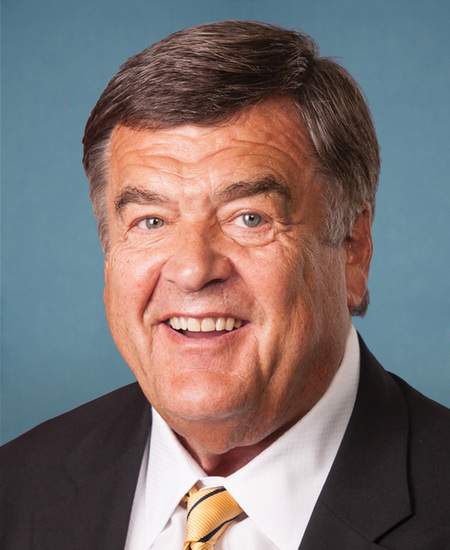
Photo of C. A. Dutch Ruppersberger
D United States House · District 2 · Maryland

Rep. C. A. Dutch Ruppersberger

Compare
Total votes
2,168
all sessions
Attendance
96%
86 missed
Lower than 86% of chamber peers
With party
98%
of cast votes
Higher than 92% of chamber peers
Bipartisan score
1%
crosses aisle rarely
Lower than 93% of chamber peers
Sponsored
731
bills & resolutions
Near the chamber average
Committees
0
assignments
731 bills and resolutions

Sponsored bills

Total
731
Primary
7
Co-sponsor
724
This page
731
matching current filters
Co-sponsor HR 3168
In committee · United States House · Co-sponsor
To establish a Joint Autonomy Office in the Department of Defense, and for other purposes.

Maddy summaryHR 3168 establishes a Joint Autonomy Office within the Department of Defense to coordinate and accelerate the development and deployment of autonomous systems across all military domains (land, air, maritime, and space). The Office will centralize data access, coordinate with existing programs like Robotic Combat Vehicles, and create a classification system for different autonomy levels to guide resource allocation and planning. It also requires a detailed plan to address gaps in funding, acquisition processes, and testing for autonomous systems, with regular updates to Congress. The Office will operate for seven years, with potential extensions, and is authorized $55 million for fiscal year 2024.

In committee May 9, 2023 1 co-sponsor
Co-sponsor HR 2891
In committee · United States House · Co-sponsor
SAFE Banking Act of 2023

Maddy summaryThe SAFE Banking Act of 2023 would protect banks and financial institutions that provide services to state-legal marijuana businesses and hemp-related businesses by preventing federal regulators from taking adverse actions against them solely for serving these businesses. It clarifies that income from state-legal marijuana businesses can be considered for mortgage applications, and requires regulators to update guidance on suspicious activity reports related to these businesses. The bill does not require financial institutions to serve these businesses, but ensures they won't face penalties for doing so. It extends similar protections to hemp-related businesses, which have faced banking challenges despite being federally legal under the 2018 Farm Bill.

In committee May 3, 2023 1 co-sponsor
Co-sponsor HR 3061
In committee · United States House · Co-sponsor
Aviation Security Checkpoint Technology Fund Act of 2023

Aviation Security Checkpoint Technology Fund Act of 2023 This bill establishes the Aviation Security Checkpoint Technology Fund within the Transportation Security Administration (TSA) to fund the procurement, deployment, and sustainment of aviation security checkpoint technology. The TSA must fund this program using airport passenger security fees that are currently collected by the TSA.

In committee May 2, 2023 1 co-sponsor
Co-sponsor HR 2992
In committee · United States House · Co-sponsor
EDUCATORS for America Act

Maddy summary# Summary of EDUCATORS for America Act Provisions This comprehensive legislation makes significant changes to educator preparation, certification, and support systems, with a strong focus on loan forgiveness and retention of educators in high-need settings. ## Key Provisions: 1. **Enhanced Loan Forgiveness Programs**: - Creates new "Educator Loan Forgiveness Programs" under sections 428J and 460 of the Higher Education Act - Provides 100% loan forgiveness for educators who complete 5 years of qualifying service in high-need schools or early childhood education programs - Offers monthly loan forgiveness/cancellation during the service period (in addition to annual forgiveness) 2. **Expanded Eligibility**: - Defines "high need school" as schools where: * Over 30% of students meet poverty measures * School is identified for comprehensive support * School is Bureau of Indian Education funded * School is operated by Tribal educational agencies - Includes Tribal early childhood programs, Native Hawaiian education systems, and Bureau of Indian Education programs as eligible settings - Special rule for educators providing instruction in Native American languages 3. **"Qualifying Educator" Definition**: - Includes elementary/secondary teachers (with full certification) - Includes school leaders (with full certification) - Includes early childhood educators and program directors - Includes educators working in Native American language instruction regardless of certification status 4. **New Support Programs**: - Centers of Excellence for teacher preparation at institutions serving underrepresented populations - Recruitment and completion grants for underrepresented students in education - Resiliency grants for technology integration and educator workforce partnerships - Doctoral fellowships to diversify faculty in high-need education areas 5. **Implementation Details**: - Monthly loan credit program for eligible educators in income-driven repayment plans - Allows counting of partial service years under specific conditions - Prevents double benefits with other service programs - Allows for promotions within qualifying schools without losing eligibility This legislation aims to create a more diverse, stable, and well-prepared educator workforce by reducing financial barriers to entering and remaining in the education profession, particularly in high-need schools and early childhood education settings.

In committee Apr 28, 2023 1 co-sponsor
Co-sponsor HR 2923
In committee · United States House · Co-sponsor
Living Donor Protection Act of 2023

Maddy summaryThis bill protects living organ donors from insurance discrimination by prohibiting life, disability, and long-term care insurers from denying coverage, raising premiums, or altering policy terms solely because someone donated an organ while alive. It also updates the Family and Medical Leave Act to include recovery from organ donation surgery as a qualifying health condition, allowing donors to take protected leave for this purpose. Additionally, the bill requires the Health and Human Services Secretary to update public educational materials about living donation benefits, risks, and insurance protections within six months of enactment. These changes directly affect living organ donors, insurers, employers, and healthcare systems by ensuring fair access to insurance and workplace leave.

In committee Apr 28, 2023 1 co-sponsor
Co-sponsor HR 2904
In committee · United States House · Co-sponsor
Anti-Racism in Public Health Act of 2023

Maddy summaryHR 2904, the Anti-Racism in Public Health Act of 2023, establishes a National Center on Antiracism and Health within the CDC. The center will declare racism a public health crisis, conduct research on how structural racism affects health outcomes, and develop data systems to track health disparities across race, ethnicity, gender, and other factors. It will fund regional centers in minority communities, create public health interventions, and require CDC to report annually on antiracist efforts. This bill directly affects public health agencies, researchers, and communities of color by mandating systemic analysis of racial inequities in healthcare and public health policy.

In committee Apr 28, 2023 1 co-sponsor
Co-sponsor HR 2966
In committee · United States House · Co-sponsor
PREPARE Act

Maddy summaryThe PREPARE Act establishes a new pre-disaster mitigation loan program for small businesses through the Small Business Administration (SBA). It authorizes $25 million annually from 2024 to 2028 to provide loans of up to $500,000 per business, enabling small businesses to fund projects that protect their property and operations from disaster damage (e.g., flood barriers or structural reinforcements). The SBA must conduct targeted outreach to businesses in economically distressed areas, offer technical assistance, and require borrowers to maintain insurance during loan terms. Annual reports will track program outcomes, including project types, cost savings avoided, and regional impacts, to evaluate effectiveness.

In committee Apr 27, 2023 1 co-sponsor
Co-sponsor HR 2987
In committee · United States House · Co-sponsor
Election Mail Act

Maddy summaryThe Election Mail Act (HR 2987) establishes new requirements for handling mail-in ballots in federal elections to improve reliability and accessibility. It requires the Postal Service to process absentee ballots on the same day received, place postmarks indicating mailing dates on ballot envelopes, and treat election mail as first-class mail with free postage for completed ballots. The bill also mandates states to use intelligent mail barcodes on return envelopes, affix specific tags for ballot visibility, and adopt a uniform 7-day deadline for accepting mailed ballots postmarked on or before election day. These changes apply to federal elections, with most provisions taking effect for the 2024 election cycle. The bill includes additional provisions for the Postal Service to consult with Indian Tribes about voting barriers on tribal lands.

In committee Apr 27, 2023 1 co-sponsor
Co-sponsor HR 2870
In committee · United States House · Co-sponsor
Raise the Age Act of 2023

Raise the Age Act of 2023 This bill establishes new restrictions on the sale or transfer of certain semiautomatic firearms to individuals under 21 years of age. Specifically, this bill makes it unlawful for a licensed gun dealer, importer, manufacturer, or collector to sell or deliver a semiautomatic center-fire rifle or semiautomatic center-fire shotgun that has (or has the capacity to accept) an ammunition feeding device with a capacity of more than five rounds to an individual who the licensee knows or has reasonable cause to believe is under age 21. The prohibition does not apply if the individual under age 21 is a full-time law enforcement officer or active-duty member of the Armed Forces. The bill also requires the Federal Bureau of Investigation to report on the operation of its public access line, including a description of information sharing protocols and recommendations for improving such protocols.

In committee Apr 26, 2023 1 co-sponsor
Co-sponsor HR 2370
In committee · United States House · Co-sponsor
Access to AEDs Act

Maddy summaryHR 2370, the Access to AEDs Act, authorizes $25 million in federal funding (2024-2028) to help public elementary and secondary schools improve access to automated external defibrillators (AEDs) and CPR training. The bill directs the Secretary of Health and Human Services to award grants to school districts and partners for developing AED programs, training staff and students, purchasing and maintaining AEDs, and creating cardiac emergency response plans. It specifically targets schools to address sudden cardiac arrest (SCA), which is a leading cause of death among student athletes and youth, with 90% of SCA victims dying without immediate CPR and defibrillation. The law requires grantees to report on their activities and establishes a clearinghouse to collect data on school AED access and costs.

In committee Apr 26, 2023 1 co-sponsor
Showing 211 to 220 of 731 bills
Previous 1 … 21 22 23 … 74 Next