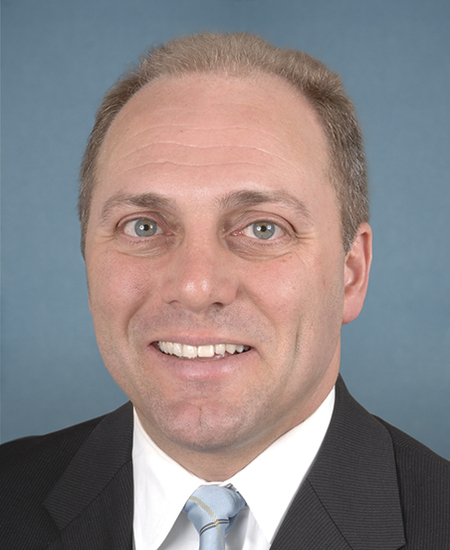
Photo of Steve Scalise
R United States House · District 1 · Louisiana On the 2026 ballot

Rep. Steve Scalise

Compare
Total votes
2,837
all sessions
Attendance
94%
169 missed
Near the chamber average
With party
97%
of cast votes
Higher than 89% of chamber peers
Bipartisan score
2%
crosses aisle rarely
Lower than 90% of chamber peers
Sponsored
143
bills & resolutions
Among the lowest in the chamber
Committees
0
assignments
143 bills and resolutions

Sponsored bills

Total
143
Primary
24
Co-sponsor
119
This page
143
matching current filters
Primary HRES 3
Passed · United States House · Lead sponsor
Authorizing the Speaker to appoint a committee to notify the President of the assembly of the Congress.

Maddy summaryHRES 3 is a routine procedural resolution authorizing the Speaker of the House to appoint a two-member committee. This committee would join a similar Senate committee to formally notify the President that both chambers have assembled in quorum and Congress is prepared to receive presidential communications. The bill affects no specific policy or population, as it only governs the initial procedural steps at the start of a congressional session. It does not create new laws or alter existing policies.

Passed Jan 3, 2025 0 co-sponsors
Primary HR 6843
Signed into law · United States House · Lead sponsor
To expand the boundaries of the Atchafalaya National Heritage Area to include Lafourche Parish, Louisiana.

Maddy summaryHR 6843 amends the Atchafalaya National Heritage Area Act to add Lafourche Parish, Louisiana, to the designated area. This procedural bill expands the existing heritage area boundaries, which already include several parishes, to include Lafourche Parish specifically. The Atchafalaya National Heritage Area preserves cultural, historical, and natural resources in the region. The bill was passed by Congress in December 2024 with no substantive policy changes beyond the boundary adjustment.

Signed into law Dec 23, 2024 0 co-sponsors
Co-sponsor HR 7
In committee · United States House · Co-sponsor
No Taxpayer Funding for Abortion and Abortion Insurance Full Disclosure Act of 2023

Maddy summaryThis bill bans federal funding for abortions in most cases, prohibiting the use of taxpayer money for abortion services or health insurance plans covering abortion. Exceptions allow funding for abortions resulting from rape, incest, or when a pregnancy endangers a woman's life. It requires health insurance plans sold through the Affordable Care Act (ACA) marketplaces to clearly disclose any separate costs for abortion coverage and prohibits ACA subsidies from being used for plans that cover abortion (except in the specified exceptions). The law directly affects federal programs like Medicaid, ACA marketplace plans, and insurers offering health coverage to individuals using federal subsidies.

In committee Dec 17, 2024 1 co-sponsor
Primary HR 7423
Signed into law · United States House · Lead sponsor
To designate the facility of the United States Postal Service located at 103 Benedette Street in Rayville, Louisiana, as the "Luke Letlow Post Office Building".

Maddy summaryThis bill designates the U.S. Postal Service facility at 103 Benedette Street in Rayville, Louisiana, as the "Luke Letlow Post Office Building" to honor Luke Letlow, a former Louisiana congressman. It changes all official references to this specific post office location to reflect the new name. The bill has no policy impact on postal operations, services, or funding - it is solely a ceremonial naming designation. The change applies to all federal documents, maps, and records referencing the facility.

Signed into law Nov 25, 2024 0 co-sponsors
Co-sponsor HR 6951
In committee · United States House · Co-sponsor
College Cost Reduction Act

Maddy summary# Summary of Proposed Higher Education Act Amendments This document outlines significant proposed amendments to the Higher Education Act of 1965, primarily as part of the "College Cost Reduction Act." The key elements include: ## Accreditation Reform - Major overhaul of accreditation standards, requiring accrediting agencies to demonstrate independence from trade associations - New requirements for accrediting agencies to assess student achievement outcomes, including median value-added earnings relative to median total price charged - Introduction of an "Alternative Quality Assurance Experimental Site Initiative" to test non-accredited institutions - Protections for religious institutions, including a new process for appealing accreditation decisions related to religious mission - Removal of "litmus tests" that would require institutions to support specific political viewpoints ## Student Success Initiatives - Establishment of "Postsecondary Student Success Grants" to increase participation, retention, and completion rates for high-need students - Focus on evidence-based practices, with tiered requirements (tier 1, 2, and 3 reforms) - Mandatory inclusion of high-need student populations (low-income, first-generation, military-connected, etc.) - Requirements for institutions to report on completion rates, retention rates, and student demographics ## Regulatory Changes - Repeal of numerous existing regulations including: * Closed school discharges * Borrower defense to repayment * Pre-dispute arbitration * False certification requirements * Ability-to-benefit rules * Financial responsibility regulations - New restrictions on incentive compensation for recruiters - Changes to third-party servicer definitions and regulations ## Transfer and Credit Policies - New requirement that institutions cannot deny transfer credit based solely on the source of accreditation - Requirements for transparent transfer policies - Changes to reverse transfer policies ## Other Key Provisions - Modifications to the National Advisory Committee on Institutional Quality and Integrity (NACIQI) - New definitions for "total price" and "value-added earnings" - Changes to the process for institutions to change accrediting agencies - New requirements for institutions to report on student outcomes The overall focus of these proposed amendments is to reduce regulatory burden on institutions, promote transparency, improve student outcomes (particularly for high-need students), modernize accreditation processes, and protect religious institutions' rights in accreditation decisions.


In committee Nov 18, 2024 1 co-sponsor
Co-sponsor HR 9921
In committee · United States House · Co-sponsor
To amend the Delta Development Act to include the parish of Terrebonne as a Delta Regional Authority area.

Maddy summaryHR 9921 amends the Delta Development Act to designate Terrebonne Parish, Louisiana, as an official Delta Regional Authority area. This change directly affects residents and local officials in Terrebonne Parish by expanding their eligibility for federal economic development programs and funding under the Delta Regional Authority. The bill achieves this by adding "Terrebonne" to the list of designated parishes in the law, following "Webster" in the existing text. This is a procedural update to geographic eligibility, not a new policy.

In committee Oct 5, 2024 1 co-sponsor
Co-sponsor HR 9462
In committee · United States House · Co-sponsor
Educational Choice for Children Act of 2024

Maddy summaryThis bill creates a federal tax credit for individuals who contribute to scholarship granting organizations (SGOs) that provide scholarships for elementary and secondary education. Taxpayers can claim a credit equal to up to 10% of their adjusted gross income or $5,000 (whichever is less) for contributions to SGOs that provide scholarships for students from households earning no more than 300% of the area median income. Scholarships can cover tuition, educational materials, tutoring, testing fees, and educational therapies, with SGOs required to verify income, undergo independent audits, and meet strict distribution rules. The program would operate with a $5 billion annual cap from 2025-2028, prohibit government control over SGOs or private/religious schools, and prevent discrimination based on religious affiliation.

In committee Oct 4, 2024 1 co-sponsor
Co-sponsor HR 8282
Passed · United States House · Co-sponsor
Illegitimate Court Counteraction Act

Maddy summaryHR 8282, the "Illegitimate Court Counteraction Act," imposes U.S. sanctions on foreign individuals or entities supporting the International Criminal Court (ICC) in investigating or prosecuting "protected persons." Protected persons include U.S. military personnel, officials, and allied personnel (from non-ICC member countries) who are not under ICC jurisdiction. The bill requires the President to block assets and deny visas to targeted foreign persons and their immediate family members within 60 days of the ICC attempting such actions. It mandates congressional notification of sanctions and allows termination if the ICC ceases all such efforts against protected persons. The law focuses on restricting U.S. economic and travel access to ICC supporters targeting specific U.S. and allied personnel.

Passed Sep 11, 2024 1 co-sponsor
Co-sponsor HR 8281
Passed · United States House · Co-sponsor
SAVE Act

Maddy summaryThe SAVE Act (HR 8281) requires U.S. citizens to provide documentary proof of citizenship when registering to vote in federal elections. It defines acceptable proof as documents like passports, REAL ID-compliant IDs, military IDs, or birth certificates, and mandates that states verify citizenship using information from government agencies like DHS and Social Security. States must establish processes for voters without required documentation to provide an attestation under penalty of perjury. The law also requires states to remove noncitizens from voter rolls when verified evidence shows they're not citizens. This bill directly affects all applicants registering to vote in federal elections and state election officials who must implement these requirements.

Passed Jul 23, 2024 1 co-sponsor
Co-sponsor HR 537
Passed · United States House · Co-sponsor
Forgotten Heroes of the Holocaust Congressional Gold Medal Act

Maddy summaryHR 537 authorizes a Congressional Gold Medal to honor 60 diplomats who saved Jewish lives during the Holocaust by issuing visas and passports against their governments' orders, risking expulsion and personal danger. The medal will be presented to the next of kin of these diplomats, alongside representatives from their home countries, and permanently displayed at the United States Holocaust Memorial Museum. The bill also permits the sale of bronze duplicates to cover production costs, with proceeds going to the U.S. Mint. This legislation recognizes the diplomats' humanitarian actions without creating new government programs or altering existing laws.

Passed Jun 12, 2024 1 co-sponsor
Showing 11 to 20 of 143 bills