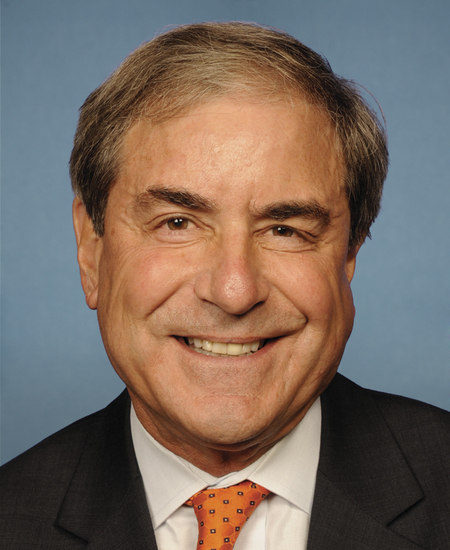
Photo of John A. Yarmuth
D United States House · District 3 · Kentucky

Rep. John A. Yarmuth

Compare
Total votes
958
all sessions
Attendance
86%
131 missed
Lower than 98% of chamber peers
With party
99%
of cast votes
Higher than 81% of chamber peers
Bipartisan score
0%
crosses aisle rarely
Lower than 82% of chamber peers
Sponsored
394
bills & resolutions
Near the chamber average
Committees
0
assignments
394 bills and resolutions

Sponsored bills

Total
394
Primary
19
Co-sponsor
375
This page
394
matching current filters
Co-sponsor HR 3355
In committee · United States House · Co-sponsor
SAFE Act of 2021

Save America’s Forgotten Equines Act of 2021 or the SAFE Act of 2021 This bill prohibits the transporting, receiving, possessing, purchasing, selling, or donation by a person of an equine (e.g., horse) that the person has reason to believe will be slaughtered for human consumption.

In committee Jun 23, 2022 1 co-sponsor
Primary HR 8067
In committee · United States House · Lead sponsor
To make technical changes clarifying section 503 of the Federal Credit Reform Act of 1990.

This bill modifies requirements regarding the development and improvement of cost estimates for federal direct loan and loan guarantee programs. Under current law, federal agencies are required to provide the Congressional Budget Office and the Office of Management and Budget with access to all agency data that may facilitate the development and improvement of the cost estimates. This bill specifies that this data must include the percent guaranteed on loan guarantee commitments.

In committee Jun 14, 2022 0 co-sponsors
Primary HR 8066
In committee · United States House · Lead sponsor
To make technical changes clarifying section 502 of the Federal Credit Reform Act of 1990.

Maddy summaryHR 8066 amends the definition of "direct loan" under the Federal Credit Reform Act of 1990 to clarify which loans count for federal budgeting purposes. It adds that "direct loans" include short-term deferred payment loans (90 days or fewer) made by non-government lenders, beyond just Commodity Credit Corporation price support loans. This technical change ensures consistent application of the Act when agencies report loans for budgetary calculations. It directly affects federal agencies managing loan programs under the Act but does not create new policy or alter existing benefits.

In committee Jun 14, 2022 0 co-sponsors
Co-sponsor HR 3525
Signed into law · United States House · Co-sponsor
Commission To Study the Potential Creation of a National Museum of Asian Pacific American History and Culture Act

Commission To Study the Potential Creation of a National Museum of Asian Pacific American History and Culture Act This bill establishes a Commission to Study the Potential Creation of a National Museum of Asian Pacific American History and Culture. The commission must (1) report recommendations for a plan of action for the establishment and maintenance of a National Museum of Asian Pacific American History and Culture in Washington, DC; (2) develop a fundraising plan to support the establishment, operation, and maintenance of the museum through public contributions; (3) obtain an independent review of this fundraising plan, including an analysis of the resources necessary to fund the construction of the museum and its operations and maintenance in perpetuity without reliance on federal funds; and (4) submit a legislative plan of action to establish and construct the museum. The commission may convene a national conference relating to the museum. The commission shall be solely responsible for acceptance of contributions to it and payment of its expenses. No federal funding may be obligated to carry out this bill.

Signed into law Jun 13, 2022 1 co-sponsor
Co-sponsor HR 2974
In committee · United States House · Co-sponsor
Military Spouse Hiring Act

Military Spouse Hiring Act This bill expands the Work Opportunity Tax Credit (WOTC) to include the hiring of a qualified military spouse. (The WOTC permits employers who hire individuals who are members of a targeted group such as qualified veterans, ex-felons, or long-term unemployment recipients to claim a tax credit equal to a portion of the wages paid to those individuals.) A qualified military spouse is any individual who is certified by the designated local agency as being (as of the hiring date) a spouse of a member of the Armed Forces.

In committee Jun 13, 2022 1 co-sponsor
Co-sponsor HR 7910
Passed · United States House · Co-sponsor
Protecting Our Kids Act

Protecting Our Kids Act This bill makes various changes to federal firearms laws, including to establish new criminal offenses and to expand the types of weapons and devices that are subject to regulation. Among the changes, the bill generally prohibits the sale or transfer of certain semiautomatic firearms to individuals who are under 21 years of age; establishes new federal criminal offenses for gun trafficking and related conduct; establishes a federal statutory framework to regulate ghost guns (i.e., guns without serial numbers); establishes a framework to regulate the storage of firearms on residential premises at the federal, state, and tribal levels; subjects bump stocks to regulation under federal firearms laws; generally prohibits the import, sale, manufacture, transfer, and possession of large capacity ammunition feeding devices; and requires the Department of Justice to report on the demographic data of persons who are determined to be ineligible to purchase a firearm based on a background check performed by the national instant criminal background check system.

Passed Jun 9, 2022 1 co-sponsor
Co-sponsor HR 2377
Passed · United States House · Co-sponsor
Federal Extreme Risk Protection Order Act of 2021

Federal Extreme Risk Protection Order Act of 2022 This bill authorizes and establishes procedures for federal courts to issue federal extreme risk protection orders. Additionally, the bill establishes grants to support the implementation of extreme risk protection order laws at the state and local levels, extends federal firearms restrictions to individuals who are subject to extreme risk protection orders, and expands related data collection. Extreme risk protection order laws, or red flag laws, generally allow certain individuals (e.g., law enforcement officers or family members) to petition a court for a temporary order that prohibits an at-risk individual from purchasing and possessing firearms. Among its provisions, the bill authorizes a family or household member, or a law enforcement officer, to petition for a federal extreme risk protection order with respect to an individual who poses a risk to themselves or others; directs the Department of Justice to establish a grant program to help states, local governments, Indian tribes, and other entities implement extreme risk protection order laws; extends federal restrictions on the receipt, possession, shipment, and transportation of firearms and ammunition to individuals who are subject to extreme risk protection orders; and requires the Federal Bureau of Investigation to compile records from federal, tribal, and state courts and other agencies that identify individuals who are subject to extreme risk protection orders.


Passed Jun 9, 2022 1 co-sponsor
Primary HR 2073
In committee · United States House · Lead sponsor
ACHE Act

Appalachian Communities Health Emergency Act or the ACHE Act This bill places restrictions and requirements on certain mining projects until the Department of Health and Human Services (HHS) determines whether such projects pose risks to human health. The bill applies to mountaintop-removal coal mining projects that use blasting with explosives in the steep slope regions of Kentucky, Tennessee, Virginia, and West Virginia. Specifically, the bill requires the National Institute of Environmental Health Sciences to conduct or support studies on the health impacts of mountaintop-removal coal mining projects on individuals in the surrounding communities. HHS must use these studies when making its determination on whether such mining presents any health risks to those individuals. Until HHS makes its determination, entities carrying out such mining must monitor levels of soil, water, air, and noise pollution. HHS must make the results of this monitoring publicly available. In addition, specified agencies may not issue permits for any mountaintop-removal coal mining project or expansion unless HHS determines that such mining does not present any health risk to individuals in the surrounding communities. The Office of Surface Mining Reclamation and Enforcement of the Department of the Interior must assess a one-time fee upon existing mining projects. The fee must cover the federal cost of the studies and pollution monitoring required by the bill.

In committee Jun 9, 2022 0 co-sponsors
Primary HRES 1151
Passed · United States House · Lead sponsor
Providing for budget allocations, and for other purposes.

This resolution establishes budget allocations and other budget enforcement requirements that apply in the House of Representatives for FY2023. Specifically, the resolution establishes committee allocations, aggregate spending and revenue levels, limitations on advance appropriations, and procedures for exempting emergency spending from the requirements. The resolution also allows certain adjustments to the budgetary levels, including adjustments to accommodate additional spending for disaster relief, wildfire suppression, health care fraud and abuse control, continuing disability reviews and redeterminations, and reemployment services and eligibility assessments. The provisions in this resolution expire if a FY2023 budget resolution is adopted by both chambers of Congress.

Passed Jun 8, 2022 0 co-sponsors
Showing 71 to 80 of 394 bills
Previous 1 … 7 8 9 … 40 Next