

Maddy summaryThis bill expands employee ownership in S corporations by extending tax deferral for selling company stock to employee ownership plans (ESOPs), creating a Treasury Department office to provide education and technical assistance for ESOPs, and amending small business rules to maintain eligibility for government programs after ESOP ownership exceeds 49%. It establishes a new Labor Department "Advocate for Employee Ownership" to coordinate federal efforts, educate stakeholders, and recommend policy improvements. The bill directly affects S corporations using ESOPs, their employees who become owners, and small businesses that might lose government program access due to ESOP acquisitions. Key provisions include tax incentive extensions, new support offices, and updated small business classification rules.
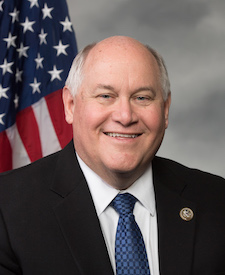
Rep. Ron Estes
Sponsored bills
Maddy summaryThis bill directs the U.S. Treasury to mint commemorative coins marking the Marine Corps' 250th anniversary in 2025. It authorizes three coin types: $5 gold coins (max 50,000), $1 silver coins (max 400,000), and half-dollar coins (max 750,000), with surcharges of $35, $10, and $5 respectively. The surcharge proceeds will fund the Marine Corps Heritage Center's educational programs, with no net cost to taxpayers as the Treasury must recover all minting costs through the surcharges. The coins can only be issued during 2025, and the Treasury must ensure all costs are covered before distributing funds to the Heritage Foundation.
Maddy summaryHR 4695, the Unfair Tax Prevention Act, amends the tax code to create special rules for certain foreign-controlled companies operating under specific foreign tax regimes. It directly affects multinational entities controlled by foreign owners that face "extraterritorial taxes" (taxes based on income connections through ownership chains, not direct ownership). Key provisions include treating these entities as "applicable taxpayers" for base erosion rules, changing a key deadline to the bill's enactment date, and requiring 50% of their cost of goods sold to be counted as a tax benefit. This targets tax avoidance strategies used by some foreign-owned businesses in jurisdictions with complex cross-border tax structures. The changes apply to taxable years beginning after the bill's enactment.
Maddy summaryHR 4721, the Main Street Tax Certainty Act, makes a permanent the 20% tax deduction for eligible small business owners under Section 199A of the tax code. This provision directly affects pass-through business owners (like S-corps, partnerships, and sole proprietorships) who qualify for the deduction. The bill achieves this by removing the temporary expiration language (subsection (i)) from the existing tax code provision. The key change is ending the need for annual congressional extensions of this deduction, providing long-term tax certainty for small businesses.
This resolution expresses the sense of the House of Representatives that research and promotion boards support efforts to develop new markets and strengthen existing markets via research, education, and promotion.
Maddy summaryHJRES 44 is a congressional resolution seeking to block a 2021 rule by the Bureau of Alcohol, Tobacco, Firearms, and Explosives (ATF). The rule classified firearms with stabilizing braces as "short-barreled rifles," which would have required additional licensing and regulation. This resolution uses a specific legal process (under Title 5, U.S. Code) to formally disapprove the ATF rule, meaning the rule would no longer be in effect. It directly affects firearm owners, manufacturers, and dealers who would have been subject to the rule’s requirements.
Maddy summaryHJRES 45 is a congressional disapproval resolution targeting a specific Department of Education rule about federal student loans. It seeks to block the rule implementing "One-Time Federal Student Loan Debt Relief" (including modifications to Perkins, FFEL, and Direct Loan programs) by invoking the Congressional Review Act. If passed, this resolution would nullify the rule, preventing the Department of Education from using it to modify or waive student loan obligations. The bill directly affects borrowers who might have qualified for debt relief under the targeted rule.
Maddy summaryHR 277 would require Congress to approve major federal regulations before they take effect. Major rules are defined as those with significant economic impact ($100 million+ annually), major cost increases for consumers or industries, or significant adverse effects on competition, employment, or innovation. Agencies must submit detailed information about these rules to Congress, including cost-benefit analyses, before they can take effect. Congress would have 70 session days to approve the rule with a joint resolution; if they don't act within that timeframe, the rule would not take effect. This would increase congressional oversight of federal regulations and require more detailed information about proposed rules before they become law.
Maddy summaryHR 4212, the Middle Class Mortgage Insurance Premium Act of 2023, increases the income limit for deducting mortgage insurance premiums on federal income taxes. It raises the cap from $100,000 (or $50,000 for married filing separately) to $200,000 (or $100,000 for married filing separately), making this deduction permanent. This change directly benefits middle-income homeowners who itemize deductions and pay mortgage insurance premiums, allowing them to deduct more of these costs. The bill applies to taxable years beginning after December 31, 2023.
Supply Chain Security Act This bill allows a taxpayer to make an election, without regard to specified Treasury regulations, for purposes of determining whether any Western Hemisphere tax is an income, war profits, or excess profits tax. A Western Hemisphere tax is any tax paid to any U.S. possession or any foreign country (other than Cuba or Venezuela) that is located in North, Central, or South America (including the West Indies).