

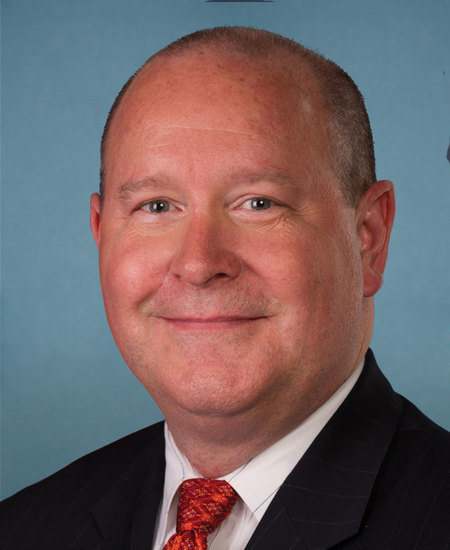
Photo of Larry Bucshon
R United States House · District 8 · Indiana

Rep. Larry Bucshon

Compare
Total votes
2,168
all sessions
Attendance
97%
75 missed
Near the chamber average
With party
91%
of cast votes
Lower than 88% of chamber peers
Bipartisan score
5%
crosses aisle rarely
Higher than 87% of chamber peers
Sponsored
556
bills & resolutions
Near the chamber average
Committees
0
assignments
556 bills and resolutions

Sponsored bills

Total
556
Primary
36
Co-sponsor
520
This page
556
matching current filters
Co-sponsor HR 2962
In committee · United States House · Co-sponsor
Hydrogen Permitting Simplification Act

Maddy summaryHR 2962, the Hydrogen Permitting Simplification Act, exempts certain federal hydrogen production projects from the National Environmental Policy Act (NEPA) review process. It directly affects developers of hydrogen facilities using nuclear, solar, wind, or geothermal energy by removing the requirement for environmental impact assessments under NEPA for projects under this specific energy policy title. The key provision amends the Energy Policy Act of 2005 to add a new section stating that major federal actions involving these hydrogen production sources are not subject to NEPA. This simplifies permitting for qualifying clean hydrogen projects by eliminating a standard federal environmental review step.

In committee Apr 28, 2023 1 co-sponsor
Co-sponsor HR 2955
In committee · United States House · Co-sponsor
Stop Institutional Child Abuse Act

Maddy summaryHR 2955, the Stop Institutional Child Abuse Act, establishes a Federal Work Group to improve data collection and best practices for youth in residential programs (like therapeutic schools, treatment centers, and group homes). The Work Group, composed of federal agency representatives and diverse stakeholders, must develop national data standards, create risk assessment tools, and issue biennial reports with recommendations to enhance safety, reduce restraints, and expand community-based alternatives. It directly affects youth with mental health, substance use, or disability needs placed in these facilities, as well as agencies overseeing them. The bill also mandates a National Academies study to examine funding, oversight, and barriers to community care. These mechanisms aim to standardize data tracking and promote less restrictive, trauma-informed care for youth in residential programs.

In committee Apr 28, 2023 1 co-sponsor
Primary HR 2819
In committee · United States House · Lead sponsor
Good Samaritan Health Professionals Act of 2023

Maddy summaryThis bill creates a federal liability shield for licensed health professionals who volunteer during declared disasters. It protects them from lawsuits for harm caused during their volunteer work, provided they act in good faith within their licensed scope, without compensation (beyond minimal reimbursements), and during a disaster period defined by federal or state declarations. Exceptions apply for gross negligence, willful misconduct, or intoxication. The law preempts conflicting state laws but adds to existing protections under the Volunteer Protection Act of 1997.

In committee Apr 28, 2023 0 co-sponsors
Co-sponsor HR 2700
In committee · United States House · Co-sponsor
Employee Rights Act

Maddy summaryThe Employee Rights Act (HR 2700) amends key labor laws to strengthen employee rights in collective bargaining and privacy. It requires employers to use secret ballot elections for selecting bargaining representatives and to provide labor organizations with voter lists containing employee names and one form of contact information (chosen by the employee) within two business days of an election. The bill prohibits employers from using employee personal information for non-organizing purposes and mandates written authorization for using union dues on non-bargaining activities, with authorizations expiring after one year. Additionally, it clarifies joint employment standards to prevent misclassification and adds tribal sovereignty protections to labor law definitions.

In committee Apr 28, 2023 1 co-sponsor
Co-sponsor HR 2957
In committee · United States House · Co-sponsor
College Transparency Act

Maddy summaryThe College Transparency Act requires the National Center for Education Statistics to develop a secure, privacy-protected system that collects and organizes student-level data from colleges and universities. The system will track enrollment patterns, progression, completion rates, costs, financial aid, and post-graduation outcomes, with data disaggregated by characteristics like race, gender, program of study, and credential level. Colleges participating in federal financial aid programs must submit this data, while the system will provide the public with customizable summary information to help students and families make informed college decisions. The bill includes strict privacy protections, prohibiting collection of sensitive data like health information or exact addresses, and requires data minimization to only what's necessary for the system's purposes.

In committee Apr 27, 2023 1 co-sponsor
Co-sponsor HR 2370
In committee · United States House · Co-sponsor
Access to AEDs Act

Maddy summaryHR 2370, the Access to AEDs Act, authorizes $25 million in federal funding (2024-2028) to help public elementary and secondary schools improve access to automated external defibrillators (AEDs) and CPR training. The bill directs the Secretary of Health and Human Services to award grants to school districts and partners for developing AED programs, training staff and students, purchasing and maintaining AEDs, and creating cardiac emergency response plans. It specifically targets schools to address sudden cardiac arrest (SCA), which is a leading cause of death among student athletes and youth, with 90% of SCA victims dying without immediate CPR and defibrillation. The law requires grantees to report on their activities and establishes a clearinghouse to collect data on school AED access and costs.

In committee Apr 26, 2023 1 co-sponsor
Co-sponsor HJRES 59
In committee · United States House · Co-sponsor
Providing for congressional disapproval under chapter 8 of title 5, United States Code, of the rule submitted by the Department of Labor relating to "Adverse Effect Wage Rate Methodology for the Temporary Employment of H-2A Nonimmigrants in Non-Range Occupations in the United States".

This joint resolution nullifies a Department of Labor final rule entitled Adverse Effect Wage Rate Methodology for the Temporary Employment of H-2A Nonimmigrants in Non-Range Occupations in the United States and published on February 28, 2023. This rule makes changes to the methodology used to set adverse effect wage rates for H-2A workers (temporary agricultural workers), including by using Bureau of Labor Statistics wage surveys in certain instances. (Generally, the minimum wage for an H-2A worker is the highest of the adverse effect wage rate, the applicable minimum wage, the prevailing wage for that occupation in that area, or any agreed-upon collective bargaining wage.)

In committee Apr 25, 2023 1 co-sponsor
Co-sponsor HR 2826
In committee · United States House · Co-sponsor
Save Local Business Act

Maddy summaryHR 2826, the Save Local Business Act, clarifies when multiple businesses can be held jointly responsible for labor laws. It amends the National Labor Relations Act and Fair Labor Standards Act to state that a business is only a joint employer if it directly controls key employment terms like hiring, pay, schedules, or discipline for another business's workers. This directly affects franchisors, contractors, and similar business models that might previously have been deemed joint employers under broader interpretations. The bill aims to limit joint employer liability to cases where one business has clear, day-to-day control over essential worker conditions.

In committee Apr 25, 2023 1 co-sponsor
Co-sponsor HR 2743
In committee · United States House · Co-sponsor
Fair Access to Banking Act

Maddy summaryHR 2743 prohibits large financial institutions (over $100 billion in assets) from denying banking services to lawful businesses based on subjective political reasons, industry type, or reputational concerns. It requires these institutions to use objective, risk-based assessments for service decisions and provide written justifications for denials. The law applies to banks, credit unions, and payment networks, with civil penalties for violations including fines up to $10,000 per incident. It specifically ensures businesses operating legally under federal law receive fair access to financial services without discrimination. The bill mandates that denials be based on documented risk factors, not political bias or category-based exclusion.

In committee Apr 20, 2023 1 co-sponsor
Co-sponsor HR 2748
In committee · United States House · Co-sponsor
Contact Lens Prescription Verification Modernization Act

Contact Lens Prescription Verification Modernization Act This bill revises the requirements for the verification of prescriptions related to the purchase of contact lenses. Specifically, online sellers of prescription contact lenses must provide consumers with a method to transmit a digital copy of their prescriptions to such sellers. Online sellers also must encrypt protected health information they send by email. Additionally, the bill prohibits any seller of prescription contact lenses from using telephone calls with an artificial or prerecorded voice (i.e., robocalls) to verify a consumer's prescription.

In committee Apr 20, 2023 1 co-sponsor
Showing 231 to 240 of 556 bills
Previous 1 … 23 24 25 … 56 Next