STEM Restoring Employment Skills through Targeted Assistance, Re-entry, and Training Act or the STEM RESTART Act This bill establishes a new national program to support mid-career workers in reentering the STEM (science, technology, engineering, and mathematics) workforce, including workers from underrepresented or rural populations, by awarding grants to certain small- and medium-sized businesses to assist such workers in reentering the workforce at positions above entry level.
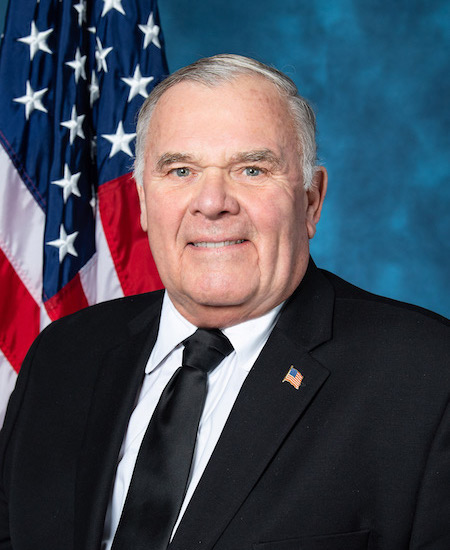
Rep. James R. Baird
Sponsored bills
Finish the Wall Act This bill requires the Department of Homeland Security (DHS) to resume activities related to the construction of a barrier system along the U.S.-Mexico border and addresses other border-related issues. DHS must resume all such construction activities that were planned or underway prior to January 20, 2021. DHS must also expend all funds appropriated or explicitly obligated since October 1, 2016, for construction of this barrier system. DHS may not cancel contracts for activities related to such construction entered into on or before January 20, 2021. Furthermore, within 14 days of this bill's enactment, DHS must certify to Congress that U.S. Customs and Border Protection facilities that process adults taken into custody at the border are fully compliant with certain laws related to the collection of DNA. (Among other things, these laws allow for the collection of DNA samples from non-U.S. persons detained under U.S. authority.)
This resolution expresses the sense of the House of Representatives that (1) clean water is a national priority, and (2) the 2020 final rule titled The Navigable Waters Protection Rule: Definition of "Waters of the United States" should not be withdrawn or vacated.
This resolution expresses support for the designation of Welcome Home Vietnam Veterans Day. It also honors and recognizes the contributions of veterans who served in Vietnam.
This resolution honors and recognizes the patriotism and contributions made by generations of veterans service organizations and commends the members of such organizations for their dedicated service to members of the Armed Forces, veterans, their families, and their communities. Additionally, the resolution encourages citizens to volunteer their support and services to veterans service organizations and to promote awareness of the contributions of such organizations to members of the Armed Forces, veterans, and their families.
Supporting Eating Disorders Recovery Through Vital Expansion Act or the SERVE Act This bill provides for inpatient and outpatient treatment of eating disorders under TRICARE for dependents of members of the uniformed services. Dependents are eligible for such care regardless of (1) their age, except with respect to residential service; and (2) whether the eating disorder is their primary or secondary diagnosis. The bill also requires the Department of Defense (DOD) and the Department of Homeland Security (with respect to the Coast Guard) to identify, treat, and rehabilitate members of the armed forces who have an eating disorder. Finally, DOD and the Department of Veterans Affairs must jointly develop, publish, and disseminate clinical practice criteria and guidelines on the identification and treatment of eating disorders.
This resolution condemns Iranian state-sponsored terrorist attacks against U.S. citizens and officials and Iranian dissidents and expresses support for the people of Iran who are engaged in legitimate and peaceful protests against the Iranian regime.
Chinese Government COVID-19 Accountability Act This bill directs the President to develop and carry out a strategy to get China's government to reimburse the U.S. government for funds made available to address COVID-19 (i.e., coronavirus disease 2019).
Military Hunger Prevention Act This bill requires the Department of Defense (DOD) to pay a basic needs allowance to certain low-income members of the Armed Forces. Specifically, those eligible for the basic needs allowance are members who (1) have completed initial entry training, (2) have a gross household income that did not exceed an amount equal to 130% of the federal poverty guidelines of the Department of Health and Human Services (HHS), and (3) do not elect to decline the allowance. In situations where a household contains two or more eligible members, the bill specifies that only one allowance may be paid per year to one member they jointly elect. The amount of the allowance must be the aggregate amount equal to 130% of the HHS federal poverty guidelines minus the gross household income of the covered member during the preceding year divided by 12. The Defense Finance and Accounting Service (DFAS) of DOD must notify, in writing, individuals determined to be eligible for the allowance. The notice must include information regarding financial management and assistance programs administered by DOD for which the individuals are also eligible. Individuals who seek to receive the allowance must submit specified information to DFAS.

This resolution commits to the use of competitive free market and free trade policies to combat national security threats caused by China and its attacks on the U.S. pharmaceutical manufacturing base. The resolution urges the United States to (1) remove tax, regulatory, and debt burdens and barriers that have weakened this base; (2) empower the U.S. Trade Representative to take specified actions to counter harmful and unfair trade practices by China; (3) address shortcomings in Food and Drug Administration data collection related to foreign-sourced pharmaceutical ingredients; and (4) identify and streamline regulatory hurdles that have impeded the U.S. pharmaceutical manufacturing base.