

Preventing Auto Recycling Theft Act or the PART Act This bill establishes requirements for motor vehicles related to catalytic converters and other motor vehicle parts that contain precious metals. The National Highway Traffic Safety Administration must revise the motor vehicle theft prevention standard for new motor vehicles to include catalytic converters among the parts that require an inscribed or affixed identifying number. Additionally, the Department of Transportation must establish a grant program through which law enforcement agencies and other entities can stamp vehicle identification numbers onto catalytic converters of existing vehicles. The bill establishes retention requirements for the purchase of motor vehicle parts that contain precious metals. It also sets forth criminal penalties for the theft of catalytic converters or any precious metals removed from a vehicle.
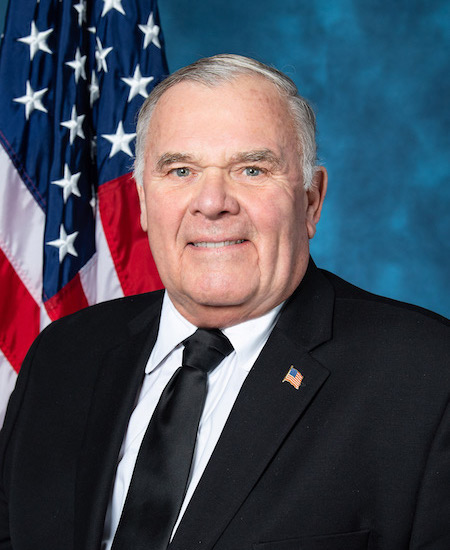
Rep. James R. Baird
Sponsored bills
Public Safety Enhancement Act of 2021 This bill reauthorizes through FY2026 the Community Oriented Policing Services (COPS) grant program. Additionally, the bill requires a certain amount of funds made available under the COPS grant program to be used for the hiring and retention of law enforcement officers.
Illegal Immigrant Payoff Prohibition Act This bill prohibits the payment of a settlement to an alien for a civil action brought against the United States in connection with the alien's inadmissibility to, or unlawful presence in, the United States.
Protect Communities from a Porous Border Act of 2021 This bill requires the Department of Homeland Security (DHS) to notify a state before placing an alien in that state and gives the state final authority to prohibit such a placement. At least 10 business days before placing (e.g., detaining or housing) such an individual in a state, DHS must provide certain information to that state, including (1) the individual's biographic and biometric information, including DNA; and (2) a certification that the biometric and biographic information has been checked in various law enforcement and counterterrorism databases. No federal court shall have jurisdiction to review (1) the requirements and procedures established under this bill, or (2) a decision by a state to prohibit the placement of such an individual in the state. The bill also prohibits any federal official from waiving any of the bill's requirements.
Supporting Every at-Risk Veteran In Critical Emergencies Act of 2021 or the SERVICE Act of 2021 This bill authorizes the Office of Community Oriented Policing Services within the Department of Justice to make grants to support the creation and operation of veterans' response teams in state, local, and tribal law enforcement agencies.
Stop Settlement Slush Funds Act of 2021 This bill prohibits the federal government from entering into or enforcing a settlement agreement on behalf of the United States that provides for a payment to any person or entity other than the United States. The bill provides exceptions to allow payments that (1) remedy actual harm (including to the environment) caused by the party making the payment, or (2) constitute a payment for services rendered in connection with the case. Government officials or agents who violate this prohibition may be removed from office or required to forfeit to the government any money they hold for such purposes to which they may otherwise be entitled. Agencies must report annually for seven years to the Congressional Budget Office about the parties, funding sources, and distribution of funds for their settlement agreements permitted by the exceptions in this bill. The Office of Inspector General for each agency must also report annually on any settlement agreements that violate the bill's requirements.
Teleabortion Prevention Act of 2021 This bill restricts the use of telehealth for chemical abortions (also known as medication abortions). Specifically, it requires a provider who dispenses or prescribes medication for a chemical abortion to physically examine the patient, be physically present at the location of the chemical abortion, and schedule a follow-up visit. The bill provides an exception for a chemical abortion that is necessary to save the life of a mother whose life is endangered by a physical disorder, illness, injury, or condition. The bill establishes criminal penalties—a fine, a prison term of up to two years, or both—for a provider who does not comply with the requirements. A patient who undergoes a chemical abortion may not be prosecuted.
Exposing Agricultural Trade Suppression Act This bill restricts state and local governments from imposing certain standards or conditions on the production or manufacture of agricultural products sold or offered for sale in interstate commerce. Specifically, it prohibits the imposition of such standards or conditions if (1) the production or manufacture occurs in another state, and (2) the standard or condition adds to requirements applicable under federal law and the laws of the state or locality where the product is produced or manufactured. The bill also allows for a private right of action to challenge state or local regulations relating to agricultural goods sold in interstate commerce. A person may bring an action in (1) the U.S. district court for the judicial district in which the person is affected by a regulation or the person resides, operates, or does business; or (2) any other appropriate court with jurisdiction.
Flag Code Modernization Act of 2021 This bill revises provisions regarding customs and practices with respect to the American flag. Among other changes, the bill permits U.S. postal workers to wear the flag on their uniforms and modifies provisions regarding the position and manner of display of the flag.
Second Amendment is Essential Act of 2021 This bill directs the Department of Homeland Security to designate the business of importing, manufacturing, or dealing firearms, or importing or manufacturing ammunition, as a critical infrastructure sector. Additionally, the bill states that individuals who are employed by those entities are critical infrastructure workers. The term critical infrastructure means systems and assets, physical or virtual, so vital to the United States that the incapacity or destruction of such systems and assets would have a debilitating impact on security, national economic security, national public health and safety, or any combination of those matters.