

Standardizing Thresholds Of Penalties for Fentanyl Act or the STOP Fentanyl Act This bill reduces the drug quantity thresholds that trigger a mandatory minimum prison term for a defendant who manufactures, distributes, imports, exports, or possesses with intent to distribute fentanyl. The bill also creates enhanced criminal penalties for certain violations involving fentanyl that was imported along the U.S.-Mexico border. Specifically, the bill reduces from 400 to 5 grams the fentanyl quantity and from 100 to 0.05 grams the fentanyl analogue quantity that trigger a mandatory minimum prison term for high-level first-time or repeat offenders. It also reduces from 40 to 0.5 grams the fentanyl quantity and from 10 to 0.005 grams the fentanyl analogue quantity that trigger a mandatory minimum prison term for low-level first-time or repeat offenders. Additionally, the bill creates enhanced mandatory minimum prison terms for importing or exporting fentanyl that was imported along the U.S.-Mexico border.
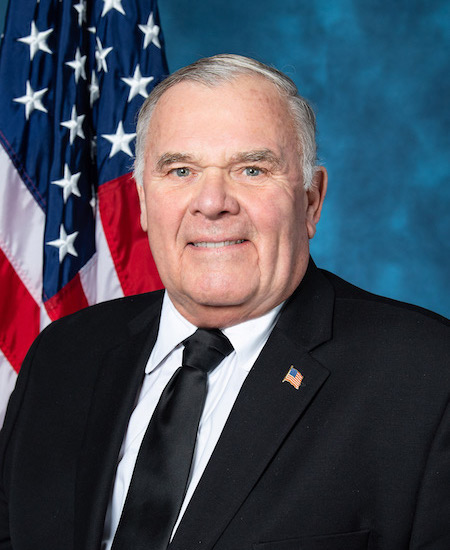
Rep. James R. Baird
Sponsored bills
Maddy summaryThis bill prohibits the export or sale of petroleum products drawn from the U.S. Strategic Petroleum Reserve to specific countries and entities, including China, Russia, North Korea, Iran, and any nation under U.S. sanctions. It also bans exports to entities owned or controlled by these countries or the Chinese Communist Party. The Secretary of Energy must enforce this ban, though they may issue a national security waiver for specific exports. The bill requires the Secretary to issue implementing rules within 60 days of enactment. It directly affects the Secretary of Energy, oil exporters seeking to use the Strategic Petroleum Reserve, and the listed countries/entities.
Maddy summaryHR 311, the Cost Estimates Improvement Act, requires the Congressional Budget Office (CBO) and Joint Committee on Taxation (JCT) to include debt servicing costs in their budget estimates where practicable and to list duplicative federal programs covered by legislation. The bill mandates that all CBO and JCT cost estimates must identify overlapping or redundant agency programs, initiatives, or activities within the proposed legislation. This change aims to improve transparency in federal budget analysis by providing clearer data on long-term debt impacts and program efficiency for lawmakers. The bill directly affects the CBO and JCT as they prepare budget estimates for Congress.
Maddy summaryThe GAS Act (HR 337) prohibits any federal agency from banning the sale or use of gas-burning stoves in the United States. This applies to all agencies defined under federal law, including the Environmental Protection Agency and Consumer Product Safety Commission. The bill directly blocks agencies from enacting new regulations that would restrict gas stoves, preventing future regulatory actions. It does not affect existing stove sales or current agency authority but sets a clear restriction on future rulemaking.
Maddy summaryHRES 29 is a procedural resolution that would amend House rules to create the "Committee on the Elimination of Nonessential Federal Programs." This committee would study and recommend cutting underperforming or nonessential federal programs, requiring annual reports listing such programs and submitting related legislation. The resolution also establishes expedited procedures for bills reported by this committee, including limiting debate to 10 hours and making motions to proceed highly privileged. It does not directly affect constituents but changes House committee structure and procedures.
Qualified Immunity Act of 2023 This bill provides statutory authority for qualified immunity for law enforcement officers in civil cases involving constitutional violations. Current law provides a statutory civil cause of action against state and local government actors (e.g., law enforcement officers) for violations of constitutional rights, also known as Section 1983 lawsuits. The Supreme Court has also found an implied cause of action against federal law enforcement officers in certain situations (e.g., Fourth Amendment violations), also known as Bivens lawsuits. However, under the judicial doctrine of qualified immunity, government officials performing discretionary duties are generally shielded from civil liability, unless their actions violate clearly established rights of which a reasonable person would have known. The bill provides statutory authority for these principles with respect to law enforcement officers. Specifically, under the bill, law enforcement officers are entitled to qualified immunity if (1) at the time of the alleged violation, the constitutional right at issue was not clearly established or the state of the law was not sufficiently clear for every reasonable officer to know that the conduct was unconstitutional; or (2) a court has held that the specific conduct at issue is constitutional. The bill applies to federal, state, and local law enforcement officers. It also specifies that law enforcement agencies and local governments may not be held liable if their officers are entitled to qualified immunity.
Maddy summaryThe Marginal Well Protection Act amends the Clean Air Act to exempt small oil and gas wells from a methane emissions and waste reduction program. Specifically, it excludes facilities producing less than 15 barrels of oil per day and less than 90 thousand cubic feet of natural gas per day from the program's requirements. This directly affects small-scale producers operating "marginal wells" by removing them from the program's scope. The bill does not create new requirements but adjusts the definition of "applicable facility" to exclude these smallest operations.
Maddy summaryH.J.Res. 12 proposes a constitutional amendment requiring the federal government to balance its budget annually, meaning spending cannot exceed revenue except under specific circumstances. It would directly affect Congress and the President by mandating that annual budgets must not exceed revenue, with exceptions requiring a 3/5 vote in both chambers of Congress or a military conflict waiver approved by a joint resolution. Key provisions include prohibiting increases to the national debt without a 3/5 congressional vote, requiring the President to submit a balanced budget proposal each year, and defining "receipts" to exclude borrowing. The amendment would take effect five years after ratification by 38 states (three-fourths of states) and includes limited waivers for declared wars or imminent national security threats. This is a procedural constitutional change, not a spending bill, and would fundamentally alter federal budgeting processes.
Maddy summaryHJRES 8 proposes a constitutional amendment to permanently set the Supreme Court's size at nine justices. The bill would require any future changes to the Court's composition to follow this specific number, locking in the current structure. It does not alter the existing Court size (which has been nine since 1869) but aims to prevent future adjustments through legislative action. The amendment must be ratified by three-fourths of state legislatures within seven years to take effect. This is a procedural proposal focused on constitutional structure, not a direct policy affecting citizens or programs.
Maddy summaryHRES 8 is a formal resolution introduced by the U.S. House of Representatives in January 2023 to impeach Secretary of Homeland Security Alejandro Mayorkas. The resolution alleges three specific violations: (1) failing to maintain border security, citing record migrant encounters and fentanyl seizures under his leadership; (2) providing false testimony to Congress about border security; and (3) spreading false claims about Border Patrol agents whipping migrants during a 2021 incident. It claims these actions violated his constitutional duties and federal law. As an impeachment resolution, it does not enact policy but seeks to refer the case to the Senate for trial.