

Maddy summaryHR 1147, the Whole Milk for Healthy Kids Act of 2023, allows schools participating in the National School Lunch Program to offer whole milk as an option during lunch. It amends the school lunch law to explicitly permit schools to serve flavored and unflavored whole milk alongside reduced-fat, low-fat, and fat-free milk choices for students. The bill also requires the Secretary of Agriculture to adjust meal regulations to account for saturated fat from whole milk, ensuring it doesn't count against meal fat limits. This change directly affects participating schools and the students who receive school lunches, expanding their milk beverage options.
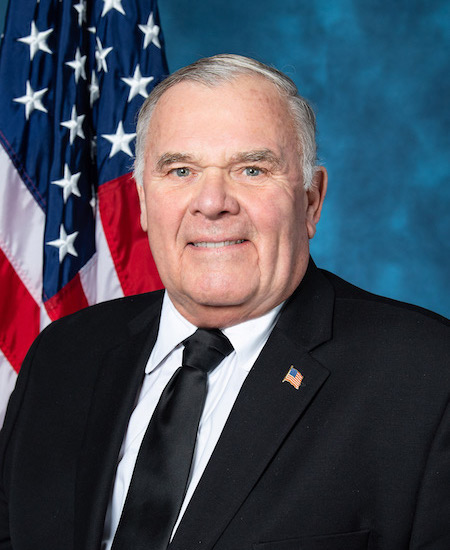
Rep. James R. Baird
Sponsored bills
Maddy summaryHR 6813 blocks the Environmental Protection Agency (EPA) from finalizing, implementing, or enforcing a specific proposed rule about air emissions reporting. The bill directly targets the EPA Administrator, preventing action on the "Revisions to the Air Emissions Reporting Requirements" rule published in the Federal Register on August 9, 2023. This bill does not change current reporting rules but stops the EPA from moving forward with this particular revision. The key mechanism is a direct prohibition on the EPA's regulatory actions regarding this specific rule.
Maddy summaryThe Defense of Property Rights Act (HR 6758) would allow property owners to seek compensation in either U.S. District Court or the U.S. Court of Federal Claims when government actions - such as regulations or physical takings - deprive them of property rights without "just compensation." It repeals a law that previously forced owners to choose between courts, clarifies that "just compensation" includes full market value and business losses (with interest), and shifts the burden of proof to the government to justify regulatory actions. The bill directly affects individuals and businesses owning real estate, water rights, mineral rights, or other property protected under the Fifth Amendment, particularly when government rules significantly restrict property use or value. It sets a 6-year statute of limitations for claims and requires courts to award attorney fees to successful plaintiffs.
Maddy summaryHR 6734 prohibits the use of federal funds to finalize, implement, or enforce the Bureau of Alcohol, Tobacco, Firearms, and Explosives' (ATF) proposed rule (2022R-17) defining "engaged in the business as a dealer in firearms." This bill directly affects the ATF by blocking funding for this specific regulatory rule, which was proposed in August 2023. The legislation does not create new requirements but prevents federal resources from being used to advance this particular ATF regulation.
Maddy summaryHJRES 88 is a resolution seeking to block a Department of Education rule that would have improved income-driven repayment options for federal student loan borrowers. The rule, published in the Federal Register on July 10, 2023, targeted the William D. Ford Direct Loan Program and the Federal Family Education Loan (FFEL) Program. This resolution uses the Congressional Review Act process to disapprove the rule, preventing it from taking effect and preserving the current repayment structure. If enacted, it would stop the proposed changes to repayment terms without altering existing loan policies.
This resolution disapproves of the United Nations' recommendations to reduce meat consumption in their global food systems' road map and opposes the use of federal resources to reduce meat consumption.
Maddy summaryThe Innovative FEED Act of 2023 defines and regulates "zootechnical animal food substances" - substances added to animal feed to affect digestion, reduce foodborne pathogens, or alter gut microbiome without providing nutrition. It requires these substances to be approved as food additives by the FDA under existing rules, with specific data on intended effects and mandatory labeling stating "Not for use in the diagnosis, cure, mitigation, treatment, or prevention of disease in animals." The bill excludes drugs, hormones, ionophores, and other substances from this category. This directly affects animal feed manufacturers, the FDA’s regulatory process, and the labeling requirements for these products.
Maddy summaryHR 6600, "Tyler’s Law," requires the Secretary of Health and Human Services to study how often hospital emergency departments test for fentanyl during overdose cases, along with the costs, benefits, risks, and patient privacy impacts. The study must be completed within one year of the bill’s enactment, followed by guidance issued within six months on whether fentanyl testing should become routine. This guidance will address how hospitals can inform clinicians about testing protocols and how fentanyl testing might affect future overdose risks and patient health outcomes. The bill directly affects hospitals and emergency departments treating overdose patients, focusing on improving data-driven practices for fentanyl detection.
Maddy summaryThis bill authorizes the posthumous presentation of a Congressional Gold Medal to honor Marshall "Major" Taylor, a pioneering Black cyclist who broke racial barriers in the late 19th and early 20th centuries. It recognizes his athletic achievements, including world records and international championship wins, as well as his advocacy for equality in sports. The medal, designed by the Treasury Secretary, will be presented to Taylor's great-granddaughter, Karen Donovan, following the congressional authorization. As a commemorative act with no policy changes, it serves solely to honor Taylor's legacy as a trailblazer and role model.
Maddy summaryThis bill requires the Department of Energy (DOE) and National Science Foundation (NSF) to formally coordinate research through a joint memorandum of understanding. It directs them to collaborate on specific scientific areas like quantum computing, energy materials, climate modeling, and advanced manufacturing, with funding and projects open to universities, labs, and nonprofits. The agencies must submit a two-year report to Congress detailing their coordination, research outcomes, and future opportunities. This primarily affects DOE, NSF, and their research partners, aiming to streamline joint efforts without creating new funding.