

Helping Tobacco Users Quit Act This bill provides for Medicaid and Children's Health Insurance Program (CHIP) coverage of certain tobacco cessation services. Specifically, the bill provides for coverage, without cost-sharing, of diagnostic, therapy, and counseling services and pharmacotherapy, including prescription and nonprescription tobacco cessation agents, that are provided under medical supervision and in accordance with specified guidelines. It also applies a 90% Federal Medical Assistance Percentage (i.e., federal matching rate) for such items and services for five years.
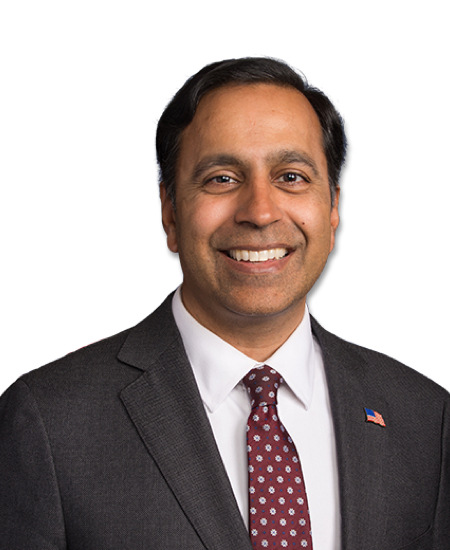
Rep. Raja Krishnamoorthi
Sponsored bills
Maddy summaryHR 4663, the Federal Mechanical Insulation Act, defines "mechanical insulation" (insulation around pipes and equipment in federal buildings) as an eligible energy efficiency measure. It requires federal agencies to include mechanical insulation in their required energy and water evaluations, specifically mandating that evaluations identify this insulation as a potential efficiency measure. The bill specifies that such insulation must meet minimum standards under Reference Standard 90.1 to qualify. This change directly affects federal building managers and contractors by formally recognizing mechanical insulation as a standard efficiency option in compliance with existing energy conservation laws.
Maddy summaryHR 4812, the Food for Thought Act of 2023, provides federal grants to eligible colleges and universities to offer free on-campus meals to low-income students. The bill targets institutions with high Pell Grant enrollment (at least 30% of undergrads), prioritizing community colleges, minority-serving institutions, and those in areas with high need. Participating schools must provide 1-10 free meals weekly to students facing food insecurity, with priority given to those with greatest financial need, and must report on student outcomes like retention and graduation rates. Grants cover meal costs, campus food pantries, and SNAP enrollment support, with funds allocated for 5 years and requiring detailed reporting on program impact.
Maddy summaryH.J.Res. 25 would remove the 1979 deadline for states to ratify the Equal Rights Amendment (ERA), which was originally proposed in 1972. This bill directly affects states that ratified the ERA after the deadline (such as Nevada, Illinois, and Virginia in 2017-2018) by making their ratifications legally valid. The key provision states that the ERA is valid as part of the Constitution if ratified by three-fourths of states, regardless of the original deadline. The bill does not create new rights but aims to finalize the constitutional amendment process by eliminating the time limit.
Maddy summaryHR 4708, the H-2 Improvements to Relieve Employers Act, streamlines U.S. visa processes for agricultural (H-2A) and non-agricultural (H-2B) workers. It extends the validity of employer certifications and petitions for these visas from one year to three years, reducing administrative burdens. The bill also allows interview waivers for workers renewing status within four years of their previous visa expiration. Additionally, it requires the Department of Labor to publish seasonal employment data on its website at an employer's request, enhancing transparency for seasonal hiring. These changes directly affect U.S. employers seeking temporary foreign workers and the workers themselves.
Maddy summaryThis bill, HR 1282 (Major Richard Star Act), expands benefits for certain military retirees by allowing them to receive both veterans' disability compensation and military retirement pay simultaneously. It specifically affects combat-related disabled retirees under Chapter 61 of the military retirement system who have fewer than 20 years of service. The key change removes the automatic reduction of military retirement pay when these retirees also receive disability compensation, as amended in Section 1413a(b)(3) of Title 10. Technical updates to the law’s structure and effective date (starting after enactment) complete the provisions.
Closing Loopholes for the Overseas Use and Development of Artificial Intelligence Act or the CLOUD AI Act This bill prohibits certain transactions between a U.S. person (i.e., natural person or entity) and an entity located in China or Macau when the transactions support remote access to certain integrated circuits. Specifically, the bill prohibits a U.S. person (and any foreign branch of a U.S. person) from providing support to an entity in China or Macau for the remote or cloud use of integrated circuits covered by export control classification numbers 3A090 or 4A090. (The classification numbers cover certain high-performance integrated circuits, computers, electronic assemblies, and related components.) The bill directs the Department of Commerce to establish the ban no later than 180 days after the bill is enacted and to issue the regulations necessary to implement the bill.
Maddy summaryHJRES 82 is a non-binding resolution stating that the Equal Rights Amendment (ERA) has been validly ratified by the required 38 states (including Virginia's 2020 ratification) and should be certified as the 28th Amendment to the U.S. Constitution. It directs the Archivist of the United States to fulfill their statutory duty under Title 1, U.S. Code, to certify and publish the ERA without delay. The resolution argues Article V of the Constitution has no ratification deadline, citing precedents like the 27th Amendment. It does not change the Constitution itself but urges the Archivist to complete the certification process. The bill affects the Archivist’s office, requiring them to act on the ERA’s ratification status.
Maddy summaryHRES 580 is a symbolic resolution expressing the House's support for designating "Journeyman Lineworkers Recognition Day." It honors lineworkers who work in hazardous conditions (such as at heights near live wires) and respond to disasters like hurricanes and wildfires, while recognizing their contributions and the legacy of Henry Miller, an early electrical worker who died on the job. The resolution has no legal effect - it solely encourages public recognition and reflection on these workers' service.
Maddy summaryThis bill increases the annual cap for H-1B visas from 65,000 to 130,000 and removes a limit on exemptions for certain workers. It also adjusts thresholds for employers considered "H-1B-dependent," raising the employee counts that trigger additional requirements (e.g., from 25 employees to 50). Additionally, it authorizes $25 million annually (2024-2028) for grants to states to strengthen K-12 STEM education, retain STEM teachers, and support higher education programs in science, math, engineering, and technology. The bill directly affects U.S. employers seeking high-skilled foreign workers, H-1B visa holders, and educational institutions receiving the grant funding.