

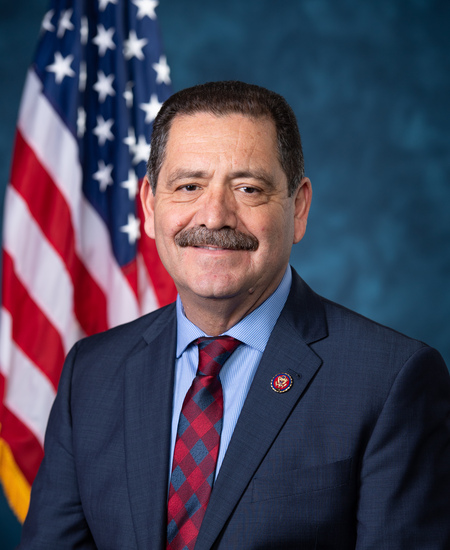
Photo of Jesús G. "Chuy" García
D United States House · District 4 · Illinois

Rep. Jesús G. "Chuy" García

Compare
Total votes
2,837
all sessions
Attendance
95%
135 missed
Near the chamber average
With party
95%
of cast votes
Near the chamber average
Bipartisan score
3%
crosses aisle rarely
Near the chamber average
Sponsored
1,948
bills & resolutions
Higher than 88% of chamber peers
Committees
7
assignments
1,948 bills and resolutions

Sponsored bills

Total
1,948
Primary
44
Co-sponsor
1,904
This page
1,948
matching current filters
Co-sponsor HRES 317
In committee · United States House · Co-sponsor
Urging the United States to lead the world back from the brink of nuclear war and halt and reverse the nuclear arms race.

Maddy summaryHRES 317 is a non-binding resolution urging the U.S. government to lead global efforts to halt and reverse the nuclear arms race. It calls on the President to pursue negotiations with nuclear-armed states to reduce arsenals, end the U.S. policy allowing first use of nuclear weapons, eliminate immediate launch readiness, stop developing new weapons, and support communities affected by nuclear programs. The resolution emphasizes diplomatic action over military modernization to reduce nuclear risks and prevent catastrophic conflict.

In committee Apr 9, 2025 1 co-sponsor
Co-sponsor HR 2763
In committee · United States House · Co-sponsor
American Family Act

Maddy summaryThe American Family Act (HR 2763) establishes a new refundable child tax credit that provides monthly payments to eligible families with children. It would pay $300 per month for each child under age 6 and $360 per month (120% of $300) for each child age 6 or older, with income limits of $150,000 for joint filers and $112,500 for other filers. The bill creates a "period of presumptive eligibility" to determine eligibility for monthly payments, allowing families to receive advance payments based on information from previous tax returns. This would directly affect millions of families with children who meet the income requirements, providing more consistent financial support throughout the year rather than an annual tax credit.

In committee Apr 9, 2025 1 co-sponsor
Co-sponsor HR 2799
In committee · United States House · Co-sponsor
Closing the Bump Stock Loophole Act of 2025

Maddy summaryHR 2799, the Closing the Bump Stock Loophole Act of 2025, prohibits the sale, possession, and modification of devices that increase the firing rate of semi-automatic firearms to mimic machine guns (commonly called "bump stocks"). It specifically bans manual, power-driven, or electronic devices designed to speed up firing, as well as modified firearms that achieve this effect. Owners of pre-existing modified firearms must register them within 120 days of the law's enactment, with exemptions for government entities and firearms already lawfully modified and registered before the bill passes. The bill does not restrict standard semi-automatic firearms or require registration of unmodified guns.

In committee Apr 9, 2025 1 co-sponsor
Co-sponsor HR 2743
In committee · United States House · Co-sponsor
Raise the Wage Act of 2025

Maddy summaryThe Raise the Wage Act of 2025 gradually increases the federal minimum wage from $9.50 to $17.00 per hour over six years, with annual adjustments based on median wage growth. It raises the base wage for tipped workers from $6.00 to $17.00 per hour, phasing out their separate minimum wage structure by 2029. The bill also eliminates special minimum wage certificates for disabled workers after 2029, requiring employers to pay the standard minimum wage. These changes apply to most covered workers, including tipped employees and those under 20, with specific transition timelines for each group.

In committee Apr 8, 2025 1 co-sponsor
Co-sponsor HR 2736
In committee · United States House · Co-sponsor
Public Service Freedom to Negotiate Act of 2025

Maddy summaryThis bill establishes federal minimum standards for collective bargaining rights for public employees and supervisors. The Federal Labor Relations Authority would determine if state laws provide these rights, and if not, would establish them for affected employees. The bill guarantees public employees the right to form unions, bargain collectively, and engage in concerted activities, while requiring public employers to recognize unions and put agreements in writing. It also prohibits strikes or lockouts that would disrupt emergency services. This would apply to public employees in states that don't meet the federal standards for collective bargaining rights.

In committee Apr 8, 2025 1 co-sponsor
Co-sponsor HR 2692
In committee · United States House · Co-sponsor
No Tax Breaks for Union Busting (NTBUB) Act

Maddy summaryThe No Tax Breaks for Union Busting Act would deny tax deductions for employers who spend money to influence employees' decisions about union activities, such as union elections or collective bargaining. It defines "labor organization activities" broadly to include union elections, labor disputes, and collective actions. The bill requires employers to report such spending on tax returns and prevents them from deducting these expenses from taxable income. This would apply to employers using tactics like captive audience meetings, outside consultants, or other efforts to sway workers' union decisions. The policy aims to remove tax incentives for employers to interfere with workers' rights under labor law.

In committee Apr 7, 2025 1 co-sponsor
Co-sponsor HR 2678
In committee · United States House · Co-sponsor
Ellie’s Law

Maddy summaryHR 2678, "Ellie’s Law," authorizes $20 million annually from fiscal years 2026 through 2030 for the National Institute of Neurological Disorders and Stroke to conduct new research on unruptured brain aneurysms. The funding specifically aims to study diverse patient populations by age, sex, and race, addressing gaps in current research. This bill directly affects the estimated 6.8 million Americans with unruptured brain aneurysms - particularly women and people of color, who face higher rupture risks - by advancing medical understanding of the condition. The law requires the funds to supplement, not replace, existing research budgets.

In committee Apr 7, 2025 1 co-sponsor
Co-sponsor HR 2671
In committee · United States House · Co-sponsor
Tax Fairness for Workers Act

Maddy summaryThe Tax Fairness for Workers Act (HR 2671) would allow certain employees to deduct work-related expenses directly from their gross income. Specifically, it creates an above-the-line deduction for union dues (amending IRC Section 62(a)(1)) and reinstates a deduction for other out-of-pocket work costs like uniforms or tools (amending IRC Section 67(g)), effective for 2025 tax years. This directly affects union members and workers with significant job-related expenses who previously could not deduct these costs. The bill removes the prior limitation that barred these deductions, making them available without needing to itemize. The policy change simplifies tax filing for affected workers by treating these expenses as deductible business costs.

In committee Apr 7, 2025 1 co-sponsor
Co-sponsor HR 2245
In committee · United States House · Co-sponsor
Autonomy for Disabled Veterans Act

Maddy summaryHR 2245, the Autonomy for Disabled Veterans Act, increases funding limits for home modifications for disabled veterans using VA home health services. It raises the maximum annual amount for home improvements from $6,800 to $10,000 and for structural alterations from $2,000 to $5,000. The bill also requires annual inflation adjustments to these amounts based on the Consumer Price Index, ensuring the funding keeps pace with rising costs. This directly affects veterans who need home modifications as part of their VA-provided home health services.

In committee Apr 4, 2025 1 co-sponsor
Co-sponsor HR 2102
In committee · United States House · Co-sponsor
Major Richard Star Act

Maddy summaryThis bill, HR 2102 (Major Richard Star Act), allows veterans with combat-related disabilities to receive both full military retired pay and veterans' disability compensation simultaneously, without the previous offset that reduced retired pay. It directly affects veterans already eligible for both benefits due to combat-related injuries, removing the requirement that their retired pay be reduced by the disability compensation amount. The key provision amends Title 10 and Title 38 to eliminate the offset rule (sections 5304 and 5305 of Title 38) for these veterans. The change applies to payments starting after the bill’s enactment date, effective for all qualifying veterans. This is a policy change to increase financial support for affected veterans, not a new benefit.

In committee Apr 4, 2025 1 co-sponsor
Showing 471 to 480 of 1,948 bills
Previous 1 … 47 48 49 … 195 Next