

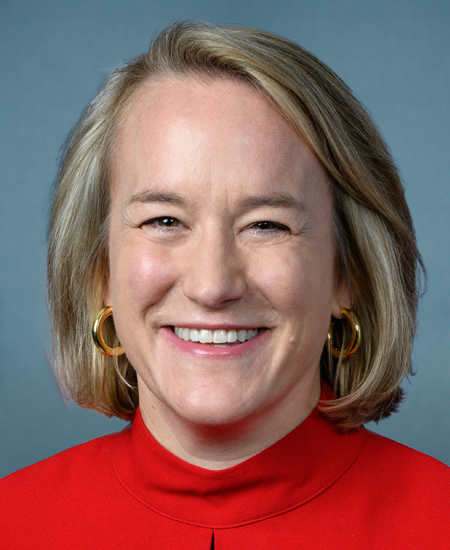
Photo of Nikki Budzinski
D United States House · District 13 · Illinois On the 2026 ballot

Rep. Nikki Budzinski

Compare
Total votes
1,879
all sessions
Attendance
100%
5 missed
Higher than 96% of chamber peers
With party
94%
of cast votes
Lower than 76% of chamber peers
Bipartisan score
3%
crosses aisle rarely
Higher than 75% of chamber peers
Sponsored
1,021
bills & resolutions
Higher than 84% of chamber peers
Committees
6
assignments
1,021 bills and resolutions

Sponsored bills

Total
1,021
Primary
34
Co-sponsor
987
This page
1,021
matching current filters
Co-sponsor HR 3506
In committee · United States House · Co-sponsor
Healthy Food Financing Initiative Reauthorization Act of 2025

Maddy summaryHR 3506 reauthorizes annual funding for the Healthy Food Financing Initiative through fiscal year 2030, setting specific mandatory funding levels starting at $25 million for 2026 and increasing to $50 million annually after 2029. The bill directs the Commodity Credit Corporation to allocate these funds to support projects expanding access to healthy food in underserved communities. It directly affects low-income neighborhoods lacking grocery stores and local food businesses seeking financing for development or expansion. The legislation provides no new policy mechanisms beyond establishing these fixed annual funding amounts.

In committee May 20, 2025 1 co-sponsor
Co-sponsor HR 3513
In committee · United States House · Co-sponsor
Supreme Court Ethics, Recusal, and Transparency Act of 2025

Maddy summaryThis bill establishes a code of conduct for Supreme Court justices, requiring them to disclose gifts, income, and potential conflicts of interest. It creates a formal process for handling complaints about justices, including a judicial investigation panel to review allegations. The bill adds specific circumstances requiring recusal, such as when a justice or family member has financial ties to a party in a case. Additionally, it mandates that parties and amicus briefs disclose any gifts given to justices and lobbying activities related to their nomination. These provisions aim to increase transparency and accountability in the Supreme Court's operations.

In committee May 20, 2025 1 co-sponsor
Co-sponsor HR 2201
Passed · United States House · Co-sponsor
Improving VA Training for Military Sexual Trauma Claims Act

Maddy summaryHR 2201, the "Improving VA Training for Military Sexual Trauma Claims Act," requires the Department of Veterans Affairs (VA) to implement specific changes for handling military sexual trauma (MST) claims. It mandates annual sensitivity training for all VA employees processing MST claims, tailored to their experience level and updated yearly, and expands the VA’s duty to proactively obtain service personnel and medical records when evidence of MST is missing. The bill also requires a report on sensitivity training for contracted healthcare professionals who examine veterans filing MST claims, with plans to prevent retraumatization during these exams. These provisions directly affect veterans filing MST claims and VA staff handling such cases, aiming to improve claim processing and veteran experience.

Passed May 20, 2025 1 co-sponsor
Co-sponsor HR 3473
In committee · United States House · Co-sponsor
Humane Accountability Act

Maddy summaryHR 3473, the Humane Accountability Act, requires U.S. Customs and Border Protection (CBP), Immigration and Customs Enforcement (ICE), and the Office of Refugee Resettlement (ORR) to submit detailed reports to Congress about immigration detentions and facility conditions. It mandates specific data on detention numbers, removals, locations (including sensitive sites like schools), and incidents of abuse, medical care, or deaths in custody. The bill also requires advance notice to Congress before using non-traditional detention sites (such as military bases or tribal lands), including justification, capacity, and compliance plans. These reports aim to increase transparency for detainees, their families, and Congress regarding detention practices. The bill directly affects immigration detention facilities, immigrant detainees, and federal agencies managing immigration enforcement.

In committee May 16, 2025 1 co-sponsor
Co-sponsor HR 3449
In committee · United States House · Co-sponsor
Stronger Communities through Better Transit Act

Stronger Communities through Better Transit Act This bill requires the Department of Transportation (DOT) to establish a grant program to support operating projects for public transportation and related service improvements, particularly in underserved communities and areas of persistent poverty. Specifically, the bill requires DOT to allocate funding under the program for urbanized areas, states, and Indian tribes that are recipients of funds under either the Federal Transit Administration's (FTA's) Urbanized Area Formula Funding program or Formula Grants for Rural Areas program. Eligible recipients may use funding for operating costs associated with projects that improve public transportation service for transit-dependent populations and support increased transit ridership (e.g., service expansion, information technology enhancements, and workforce development). DOT must apportion the funding so that recipients receive funds that are proportional to their share of operating costs. The bill also provides for an increased federal cost share for operating assistance for projects or programs carried out in areas of persistent poverty or underserved communities. DOT must set up a multimodal access measurement interface for public agencies to aid transit agencies in determining and reporting on access to jobs and essential services. A grant recipient must (1) report specific information to the FTA for inclusion in the National Transit Database, and (2) survey transit riders and non-riding residents regarding transit service improvements. Further, the bill expands the purposes of the public transportation programs to include supporting public transportation's role in combating climate change through growing/retaining transit ridership.

In committee May 16, 2025 1 co-sponsor
Co-sponsor HRES 417
In committee · United States House · Co-sponsor
Commemorating the National Science Foundation's 75th anniversary.

Maddy summaryThis resolution (HRES 417) is a symbolic gesture to honor the National Science Foundation (NSF) on its 75th anniversary. It recognizes the NSF’s founding in 1950 to advance science, engineering, and education, highlighting its role in supporting research across all 50 states, fostering global scientific collaboration, and enabling key innovations like the internet, MRI technology, and AI. The resolution does not create new policy or funding but formally commends the NSF’s mission and achievements, including its annual support for roughly 350,000 researchers and its contribution to 268 Nobel Prize-winning discoveries. It concludes by reaffirming congressional support for the NSF’s ongoing work.

In committee May 15, 2025 1 co-sponsor
Co-sponsor HR 3418
In committee · United States House · Co-sponsor
Historic Preservation Fund Reauthorization Act

Maddy summaryHR 3418, the Historic Preservation Fund Reauthorization Act, extends the federal Historic Preservation Fund through 2035 and increases its annual funding from $150 million to $250 million. This bill directly affects historic preservation programs nationwide, including state and local grants for protecting historic sites and buildings. The key provision updates the funding levels and duration in existing law (54 U.S. Code § 303102), ensuring continued support for preservation efforts. The change maintains current program operations without creating new requirements or altering eligibility.

In committee May 14, 2025 1 co-sponsor
Co-sponsor HR 3405
In committee · United States House · Co-sponsor
Suspending Transfer of Property for Improper Trump Use Act

Maddy summaryHR 3405 requires the Secretary of State to provide Congress with all documents and a detailed report within 30 days regarding negotiations between the U.S. and Qatar about transferring an aircraft to the U.S. government for eventual transfer to an entity controlled by former President Donald Trump. The report must detail any promises made to Qatar, potential private contracts, and legal reviews related to the transfer. The bill also prohibits federal funding for any action supporting the transfer of foreign-owned aircraft to the U.S. government, the President, or Trump’s presidential library. This applies specifically to aircraft transfers involving Qatar and Trump-controlled entities, focusing on transparency and funding restrictions.

In committee May 14, 2025 1 co-sponsor
Co-sponsor HR 3398
In committee · United States House · Co-sponsor
Aaron Salter, Jr., Responsible Body Armor Possession Act

Maddy summaryHR 3398 (the Aaron Salter, Jr., Responsible Body Armor Possession Act) bans civilians from purchasing, owning, or possessing "enhanced body armor" (defined as bullet-resistant gear meeting National Institute of Justice RF1 standards) without exception. The law directly affects most private citizens who might seek such armor, while exempting law enforcement officers (including corrections officers), government agencies, tribes, and individuals who legally owned enhanced body armor before the law took effect. Key provisions include creating a new federal criminal offense punishable by up to five years in prison for violations, with clear definitions of "enhanced body armor" and "covered law enforcement officer" based on existing legal standards. The bill focuses on restricting access to high-level protective gear for non-official use, not on regulating standard body armor.

In committee May 14, 2025 1 co-sponsor
Co-sponsor HR 3367
In committee · United States House · Co-sponsor
Improving Training for School Food Service Workers Act of 2025

Maddy summaryHR 3367, the "Improving Training for School Food Service Workers Act of 2025," requires school food service workers in public schools to receive mandatory training during paid working hours. The bill mandates that training must be offered in-person when appropriate, include hands-on practice, and cost workers nothing. If training occurs outside regular hours, workers must be paid at their regular rate (including overtime), consulted about scheduling, and protected from penalties for not attending. This law amends the Child Nutrition Act of 1966 and does not override existing state or local labor laws governing employer-employee relationships.

In committee May 13, 2025 1 co-sponsor
Showing 331 to 340 of 1,021 bills
Previous 1 … 33 34 35 … 103 Next