

Democracy Is Strengthened by Casting Light On Spending in Elections Act of 2021 or the DISCLOSE Act of 2021 This bill addresses campaign finance, including by expanding the prohibition on campaign spending by foreign nationals, requiring additional disclosures of campaign expenditures, and requiring additional disclosures regarding certain political advertisements. First, the bill prohibits foreign nationals from participating in the decision-making process regarding an election expenditure. Additionally, the bill expands existing foreign money prohibitions to include disbursements for paid web-based or digital communications and federal judicial nomination communications. It also prohibits foreign nationals from contributing to campaigns related to ballot initiatives and referenda. The Federal Election Commission (FEC) must conduct an audit after each federal election cycle to determine the incidence of illicit foreign money. Next, the bill makes it unlawful to establish or use a corporation, company, or other entity with the intent to conceal an election contribution or donation by a foreign national. A violator is subject to criminal penalties—a fine, a prison term of up to five years, or both. Covered organizations (e.g., corporations, labor organizations, and political organizations) must, within 24 hours, file reports with the FEC to disclose campaign expenditures of more than $10,000 during an election cycle. Finally, the bill requires organizations to provide additional disclosures regarding political advertisements, including the donors who contributed the most money to that organization in the last year.
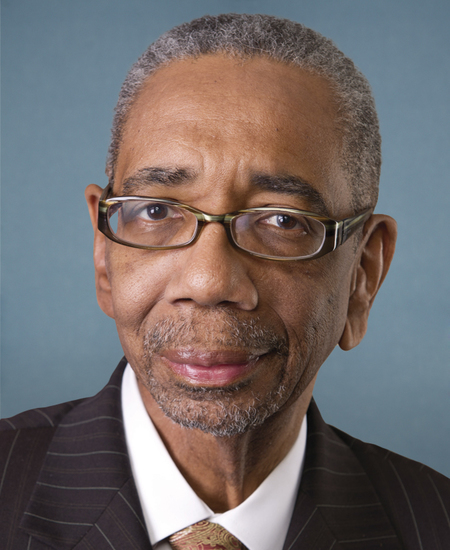
Rep. Bobby L. Rush
Sponsored bills
Eric Garner Excessive Use of Force Prevention Act of 2021 This bill modifies the criminal civil rights statute that prohibits the deprivation of rights under color of law. Currently, the second prong of the prohibition bars the application of different punishments, pains, or penalties based on an individual's alien status, color, or race. This bill specifies that the application of any pressure to a person's throat or windpipe, the use of maneuvers that restrict blood or oxygen flow to the brain, or carotid artery restraints that prevent or hinder breathing or reduce intake of air (e.g., a chokehold) constitute a punishment, pain, or penalty.
Mainstreaming Addiction Treatment Act of 2021 This bill removes the requirement that a health care practitioner apply for a separate waiver through the Drug Enforcement Administration (DEA) to dispense certain narcotic drugs (e.g., buprenorphine) for maintenance or detoxification treatment (i.e., substance use disorder treatment). Further, a community health aide or community health practitioner may dispense certain narcotic drugs for maintenance or detoxification treatment without registering with the DEA if the drug is prescribed by a health care practitioner through telemedicine. It preempts state laws related to licensure for this activity. The bill also directs the Substance Abuse and Mental Health Services Administration to conduct a national campaign to educate health care practitioners and encourage them to integrate substance use disorder treatment into their practices.
Juror Non-Discrimination Act of 2021 This bill prohibits the exclusion of individuals from jury service on the basis of their sexual orientation or gender identity.
U.S. Citizenship Act This bill establishes a path to citizenship for certain undocumented individuals. The bill also replaces the term alien with noncitizen in the immigration statutes and addresses other related issues. Specifically, the bill establishes a new status of lawful prospective immigrant . This status shall be available to an applying noncitizen who meets certain requirements, including being continually present in the United States from January 1, 2021, and passing background checks. After at least five years with this status, an eligible noncitizen may apply for and receive permanent resident status. The bill also provides permanent resident status to certain applying noncitizens, specifically for eligible noncitizens who (1) entered the United States as a minor, (2) were eligible for temporary protected status or deferred enforced departure on January 1, 2017, or (3) worked a certain amount of agricultural labor in the five years prior to applying. Among other things, the bill also redefines for immigration purposes the term conviction to exclude convictions that have been expunged or vacated, requires the Department of State to implement a strategy to advance reforms in Central America and address key factors contributing to migration from the region to the United States, requires the State Department to establish refugee processing centers in Central America, requires Customs and Border Patrol sectors and stations to have a certain number of employees with certain qualifications such as paramedic training, generally prohibits religious discrimination in granting or denying immigration benefits, and establishes grant programs for providing training and services to immigrants.
New Opportunities to Expand Healthy Air Using Sustainable Transportation Act of 2021 or the NO EXHAUST Act of 2021 This bill establishes incentives and related requirements to encourage the manufacture and use of electric, fuel-efficient, or zero-emission vehicles. For example, the bill directs the Department of Energy to establish a program to provide rebates for expenses associated with publicly accessible electric vehicle supply equipment (e.g., power outlets). In addition, the bill reauthorizes existing grant programs and creates new grant programs, such as grants for the deployment of electric vehicle charging infrastructure in underserved or disadvantaged communities. It also revises a loan program that provides incentives to manufacture advanced vehicles, including by allowing loans to be awarded through FY2031. Finally, the bill establishes minimum conservation requirements for federal fleets of vehicles.
Elijah E. Cummings Lower Drug Costs Now Act This bill establishes several programs and requirements relating to the prices of prescription drugs. In particular, the bill requires the Department of Health and Human Services (HHS) to negotiate prices for certain drugs (current law prohibits HHS from doing so). Specifically, HHS must negotiate maximum prices for single-source, brand-name drugs that lack certain generics and that are among either the 125 drugs that account for the greatest national spending or the 125 drugs that account for the greatest Medicare spending. HHS must negotiate the prices of at least 25 such drugs for 2024 and of at least 50 such drugs thereafter and must also negotiate prices for certain newly approved drugs and for insulin products. The negotiated prices must be offered under Medicare and may also be offered under private health insurance unless the insurer opts out. The negotiated maximum price may not exceed (1) 120% of the average price in Australia, Canada, France, Germany, Japan, and the United Kingdom; or (2) if such information is not available, 85% of the U.S. average manufacturer price. Drug manufacturers that fail to comply with the bill's negotiation requirements are subject to civil and tax penalties. The bill also makes a series of additional changes to Medicare prescription drug coverage and pricing, including by (1) requiring drug manufacturers to issue rebates to the Centers for Medicare & Medicaid Services for covered drugs that cost $100 or more and for which the average manufacturer price increases faster than inflation, and (2) capping annual out-of-pocket spending under the Medicare prescription drug benefit. The bill also requires drug manufacturers to report specified information for certain high-cost drugs, and it provides funds for opioid epidemic initiatives and biomedical research.
PFC Joseph P. Dwyer Peer Support Program Act This bill requires the Department of Veterans Affairs (VA) to establish the PFC Joseph P. Dwyer Peer Support Program to make grants to eligible entities for peer-to-peer mental health programs for veterans. Eligible entities include (1) a nonprofit organization that has historically served the mental health needs of veterans; (2) a congressionally chartered veteran service organization; or (3) a state, local, or tribal veteran service agency, director, or commissioner. The VA shall establish an advisory committee to create appropriate program standards.
This resolution condemns the bigotry that fueled those who stormed the U.S. Capitol, the elected officials who stoked that bigotry, including former President Trump, and the Members of Congress who have continued to support those individuals. It reaffirms that harmful rhetoric and violent behavior against individuals based on factors including religion, race, immigration status, and sex will not be tolerated.
Agriculture Resilience Act This bill establishes, expands, and revises multiple programs and activities of the Department of Agriculture (USDA) primarily to reduce carbon emissions from the agriculture sector. Specifically, USDA must finalize and implement a plan to achieve net-zero emissions from the sector by 2040. USDA must periodically review and revise the plan, as necessary, and annually report on its implementation. Additionally, the bill expands the scope of various USDA research, extension, and education programs; conservation programs; and livestock programs to incorporate climate change adaption and mitigation. Expanded activities include efforts to improve soil health and preserve farmland and grassland. Further, the bill changes programs that support renewable energy in rural areas to address carbon emissions in the agriculture sector. Among these changes, the bill provides statutory authority for a program for reducing methane emissions from livestock waste that is carried out by the Environmental Protection Agency and transitions the program to USDA. The bill also addresses food waste, for example, by (1) standardizing the voluntary labels used by food producers to indicate the date by which food should be used or discarded, and (2) making composting activities eligible for support through USDA conservation programs. Moreover, the bill establishes grants to reduce and prevent food waste in landfills and in schools.