

Urban Agriculture and Community Food Security Act This bill addresses Department of Agriculture programs relating to urban agricultural production. Specifically, the bill establishes and provides funding for an urban agriculture conservation easement program for the conservation of certain private land, improved community food security, and improved access to cropland for beginning farmers or ranchers, socially disadvantaged farmers or ranchers; and majority-controlled producer-based business ventures through easements or other interests in land; establishes and provides funding for an urban agriculture microentrepreneur assistance program to provide loans and grants to support microentrepreneurs in the development and ongoing success of urban agriculture microenterprises; and authorizes additional funding for a program that provides grants for nonprofit entities to establish and carry out community food projects.
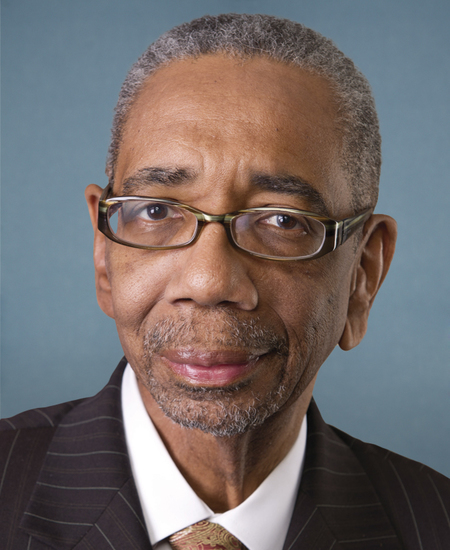
Rep. Bobby L. Rush
Sponsored bills
Improving Access to Home Dialysis Act of 2021 This bill provides for Medicare coverage of staff-assisted home dialysis services for certain individuals with end-stage renal disease (ESRD). Specifically, the bill provides for coverage of services for ESRD individuals who are either initiating peritoneal or home hemodialysis or receiving home dialysis and are unable to self-dialyze due to illness, injury, caregiver issues, or other temporary circumstances. The Centers for Medicare & Medicaid Services must develop a payment system for such services. The bill also requires the development of a patient-centered decision tool that includes home dialysis as an option, as well as a report on racial disparities with respect to the use of staff-assisted home dialysis services.
This bill requires the Department of Defense (DOD) to conduct outreach to build awareness among former members of the Armed Forces of the process established for the review of discharge characterizations related to sexual orientation (i.e., on the basis of Don't Ask, Don't Tell or a similar policy). DOD must also provide for specified relief for former members of the Armed Forces who were impacted by the discharge characterizations and ensure that DOD oral historians review related facts and receive testimony from affected individuals.
Veteran Families Health Services Act of 2021 This bill addresses fertility treatments, counseling, and other health-related programs for veterans and members of the Armed Forces. Specifically, the bill requires the Department of Defense (DOD) and the Department of Veterans Affairs (VA) to provide fertility treatments and counseling to covered veterans and active duty service members or a spouse, partner, or gestational surrogate of such veteran or service member. A covered veteran or service member is a former or current member of the Armed Forces who has an infertility condition, unless it is demonstrable that the individual was completely infertile prior to serving in the Armed Forces. In the case of in vitro fertilization treatment, DOD and the VA may not furnish more than three completed cycles or six attempted cycles, whichever occurs first. DOD must establish procedures related to gamete retrieval and storage. Additionally, DOD must provide service members with the opportunity to cryopreserve and store their gametes prior to deployment to a combat zone or a hazardous duty assignment. DOD and the VA must share best practices and facilitate referrals for the furnishing of fertility treatment and counseling to eligible individuals. Fertility counseling and treatment are included within authorized VA medical services. The VA may pay the adoption expenses (for up to three adoptions) for a covered member who is enrolled in the VA health care system. The VA must facilitate specified reproduction and infertility research conducted collaboratively by DOD and the Department of Health and Human Services.
This resolution condemns and denounces the actions of the Customs and Border Patrol agents who confronted Haitian migrants on horseback using their reins as lashes.
Two-State Solution Act This bill addresses U.S. policy and related activities to preserve conditions for a two-state solution to resolve territorial disputes between Israel and Palestine. The bill prohibits the United States from providing support for projects in geographic regions that came under Israeli control after June 5, 1967. It also prohibits the use of any U.S. security assistance, defense articles, or defense services provided to Israel for efforts to annex or exercise permanent control over any part of the West Bank or Gaza. Current law designates the Palestine Liberation Organization (PLO) as a terrorist organization and restricts its activities (e.g., prohibiting it from maintaining an office in the United States). The President may waive for up to six months some of these restrictions to serve U.S. national security or diplomatic interests. If the President certifies that the PLO has ceased supporting terrorist actions and met other conditions, the bill automatically terminates the terrorist organization designation. Goods produced in the West Bank or Gaza that are imported into the United States must indicate those areas as the country of origin on their labels. The bill expands the scope of certain foreign and development assistance to foster initiatives, including shared educational opportunities and youth activities, that connect Israelis and Palestinians. Additionally, the Department of State and the U.S. Agency for International Development may jointly award grants to private, nonprofit organizations to promote human rights and democracy, strengthen civil society, and otherwise address the needs of the Palestinian people.
Patient Access to ESRD New Innovative Devices Act This bill requires the Centers for Medicare & Medicaid Services (CMS) to provide a certain payment adjustment under the Medicare end-stage renal disease (ESRD) prospective payment system. Specifically, the CMS must provide for a three-year temporary add-on payment adjustment for new medical devices used to diagnose, treat, or manage ESRD. (CMS regulations currently provide a two-year temporary add-on payment adjustment.)
This resolution supports the designation of National Clean Energy Week.
Keeping Renters Safe Act of 2021 This bill expressly authorizes the Department of Health and Human Services (HHS) to place a moratorium on residential evictions to prevent the spread of communicable diseases. The bill also requires HHS to implement a moratorium nationwide to reduce the spread of COVID-19. This moratorium must remain in effect for at least 60 days following the termination of the COVID-19 public health emergency. Current law authorizes HHS to take measures to prevent the spread of communicable diseases. As part of the COVID-19 response, HHS delegated this authority to the Centers for Disease Control and Prevention (CDC), which then issued (and extended) several orders banning residential evictions. Whether these orders exceed the CDC's statutory and constitutional authority has been the subject of multiple legal challenges; the Supreme Court blocked enforcement of the most recent order on August 26, 2021.
This resolution supports the goals and ideals of National HIV/AIDS and Aging Awareness Day.