

Overdraft Protection Act of 2021 This bill prohibits a financial institution from engaging in unfair or deceptive acts in connection with overdraft coverage. Each financial institution that offers overdraft coverage for accounts must disclose overdraft coverage fees. It must also disclose that the consumer's transaction may be declined if there are insufficient funds in the related account, and the consumer will not be charged a fee if such transaction is declined. A financial institution must provide certain other disclosures regarding its overdraft protection program, including prompt notification of the account's overdraft status. The bill limits the number of overdraft fees a consumer may be charged each month and year, and provides that such fees must be reasonable. The bill prohibits an overdraft coverage fee if the overdraft results solely from a debit hold amount that exceeds the actual dollar amount of the transaction. The bill also prohibits a financial institution from charging a non-sufficient fund fee for any automated teller machine or debit card transaction, or reporting negative information regarding consumer use of overdraft coverage to any consumer reporting agency when the overdraft amounts and coverage fees are paid under the terms of an overdraft coverage program.
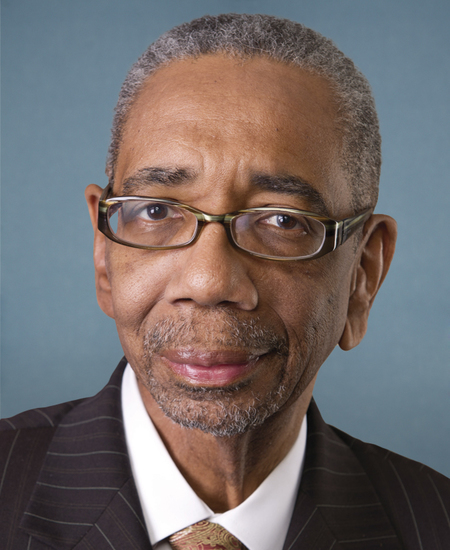
Rep. Bobby L. Rush
Sponsored bills
American Families United Act This bill authorizes the Department of Homeland Security (DHS) or the Department of Justice (DOJ) to exercise discretion in certain immigration cases. The bill also removes certain requirements related to birthright citizenship. Under this bill, DOJ or DHS may, on a case-by-case basis, exercise discretion by declining to remove an alien or bar an alien from entering the United States to prevent hardship for the alien's U.S. citizen spouse, parent, or child. However, DOJ or DHS may not exercise this discretion if the alien is removable or inadmissible due to certain grounds, including specified crime- and security-related grounds. The bill also removes certain requirements related to birthright citizenship for a child born outside of the United States to one U.S. citizen parent and one alien parent. Specifically, the bill removes a provision that requires the U.S. citizen parent to be physically present in the United States for at least five years before the child's birth in order for the child to acquire U.S. citizenship at birth.
This resolution condemns the mass shooting that occurred on July 4, 2022, in Highland Park, Illinois, as horrific and heinous. The resolution also honors the memory and the lives of the seven innocent victims who were murdered.
Evaluating Lynching Locations (ELL) for National Park Sites Act This bill directs the Department of the Interior to conduct a special resource study of sites within approximately 100 miles of Memphis, Tennessee, at which lynchings took place. In conducting the special resource study, Interior shall (1) evaluate the national significance of such study area, and (2) determine the suitability and feasibility of designating the study area as a unit of the National Park System.
Active Shooter Alert Act of 2022 This bill requires a designated officer of the Department of Justice to act as the national coordinator of an Active Shooter Alert Communications Network regarding an emergency involving an active shooter. The bill sets forth duties of the coordinator, including to work with state, tribal, and local governments to encourage coordination of various elements of the network. The coordinator must also encourage federal, state, local, and tribal government agencies to establish procedures for responding to active shooters. Finally, the bill requires the Government Accountability Office to study and report on state and local responses to active shooters and situations requiring the issuance of a public alert or warning.
Public Health Air Quality Act of 2022 This bill requires the Environmental Protection Agency to take specified actions related to monitoring and improving air quality, including by implementing a program to administer or conduct emissions measurement and quantification, promulgating regulations related to specified source categories, and deploying not fewer than 1,000 air quality sensors.
This resolution expresses support for the designation of Journeyman Lineworkers Recognition Day. (A journeyman lineworker is a person who builds and maintains electrical power systems.)
Break Free From Plastic Pollution Act of 2021 This bill sets forth requirements and incentives to reduce the production of a variety of products and materials, including plastics, and increase efforts to collect, recycle, or compost products and materials. The bill makes certain producers of products (e.g., packaging, paper, single-use products, beverage containers, or food service products) fiscally responsible for collecting, managing, and recycling or composting the products after consumer use. In addition, the bill establishes (1) minimum percentages of products that must be reused, recycled, or composted; and (2) an increasing percentage of recycled content that must be contained in beverage containers. Beginning on January 1, 2023, the bill phases out a variety of single-use products, such as plastic utensils. The bill also sets forth provisions to encourage the reduction of single-use products, including by establishing programs to refund consumers for returning beverage containers and by establishing a tax on carryout bags. The bill creates a temporary moratorium on new or expanded permits for certain facilities that manufacture plastics until regulations are updated to address pollution from the facilities. The Environmental Protection Agency (EPA) must publish guidelines for a national standardized labeling system for recycling and composting receptacles. Producers must include labels on their products that are easy to read and indicate whether the products are recyclable, compostable, or reusable. The EPA must also ensure that certain clothes washers have filtration units as required by this bill. Finally, the bill establishes limitations on the export of plastic waste to other countries.
Climate Leadership and Environmental Action for our Nation’s Future Act or the CLEAN Future Act This bill creates requirements and incentives to reduce emissions of greenhouse gases. The bill establishes an interim goal to reduce greenhouse gas emissions to at least 50% below 2005 levels by 2030 as well as a national goal to achieve net-zero greenhouse gas emissions by 2050. Each federal agency must develop a plan to achieve the goals. Beginning in 2023, retail electricity suppliers must provide an increasing percentage of electricity that is generated without the release of greenhouse gases into the atmosphere (zero-emission electricity). By 2035, the suppliers must provide 100% zero-emission electricity or demonstrate alternative means of compliance. For example, the suppliers may buy credits under a trading program that allows entities to buy, sell, and trade credits to demonstrate compliance. The bill also establishes a variety of requirements, programs, and incentives to reduce or eliminate greenhouse gas emissions by modernizing the electric grid and supporting clean energy microgrids; increasing the use of renewable energy and advanced nuclear power technologies; increasing energy efficiency in buildings, homes, and appliances; supporting clean transportation, including electric vehicles and related charging infrastructure; issuing greenhouse gas standards for certain vehicles, engines, and aircraft; promoting manufacturing and industrial decarbonization, including through buy-clean programs; supporting environmental justice efforts; and reducing methane, plastics, and super pollutants.
Expedited Hiring for VA Trained Psychiatrists Act of 2022 This bill authorizes the Department of Veterans Affairs to appoint a psychiatrist who completes a residency at a Veterans Health Administration (VHA) facility to a VHA health care position immediately after such residency, without regard to civil service or classification laws, if (1) the psychiatrist meets the qualifications established in regulations prescribed for the position, and (2) the position has been unfilled for at least 35 days.