

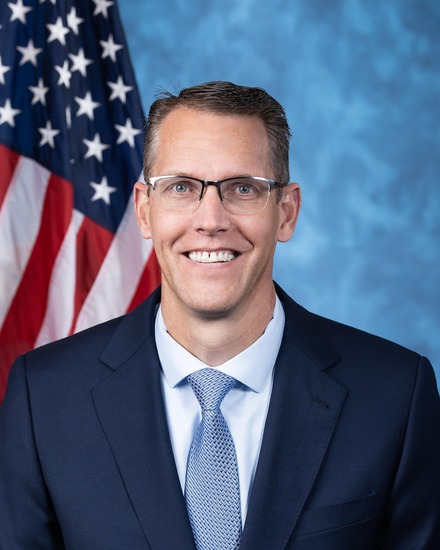
Photo of Randy Feenstra
R United States House · District 4 · Iowa

Rep. Randy Feenstra

Compare
Total votes
2,837
all sessions
Attendance
99%
18 missed
Near the chamber average
With party
97%
of cast votes
Near the chamber average
Bipartisan score
2%
crosses aisle rarely
Near the chamber average
Sponsored
926
bills & resolutions
Near the chamber average
Committees
7
assignments
926 bills and resolutions

Sponsored bills

Total
926
Primary
101
Co-sponsor
825
This page
926
matching current filters
Co-sponsor HR 4564
In committee · United States House · Co-sponsor
Countering Hate Against Israel by Federal Contractors Act

Maddy summaryThis bill prohibits U.S. federal agencies from entering new contracts with companies that boycott Israel after January 1, 2024. Companies must certify they are not boycotting Israel at contract signing, and contracts must include this prohibition. It applies to federal contracts over $100,000 for services or IT with companies employing more than 10 people. If a company violates the boycott prohibition, the agency must terminate the contract after 30 days unless the company ends the boycott. The bill explicitly states it does not infringe on First Amendment rights or take sides on the Israeli-Palestinian conflict.

In committee Jul 11, 2023 1 co-sponsor
Primary HR 4407
In committee · United States House · Lead sponsor
Voluntarily Offered Tools for Election Reforms by States Act

Maddy summaryHR 4407, the VOTERS Act, creates voluntary best practices for election administration that states may choose to adopt. It requires the Election Assistance Commission's Standards Board to compile and release non-binding guidelines by December 2024 on key election processes like mail ballot handling, signature verification, voter list maintenance, poll worker recruitment during emergencies, and post-election audits. States are not required to follow these guidelines, and using federal election funds to implement them is optional. The bill ensures these voluntary recommendations cannot be used to deny federal funding or affect voting rights law compliance.

In committee Jun 30, 2023 0 co-sponsors
Co-sponsor HR 4417
In committee · United States House · Co-sponsor
Ending Agricultural Trade Suppression Act

Maddy summaryHR 4417, the "Ending Agricultural Trade Suppression Act," prevents state and local governments from imposing additional production standards on agricultural products sold across state lines if those standards aren't already required by federal law or the state where the product is grown. It directly affects agricultural producers, distributors, and businesses operating in interstate commerce by allowing them to sue states in federal court to challenge such regulations. The bill creates a private right of action for affected parties to seek court invalidation of the regulations and damages for economic losses, with provisions for preliminary injunctions to halt enforcement during litigation. This aims to reduce regulatory barriers that could hinder the movement of agricultural goods between states.

In committee Jun 30, 2023 1 co-sponsor
Co-sponsor HR 4355
In committee · United States House · Co-sponsor
Rural Veterinary Workforce Act

Maddy summaryHR 4355, the Rural Veterinary Workforce Act, modifies the Internal Revenue Code to exclude certain loan repayment or forgiveness assistance from taxable income. It specifically adds programs under the National Agricultural Research, Extension, and Teaching Policy Act of 1977 and similar state initiatives - designed to boost veterinary services in rural areas - to the list of tax-exempt benefits. This directly affects veterinary students participating in these state or federal programs who work in underserved rural communities. The change takes effect for assistance received in taxable years beginning after December 31, 2023.

In committee Jun 23, 2023 1 co-sponsor
Co-sponsor HR 3419
In committee · United States House · Co-sponsor
Foreign Animal Disease Prevention, Surveillance, and Rapid Response Act of 2023

Maddy summaryHR 3419 reauthorizes and increases mandatory funding for U.S. animal disease prevention programs through fiscal year 2028. It allocates $233 million annually from the Commodity Credit Corporation for three key areas: $10 million for disease prevention, $70 million for surveillance, and $153 million for rapid response. The bill also raises annual funding for the National Animal Health Laboratory from $30 million to $45 million. These provisions directly affect USDA programs that protect livestock and agricultural industries from foreign animal disease outbreaks. The funding increases extend existing programs through 2028, with reduced annual amounts starting in 2029.

In committee Jun 23, 2023 1 co-sponsor
Co-sponsor HR 3425
In committee · United States House · Co-sponsor
Community College Agriculture Advancement Act of 2023

Maddy summaryHR 3425 creates federal grants to community colleges and college consortia with agriculture programs, helping them expand workforce training, education, and research in farming and related fields. The bill prioritizes colleges partnering with local farms for hands-on student training and allows grant funds to cover equipment, faculty development, and apprenticeships. It authorizes $20 million annually from 2024-2029 for these programs and requires a 3-year evaluation report to Congress. The law directly affects community colleges offering agriculture-focused education, aiming to strengthen their capacity to serve students and the agricultural industry.

In committee Jun 23, 2023 1 co-sponsor
Co-sponsor HJRES 44
Failed · United States House · Co-sponsor
Providing for congressional disapproval under chapter 8 of title 5, United States Code, of the rule submitted by the Bureau of Alcohol, Tobacco, Firearms, and Explosives relating to "Factoring Criteria for Firearms with Attached 'Stabilizing Braces'".

Maddy summaryHJRES 44 is a congressional resolution seeking to block a 2021 rule by the Bureau of Alcohol, Tobacco, Firearms, and Explosives (ATF). The rule classified firearms with stabilizing braces as "short-barreled rifles," which would have required additional licensing and regulation. This resolution uses a specific legal process (under Title 5, U.S. Code) to formally disapprove the ATF rule, meaning the rule would no longer be in effect. It directly affects firearm owners, manufacturers, and dealers who would have been subject to the rule’s requirements.

Failed Jun 22, 2023 1 co-sponsor
Co-sponsor HR 277
Passed · United States House · Co-sponsor
Regulations from the Executive in Need of Scrutiny Act of 2023

Maddy summaryHR 277 would require Congress to approve major federal regulations before they take effect. Major rules are defined as those with significant economic impact ($100 million+ annually), major cost increases for consumers or industries, or significant adverse effects on competition, employment, or innovation. Agencies must submit detailed information about these rules to Congress, including cost-benefit analyses, before they can take effect. Congress would have 70 session days to approve the rule with a joint resolution; if they don't act within that timeframe, the rule would not take effect. This would increase congressional oversight of federal regulations and require more detailed information about proposed rules before they become law.

Passed Jun 21, 2023 1 co-sponsor
Co-sponsor HR 4029
In committee · United States House · Co-sponsor
Supply Chain Security Act

Supply Chain Security Act This bill allows a taxpayer to make an election, without regard to specified Treasury regulations, for purposes of determining whether any Western Hemisphere tax is an income, war profits, or excess profits tax. A Western Hemisphere tax is any tax paid to any U.S. possession or any foreign country (other than Cuba or Venezuela) that is located in North, Central, or South America (including the West Indies).

In committee Jun 12, 2023 1 co-sponsor
Showing 481 to 490 of 926 bills
Previous 1 … 48 49 50 … 93 Next