

Maddy summaryHR 6600, "Tyler’s Law," requires the Secretary of Health and Human Services to study how often hospital emergency departments test for fentanyl during overdose cases, along with the costs, benefits, risks, and patient privacy impacts. The study must be completed within one year of the bill’s enactment, followed by guidance issued within six months on whether fentanyl testing should become routine. This guidance will address how hospitals can inform clinicians about testing protocols and how fentanyl testing might affect future overdose risks and patient health outcomes. The bill directly affects hospitals and emergency departments treating overdose patients, focusing on improving data-driven practices for fentanyl detection.
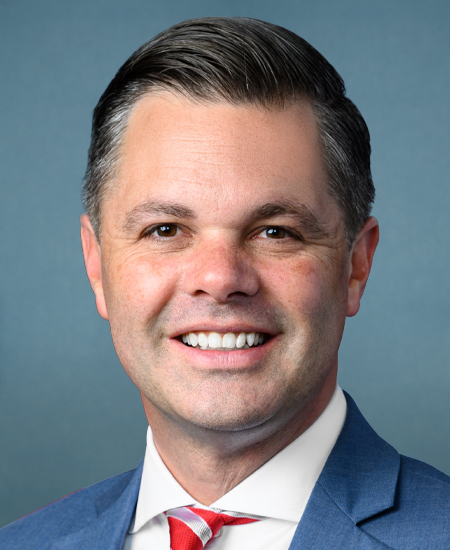
Rep. Zachary Nunn
Sponsored bills
Maddy summaryHR 6573, the Protecting Military Servicemembers' Data Act of 2023, prohibits data brokers from selling, reselling, or sharing military servicemember lists to "covered nations" (as defined in federal law). It directly affects military members by preventing their personal information - contained in specialized lists created for compiling military service details - from being sold to specific foreign governments. The key mechanism bans the commercial transfer of these lists, with enforcement handled by the Federal Trade Commission and state attorneys general. The law takes effect within one year of enactment or when the FTC issues final rules, whichever comes first. This is a concrete policy change targeting data brokers' practices, not a procedural measure.
Maddy summaryThe PLAN for School Safety Act of 2023 creates a federal program to fund State and regional centers that help schools develop and improve individualized safety plans. These centers, established by eligible entities like state education agencies or Tribal organizations, provide tailored consulting on school safety, mental health, and violence prevention using research-backed methods. The program requires centers to cover 5% of activity costs and prioritizes support for schools in rural, Tribal, or low-resourced communities. Annual reports to Congress will track implementation progress, effectiveness, and how centers assist schools in accessing funding for safety initiatives.
Maddy summaryHR 6605 (STIFLE Act of 2023) requires the Treasury Department to study how criminals exploit location-obfuscation tools like VPNs and manipulated GPS data to evade U.S. financial sanctions and anti-money laundering laws. The bill mandates a report within one year assessing the risks of inaccurate location tracking via IP addresses, the ease of evasion, and potential solutions using aggregated location data. This study targets financial technology platforms that currently rely on IP addresses as their primary method for verifying user locations to comply with sanctions and banking regulations. The bill itself does not change existing laws but sets the stage for future policy decisions based on the Treasury's findings.
Maddy summaryHR 6579, the Congressional Pension Accountability Act, changes pension rules for members of Congress expelled from office. If a member is expelled, their congressional service is no longer counted toward their pension eligibility or amount under either the Civil Service Retirement System or the Federal Employees Retirement System. The bill requires a refund of the member’s own contributions (minus prior annuity payments) but does not require repayment of pensions already received before expulsion. Additionally, any government contributions to the member’s Thrift Savings Plan during their congressional service would be forfeited. These changes apply only to expulsions occurring after the bill’s enactment date.
Maddy summaryThe Flex Fuel Fairness Act of 2023 requires the Environmental Protection Agency (EPA) to adjust emissions calculations for flexible fuel vehicles (FFVs) that run on E85 (a fuel blend containing 85% ethanol). It mandates that the EPA use a 31% lower CO2 emissions value for FFVs compared to standard gasoline vehicles, based on a study showing E85 reduces emissions by 31% per mile. This change directly helps vehicle manufacturers meet federal fleet emissions standards by making it easier to count FFVs as lower-emission vehicles. The EPA may further adjust this percentage higher if future studies support a larger reduction.
Maddy summaryThis bill requires U.S. Customs and Border Protection (CBP) to obtain fingerprints from noncitizen children under 14 years old if officers suspect they are trafficking victims upon entering the U.S. It also creates a new federal crime for adults (18+) who knowingly use a minor for entry without being a relative or guardian, punishable by fines or up to 10 years in prison. The bill mandates sharing fingerprints collected under this provision with the Department of Health and Human Services for unaccompanied minors and requires CBP to report monthly data on trafficking-related apprehensions and annual data on fingerprinting to Congress. These provisions directly affect CBP officers, unaccompanied children, and individuals suspected of exploiting minors for entry.
Maddy summaryThis bill directs the Department of Labor to commission the National Academies to study how to measure automation's impact on jobs, including job creation, displacement, and shifting skills needs. It also requires establishing an advisory board with diverse stakeholders (labor, industry, academia) to recommend data sources and strategies for addressing automation's workforce effects. The study must be completed within 2 years, followed by a Bureau of Labor Statistics implementation plan within 1 year. The bill aims to improve data collection and policy responses to automation, focusing on worker demographics and economic consequences.
Maddy summaryThe Southern Border Transparency Act of 2023 (HR 6523) requires U.S. Customs and Border Protection (CBP), the Department of Homeland Security (DHS), and U.S. Citizenship and Immigration Services (USCIS) to publish specific immigration data online. It mandates monthly reports on parole grants at ports of entry (including numbers by nationality and family status), quarterly reports on processing outcomes for aliens encountered at the southern border (disaggregated by nationality, demographics, and processing paths), and annual reports on parolees (including employment status and status changes). These reports must be posted on agency websites and submitted to relevant congressional committees. The bill directly affects federal agencies responsible for border processing and aims to increase public and congressional transparency about immigration enforcement practices at the southern border.
Maddy summaryThe Sustainable Budget Act of 2022 establishes a 18-member National Commission on Fiscal Responsibility and Reform to develop recommendations for improving federal fiscal policy. The Commission, with balanced political representation (including members appointed by congressional leaders and the President), must identify policies to balance the budget within 10 years and address long-term challenges like entitlement spending. After submitting a final report within one year, the President must propose implementing legislation within 60 days. Congress would then consider this legislation through an expedited process without amendments. The bill creates a structured, bipartisan process for addressing federal budget challenges through commission recommendations.