

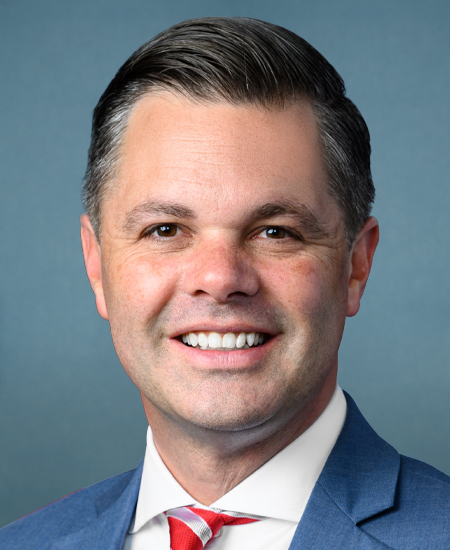
Photo of Zachary Nunn
R United States House · District 3 · Iowa On the 2026 ballot

Rep. Zachary Nunn

Compare
Total votes
1,879
all sessions
Attendance
96%
66 missed
Lower than 79% of chamber peers
With party
90%
of cast votes
Near the chamber average
Bipartisan score
5%
crosses aisle rarely
Near the chamber average
Sponsored
998
bills & resolutions
Higher than 80% of chamber peers
Committees
7
assignments
998 bills and resolutions

Sponsored bills

Total
998
Primary
115
Co-sponsor
883
This page
998
matching current filters
Co-sponsor HRES 1447
In committee · United States House · Co-sponsor
Expressing support for the designation of the week of September 22 through September 28, 2024, as "Gold Star Families Remembrance Week".

Maddy summaryHRES 1447 is a non-binding resolution expressing support for designating the week of September 22-28, 2024, as "Gold Star Families Remembrance Week." It directly honors families who lost loved ones while serving in the U.S. military (referred to as "Gold Star Families") and families of veterans. The resolution encourages Americans to observe the week by performing community service and celebrating the sacrifices of fallen service members, without creating new laws or obligations. It aligns with existing recognition of Gold Star Mother’s Day (the last Sunday in September) but expands the focus to all affected families.

In committee Sep 12, 2024 1 co-sponsor
Co-sponsor HR 9576
In committee · United States House · Co-sponsor
Pathways to Policing Act

Maddy summaryThis bill creates a federal grant program to help law enforcement agencies recruit officers from underrepresented communities. It authorizes $50 million annually (2025-2029) for states and local agencies to fund recruitment campaigns and "Pathways to Policing" programs. These programs provide financial support during training for candidates facing education barriers, with no prior law enforcement experience, who are members of underrepresented groups or have nontraditional backgrounds. Grants prioritize agencies targeting underrepresented communities and officers who will serve or live near the communities they protect.

In committee Sep 12, 2024 1 co-sponsor
Co-sponsor HR 9577
In committee · United States House · Co-sponsor
STOP Suicide Act

Maddy summaryHR 9577, the STOP Suicide Act, provides $30 million annually (2025-2029) to fund grants for community health centers, schools, crisis centers, and tribal organizations to implement immediate suicide crisis intervention services. The grants support evidence-based outpatient, virtual, or peer-led care in the least restrictive setting to stabilize individuals experiencing acute suicidal thoughts. Grant recipients must include a plan for sustaining services after the 5-year grant period ends, and the program requires annual evaluations of the funded models. This bill directly affects health providers serving at-risk individuals by creating new funding for crisis stabilization services.

In committee Sep 12, 2024 1 co-sponsor
Co-sponsor HR 9403
In committee · United States House · Co-sponsor
Expanding AI Voices Act

Maddy summaryThe Expanding AI Voices Act directs the National Science Foundation to provide competitive grants to institutions not among the top 100 in federal research spending, Historically Black Colleges and Universities, minority-serving institutions, Tribal Colleges, or consortia of these entities. These grants fund concrete AI capacity-building activities like developing research programs, recruiting AI faculty, creating student bridge programs, and providing access to computing resources and partnerships. The program specifically aims to broaden participation in AI from underserved communities and avoid duplicating existing federal initiatives. It requires outreach to underrepresented groups and mandates that funded activities integrate ethical AI practices and workforce development.

In committee Sep 11, 2024 1 co-sponsor
Co-sponsor HR 9188
In committee · United States House · Co-sponsor
Gold Star and Surviving Spouse Career Services Act

Maddy summaryThis bill amends the Disabled Veterans' Outreach Program to expand eligibility for career services to include Gold Star spouses (spouses of service members who died while on active duty) and surviving spouses (spouses of veterans who died from service-connected causes). It updates existing program language to replace references to "veterans" with "veterans or eligible persons" and adds a new definition clarifying that "eligible person" includes these spouses. The change directly affects spouses who lost their partners in military service, allowing them to access the same career counseling and job placement services previously available only to veterans. The bill modifies existing program provisions without creating new services or funding.

In committee Sep 11, 2024 1 co-sponsor
Co-sponsor HR 9146
In committee · United States House · Co-sponsor
Ensuring Continuity in Veterans Health Act

Maddy summaryThe context provided for HR 9146 does not include the full text of the amendment or the specific language added to Section 1703(d)(2) of title 38, U.S. Code. Without the actual provisions of the new subparagraph (F) titled "Continuity of care," it is impossible to describe the bill's key mechanisms, who it affects, or its concrete policy changes. The bill's title suggests it relates to veterans' health care continuity under the Veterans Community Care Program, but the details are omitted in the provided excerpt. Therefore, a complete and accurate summary cannot be generated from the available information.

In committee Sep 11, 2024 1 co-sponsor
Co-sponsor HR 5077
In committee · United States House · Co-sponsor
CREATE AI Act of 2023

Maddy summaryThe CREATE AI Act of 2023 establishes a National Artificial Intelligence Research Resource (NAIRR) to improve access to AI research tools, computational resources, data, and educational materials for researchers and students across the United States. The NAIRR will provide computational resources, curated datasets, educational tools, and access to AI testbeds, with special emphasis on supporting groups historically underrepresented in STEM fields. Governed by a Steering Subcommittee chaired by the Director of the Office of Science and Technology Policy and managed by a Program Management Office within the National Science Foundation, the NAIRR includes specific requirements for ethical AI development, privacy protections, and security measures. The resource will be accessible to researchers at U.S. institutions of higher education, nonprofits, government agencies, and certain businesses, with priority given to projects addressing privacy, ethics, civil rights, and AI safety.

In committee Sep 11, 2024 1 co-sponsor
Co-sponsor HR 9523
In committee · United States House · Co-sponsor
Renewed Hope Act of 2024

Maddy summaryHR 9523, the Renewed Hope Act of 2024, directs the Department of Homeland Security to hire 200 additional personnel (including 40 forensics analysts and 30 child exploitation investigators for the Victim Identification Laboratory, plus 130 more staff) to support identifying and rescuing victims of child sexual exploitation. It also authorizes temporary hiring of experts for image/audio forensic analysis at specified rates and requires DHS to establish joint procedures for coordinating child exploitation investigations across agencies. The bill mandates a new Victim Identification Training Program at the Cyber Crimes Center, providing annual training on advanced victim identification technology to DHS personnel and external law enforcement agencies (federal, state, local, tribal, military, and foreign) upon request. These provisions directly affect DHS investigative units and law enforcement agencies actively working on child exploitation cases nationwide.

In committee Sep 10, 2024 1 co-sponsor
Co-sponsor HR 4741
Passed · United States House · Co-sponsor
Securing Global Telecommunications Act

Maddy summaryHR 4741, the Securing Global Telecommunications Act, requires the U.S. State Department to develop a strategy within 90 days to promote secure telecommunications infrastructure globally, focusing on countering security risks from untrusted vendors like Huawei. The strategy must address mobile networks, data centers, 6G technology, and satellite systems, emphasizing collaboration with allies and developing nations to encourage the use of "trusted" equipment providers. It also mandates reports on Chinese and Russian influence at the International Telecommunication Union (ITU) and opportunities for multilateral financing to support secure telecom projects. The bill directly affects U.S. government agencies (State Department, FCC, development finance entities) and foreign countries selecting telecom infrastructure providers. It does not impose direct restrictions but outlines U.S. policy actions to strengthen global telecom security and market leadership for allied vendors.

Passed Sep 10, 2024 1 co-sponsor
Co-sponsor HR 9479
In committee · United States House · Co-sponsor
To amend the Internal Revenue Code of 1986 to establish a refundable credit for expenses incurred for in vitro fertilization.

Maddy summaryHR 9479 would create a refundable tax credit for individuals with medical expenses related to in vitro fertilization (IVF). The credit covers up to $30,000 annually in qualified IVF costs (such as medical procedures), minus any credits claimed in prior years. It applies to expenses for the taxpayer or their spouse (for joint filers) and prevents double benefits by reducing other deductions for the same expenses. This policy change would take effect for expenses paid after the bill's enactment.

In committee Sep 6, 2024 1 co-sponsor
Showing 561 to 570 of 998 bills
Previous 1 … 56 57 58 … 100 Next