

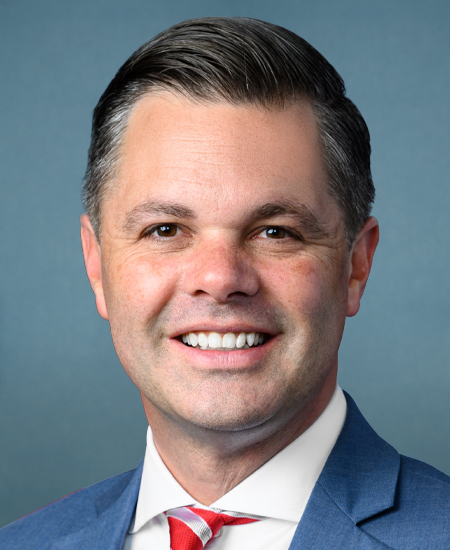
Photo of Zachary Nunn
R United States House · District 3 · Iowa On the 2026 ballot

Rep. Zachary Nunn

Compare
Total votes
1,879
all sessions
Attendance
96%
66 missed
Lower than 79% of chamber peers
With party
90%
of cast votes
Near the chamber average
Bipartisan score
5%
crosses aisle rarely
Near the chamber average
Sponsored
998
bills & resolutions
Higher than 80% of chamber peers
Committees
7
assignments
998 bills and resolutions

Sponsored bills

Total
998
Primary
115
Co-sponsor
883
This page
998
matching current filters
Co-sponsor HR 1189
In committee · United States House · Co-sponsor
National Plan for Epilepsy Act

Maddy summaryHR 1189, the National Plan for Epilepsy Act, creates a coordinated federal strategy to address epilepsy through a National Plan for Epilepsy. The plan requires the Secretary of Health and Human Services to establish an annual assessment, maintain a diverse Advisory Council (including people with epilepsy, caregivers, and experts), and coordinate research and care across federal agencies. Key provisions include annual progress reports to Congress, data sharing between agencies, and recommendations to improve diagnosis, treatment access, and reduce epilepsy-related disparities. The plan expires December 31, 2035, and directly affects the estimated 3.4 million people in the U.S. living with epilepsy and their caregivers.

In committee Feb 11, 2025 1 co-sponsor
Co-sponsor HR 1215
In committee · United States House · Co-sponsor
Semiconductor Supply Chain Security and Diversification Act of 2025

Maddy summaryHR 1215, the Semiconductor Supply Chain Security and Diversification Act of 2025, aims to strengthen U.S. semiconductor security by promoting diversified supply chains across the Western Hemisphere. It directs the State Department, Commerce, and other agencies to support Western Hemisphere countries - particularly those with upper-middle or high-income economies - to develop their own semiconductor infrastructure, including mining critical minerals (like zinc and gallium) and testing facilities. The bill authorizes U.S. funding through the International Development Finance Corporation for these projects, requiring presidential certification that they advance U.S. interests and either benefit the poorest populations or counter strategic competitors. It focuses on building regional supply chain resilience through diplomatic support, regulatory cooperation, and market integration across the hemisphere.

In committee Feb 11, 2025 1 co-sponsor
Co-sponsor HR 1197
In committee · United States House · Co-sponsor
PREEMIE Reauthorization Act of 2025

Maddy summaryThe PREEMIE Reauthorization Act of 2025 extends federal research funding for preterm birth prevention and care through fiscal years 2025-2029, replacing the prior 2019-2023 period. It requires the HHS Secretary to establish an interagency working group within 18 months and mandates a National Academies study on preterm birth costs, risk factors, and prevention strategies. The study must assess neonatal intensive care costs, long-term family expenses, and opportunities for early detection and support. It also analyzes targeted research for at-risk pregnancies, state program best practices, and precision medicine approaches starting in pregnancy. This bill directly affects preterm infants, their families, and federal health agencies through these research and coordination mechanisms.

In committee Feb 11, 2025 1 co-sponsor
Co-sponsor HR 1212
In committee · United States House · Co-sponsor
Countering Online Radicalization and Terrorism Act

Maddy summaryHR 1212 requires the Department of Homeland Security (DHS) to annually assess terrorism threats from terrorist groups using foreign messaging apps like Telegram, WeChat, and Weibo. The assessments must analyze how these apps facilitate radicalization, funding, and recruitment, while ensuring compliance with privacy and civil liberties laws. DHS must share findings with Congress and state/local fusion centers, and post unclassified reports publicly. This is a procedural bill focused on monitoring and reporting threats, not on banning apps or changing policies.

In committee Feb 11, 2025 1 co-sponsor
Co-sponsor HR 975
Passed · United States House · Co-sponsor
Credit Union Board Modernization Act

Credit Union Board Modernization Act This bill reduces the required frequency of meetings held by the board of directors of certain credit unions. Under the bill, new credit unions and credit unions with a low soundness rating must meet monthly, as required under current law. All other credit unions must hold at least six meetings annually, with at least one meeting held during each fiscal quarter.

Passed Feb 11, 2025 1 co-sponsor
Primary HR 736
Passed · United States House · Lead sponsor
Protect Small Businesses from Excessive Paperwork Act of 2025

Maddy summaryThis bill extends the deadline for small businesses to file certain financial reports from a variable timeline tied to regulatory dates to a fixed date of January 1, 2026. It modifies Section 5336(b)(1)(B) of Title 31, U.S. Code, directly affecting small businesses already required to submit specific financial disclosures under existing law. The key change simplifies compliance by replacing flexible regulatory deadlines with a single, clear cutoff date. This adjustment provides additional time for affected businesses without altering the underlying reporting requirements.

Passed Feb 11, 2025 0 co-sponsors
Co-sponsor HR 1175
In committee · United States House · Co-sponsor
Blind Americans Return to Work Act of 2025

Blind Americans Return to Work Act of 2025 This bill requires the Social Security Administration to carry out a demonstration project during which blind Social Security Disability Insurance (SSDI) beneficiaries receive reduced benefits commensurate with income above certain thresholds. Under current law, only individuals who earn under a specified monthly income, known as the substantial gainful activity (SGA) threshold, are considered disabled and thereby eligible for SSDI benefits. For blind workers, this limit is $2,700 per month in 2025. SSDI beneficiaries may earn beyond the SGA threshold for a limited period of time, known as the trial work period , before their benefits are suspended and ultimately terminate. The bill establishes a 20-year demonstration project during which individuals who are entitled to SSDI benefits by reason of blindness and who earn above the SGA threshold continue to receive benefits at an amount gradually reduced commensurate with their earnings beyond a specified amount. During this period, blind workers’ SSDI benefits must be reduced by $1 for every $2 that a worker earns above the sum of (1) the SGA threshold, and (2) the worker’s expenses reasonably attributable to their work. The SGA threshold may not be used to determine whether an individual is disabled during this period, and blind workers’ SSDI benefits may not be terminated due to work-related earnings. The trial work period also must not apply.  After 10 years, affected beneficiaries may opt out of the modified benefits structure.

In committee Feb 10, 2025 1 co-sponsor
Co-sponsor HR 1162
In committee · United States House · Co-sponsor
Medicaid Primary Care Improvement Act

Maddy summaryThis bill clarifies that states may use direct primary care arrangements under Medicaid, where patients pay a fixed fee for primary care only (not for other services). It requires the HHS Secretary to issue implementation guidance within one year and submit a report to Congress within two years analyzing state contracting practices and outcomes of these arrangements. The bill directly affects state Medicaid programs and managed care organizations by removing barriers to adopting this payment model. It does not change Medicaid eligibility, funding, or cost-sharing requirements. The focus is on enabling states to explore new primary care delivery methods through clear regulatory guidance.

In committee Feb 10, 2025 1 co-sponsor
Co-sponsor HR 29
Passed · United States House · Co-sponsor
Laken Riley Act

Maddy summaryThe Laken Riley Act expands mandatory detention for immigrants convicted of certain property crimes like burglary, theft, or shoplifting by adding these offenses to existing immigration detention criteria. It requires the federal government to issue detainers for such individuals and take custody if not detained by local authorities. The bill also grants state attorneys general standing to sue federal officials in federal court if they believe immigration enforcement actions (like releasing detained immigrants) cause the state financial harm exceeding $100. This creates new legal pathways for states to challenge federal immigration decisions through expedited lawsuits.

Passed Feb 10, 2025 1 co-sponsor
Co-sponsor HR 27
Passed · United States House · Co-sponsor
HALT Fentanyl Act

Maddy summaryThe HALT Fentanyl Act (HR 27) creates a new category of Schedule I controlled substances for "fentanyl-related substances" defined by specific chemical modifications to fentanyl. This law directly affects researchers, medical professionals, and law enforcement by expanding the legal definition of fentanyl-related substances to include many structurally similar compounds. Key provisions include streamlined registration processes for research on these substances, allowing researchers to conduct studies with expedited procedures if related to FDA-approved drug development or government-funded research. The bill requires the Attorney General to issue implementing rules within six months and includes penalties for violations involving these substances.

Passed Feb 10, 2025 1 co-sponsor
Showing 431 to 440 of 998 bills
Previous 1 … 43 44 45 … 100 Next