

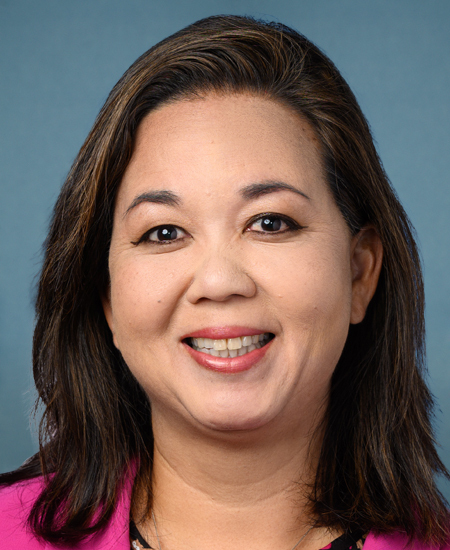
Photo of Jill N. Tokuda
D United States House · District 2 · Hawaii On the 2026 ballot

Rep. Jill N. Tokuda

Compare
Total votes
1,879
all sessions
Attendance
99%
13 missed
Higher than 92% of chamber peers
With party
98%
of cast votes
Higher than 91% of chamber peers
Bipartisan score
1%
crosses aisle rarely
Lower than 92% of chamber peers
Sponsored
1,816
bills & resolutions
Higher than 96% of chamber peers
Committees
6
assignments
1,816 bills and resolutions

Sponsored bills

Total
1,816
Primary
77
Co-sponsor
1,739
This page
1,816
matching current filters
Co-sponsor HR 7032
In committee · United States House · Co-sponsor
Pay Paraprofessionals and Support Staff Act

Maddy summaryThis bill establishes minimum salary and wage standards for paraprofessionals and education support staff in public schools. It requires states to set a minimum annual salary of $45,000 for full-time staff (increasing with inflation after 2030) and a minimum hourly wage of $30 for part-time staff (also inflation-adjusted). The federal government will provide $25 billion in FY2026, with annual funding increases, to help states implement these standards through grants. States must ensure all local schools meet these minimums within 4 years of receiving funds, with 98% of grant money allocated directly to schools for salary increases or professional development.

In committee Jan 13, 2026 1 co-sponsor
Co-sponsor HR 6436
In committee · United States House · Co-sponsor
To amend the Agricultural Act of 2014 to allow for the advance payment of assistance under Tree Assistance Program, and for other purposes.

Maddy summaryThis bill amends the Tree Assistance Program under the 2014 Agricultural Act to allow eligible orchardists and nursery tree growers to receive up to 25% of their recovery payment *before* they replant trees damaged by natural disasters. The key change permits the Secretary of Agriculture to disburse this advance payment upfront, rather than waiting until after replanting is complete. This directly affects growers who suffered tree losses and need financial support for replanting costs. The provision modifies existing payment rules without creating new eligibility requirements.

In committee Jan 13, 2026 1 co-sponsor
Primary HR 6368
In committee · United States House · Lead sponsor
Feeding Rural Families Act of 2025

Maddy summaryThis bill amends the Food and Nutrition Act of 2008 to explicitly include both "urban and rural parts" of Hawaii in two specific references within the law. It directly affects how food assistance programs administered under the Act apply to rural communities in Hawaii, ensuring these areas are formally recognized in the legal text. The change is purely technical, updating language to prevent ambiguity about rural coverage without altering program benefits or eligibility. This is a minor procedural adjustment, not a substantive policy change.

In committee Jan 13, 2026 0 co-sponsors
Primary HR 6343
In committee · United States House · Lead sponsor
Parity for Alaska Native and Native Hawaiian Students in Agriculture Act

Maddy summaryThis bill amends federal grant provisions to increase funding and clarify terms for Alaska Native and Native Hawaiian-serving agricultural education institutions. It extends the maximum grant period from unspecified to three years and adjusts funding levels, increasing annual support to $15 million per year from fiscal years 2027 through 2031 (up from $10 million annually in prior years). The changes directly affect institutions designated as serving Alaska Native or Native Hawaiian students in agricultural education programs. The policy update ensures stable, long-term funding for these institutions to support student enrollment and program development.

In committee Jan 13, 2026 0 co-sponsors
Co-sponsor HR 6088
In committee · United States House · Co-sponsor
Restoring Food Security for American Families and Farmers Act of 2025

Maddy summaryHR 6088, the *Restoring Food Security for American Families and Farmers Act of 2025*, repeals specific sections (10101-10108) from a prior reconciliation law. This action revives previous provisions related to food security programs that were modified by those repealed sections. The bill directly affects federal food assistance and agricultural support programs by restoring their prior legal framework. It does not create new policies but reverses recent changes to existing food security measures.

In committee Jan 13, 2026 1 co-sponsor
Primary HR 5241
In committee · United States House · Lead sponsor
RTCP Revitalization Act

Maddy summaryThe RTCP Revitalization Act amends funding provisions for geographically disadvantaged farmers and ranchers under the Food, Conservation, and Energy Act of 2008. It establishes mandatory annual funding from the Commodity Credit Corporation, starting at $10 million for fiscal year 2026 and increasing to $15 million annually through 2031 and beyond. The bill removes payment limits for eligible farmers when sufficient funds are available, ensuring they receive full payments without arbitrary caps. This directly affects farmers and ranchers in geographically disadvantaged areas who qualify for these payments. The changes provide predictable funding and protect payment access for this specific group.

In committee Jan 13, 2026 0 co-sponsors
Co-sponsor HR 5168
In committee · United States House · Co-sponsor
Puerto Rico Nutrition Assistance Fairness Act

Maddy summaryThis bill updates federal nutrition law to include Puerto Rico in the Supplemental Nutrition Assistance Program (SNAP), allowing it to transition from its current funding method to the same SNAP benefits available to U.S. states. Puerto Rico must submit a 180-day plan to the USDA detailing its transition to SNAP, with approval required within another 180 days. The transition period lasts up to 5 years from the bill's effective date, during which Puerto Rico would continue receiving block grants while preparing for full SNAP participation. This change directly affects Puerto Rico's 1.4 million residents who currently receive nutrition assistance under a separate funding structure.

In committee Jan 13, 2026 1 co-sponsor
Primary HR 5164
In committee · United States House · Lead sponsor
Promoting American Competition in Aquaculture Research Act

Maddy summaryHR 5164 renews federal funding for U.S. aquaculture research programs, providing $15 million annually from fiscal years 2026 through 2030. It directly affects research institutions and organizations receiving federal grants under the Food and Agriculture Act of 1977. The bill removes a previous cap on indirect costs (like administrative expenses) for these grants, allowing full reimbursement under new rules, while maintaining other cost limitations. This change aims to streamline funding for aquaculture innovation without altering the program's core purpose.

In committee Jan 13, 2026 0 co-sponsors
Co-sponsor HR 5017
In committee · United States House · Co-sponsor
Greyhound Protection Act of 2025

Maddy summaryHR 5017, the Greyhound Protection Act of 2025, prohibits commercial greyhound racing, live lure training, open field coursing, and related betting across state lines. It bans activities like using live animals as bait, conducting interstate simulcast betting, and transporting greyhounds for racing purposes. The law amends the Animal Welfare Act to make these actions unlawful, with penalties including fines and up to 7 years in prison per violation. It applies to conduct occurring on or after October 1, 2027, and does not override existing state laws banning these activities. The bill directly affects greyhound racing industry participants and the animals involved in these practices.

In committee Jan 13, 2026 1 co-sponsor
Co-sponsor HR 3453
In committee · United States House · Co-sponsor
Empower Charter School Educators to Lead Act

Maddy summaryHR 3453, the Empower Charter School Educators to Lead Act, creates new federal grants to help educator-led teams plan and open charter schools. It provides up to $100,000 per team for pre-charter planning, targeting groups led by educators with at least 4.5 years of school-based experience (including after-school programs) and a demonstrated ability to lead. To qualify, teams must submit a community needs assessment and a plan showing how their proposed school will address those needs. The bill reserves 5% of relevant funding for these educator-led grants, adjusting existing ESEA grant formulas to prioritize this new support. This directly affects educators seeking to start charter schools and the communities where those schools would operate.

In committee Jan 13, 2026 1 co-sponsor
Showing 191 to 200 of 1,816 bills
Previous 1 … 19 20 21 … 182 Next