Protecting First Responders from Secondary Exposure Act of 2021 This bill expands the allowable uses of grant funds under the Comprehensive Opioid, Stimulant, and Substance Abuse Program administered by the Department of Justice. Specifically, the bill allows grants to be used for purchasing containment devices for first responders and training first responders on the use of containment devices to prevent secondary exposure to fentanyl and other potentially lethal substances.
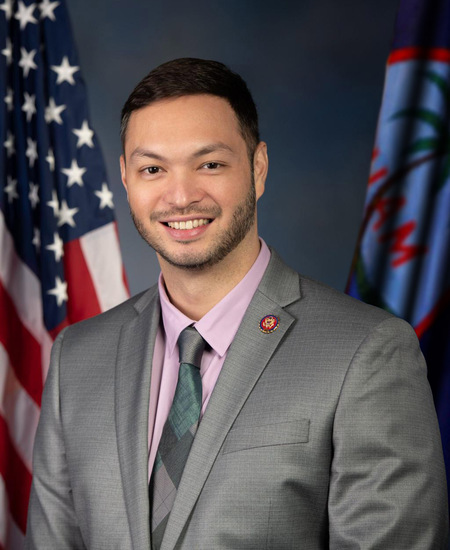
Rep. Michael F. Q. San Nicolas
Sponsored bills
Daniel Anderl Judicial Security and Privacy Act of 2021 This bill generally prohibits federal agencies and private businesses from publicly posting the personally identifiable information (e.g., home addresses) of federal judges and their immediate family members. It also (1) requires information to be removed upon written request from the federal judge concerned, (2) prohibits data brokers from purchasing or selling such information, and (3) establishes programs to protect such information at the state and local level and to enhance security for judges.
Ending Homelessness Act of 2021 This bill expands the housing choice voucher program and provides assistance to homeless individuals and families. Specifically, the bill provides FY2022-2025 funding for the expansion of the housing choice voucher program for certain extremely low income families. Furthermore, beginning in FY2026, the bill creates and funds an entitlement to housing choice vouchers for certain extremely low income families. Eligibility for the entitlement expands annually, extending to low-income families by FY2030. The bill also reduces the geographic area used to calculate an area's fair market rent for purposes of voucher payment standards and prohibits the use of criminal history in determining eligibility for certain housing assistance. Additionally, the bill prohibits housing discrimination on the basis of a renter's source of income or a renter's veteran status. The bill also provides additional FY2022-FY2026 funding for the Department of Housing and Urban Development (HUD) to assist the homeless, including to award emergency relief grants in jurisdictions with the highest need and award grants to provide outreach and coordinate services. Furthermore, the bill provides additional FY2022-FY2026 funding for the Housing Trust Fund, which provides affordable housing for extremely low-income and very low-income families. While this additional funding is available, HUD must ensure that priority for occupancy in assisted units is given to individuals and families who are homeless. Finally, the bill permanently reauthorizes certain homeless assistance grants and makes permanent the U.S. Interagency Council on Homelessness.
Housing is Infrastructure Act of 2021 This bill generally addresses housing affordability and infrastructure. The bill authorizes the Department of Housing and Urban Development (HUD) to provide grants, programs, and other support related to public housing, affordable housing preservation and construction, and mortgage access. The bill also establishes and funds the National Investment Authority (NIA) which must design, finance, and implement a strategy of long-term national economic growth and development. The NIA must select projects that coordinate investment of public and private capital in equitable, inclusive, and sustainable growth of the economy. Furthermore, the bill establishes the National Infrastructure Bank (NIB) to implement the strategy by engaging in credit market activities that support public and private investment in critical public infrastructure projects. The bill gives the NIA bond issuing authority and authorizes the Board of Governors of the Federal Reserve System to purchase these bonds. The Federal Reserve must lend funds on a short-term basis upon the request of the NIB and other subsidiaries. Additionally, the Department of the Treasury must provide for a line of credit not to exceed 100% of the NIA's total assets. Finally, the bill (1) authorizes HUD to provide support for fair housing organizations, and (2) requires consultation with a fair housing enforcement organization as part of an application for certain housing grants or funds.
Veterans Visa and Protection Act of 2021 This bill provides permanent resident status and citizenship eligibility to certain noncitizen veterans and addresses related issues. The Department of Homeland Security (DHS) must establish a program that allows (1) eligible noncitizen veterans outside of the United States to be admitted as permanent residents, and (2) eligible noncitizen veterans in the United States to obtain permanent resident status. Generally, an eligible noncitizen veteran under this bill is one who was not removed from the United States for certain crimes related to violence or national security. DHS may waive these eligibility requirements for humanitarian, family unity, public interest, or exceptional military service reasons. A noncitizen veteran who obtains permanent resident status under this bill shall be eligible for (1) naturalization through service in the Armed Forces, and (2) military and veterans benefits as if they had not been removed (or ordered removed) from the United States. For a noncitizen veteran in removal proceedings or subject to a final removal order, the Department of Justice (DOJ) must determine whether the veteran is eligible for permanent resident status under this bill. If the veteran is eligible, DOJ must adjust the veteran's status. The bill also protects noncitizen veterans or service members from being removed from the United States unless the veteran has been convicted of a crime of violence.
Greater Leadership Overseas for the Benefit of Equality Act of 2021 or the GLOBE Act of 2021 This bill contains provisions related to (1) the protection of LGBTQI individuals globally; and (2) immigration protections for vulnerable individuals. The bill establishes (1) an interagency group to respond to urgent threats to LGBTQI people in foreign countries, and (2) a permanent Special Envoy for the Human Rights of LGBTQI Peoples in the Department of State. The President shall impose visa-blocking sanctions on foreign persons responsible for violating the human rights of individuals based on sexual orientation, gender identity, or sex characteristics. The State Department shall establish the Global Equality Fund to provide assistance to nongovernmental organizations working to advance and protect human rights. The U.S. Agency for International Development shall establish the LGBTQI Global Development Partnership to work with the private sector and nongovernmental organizations to support LGBTQI rights. The bill removes prohibitions against providing foreign assistance to nongovernmental organizations that offer certain medical services (e.g., abortion-related services) using non-U.S. government funds. The bill contains several immigration-related provisions, such as those establishing that persecution based on sexual orientation or gender identity may form the basis of an asylum request, allowing certain applicants to file asylum claims more than a year after their arrival in the United States, including a permanent partnership between two partners as a marriage for immigration law purposes, providing for free counsel in certain immigration proceedings, and granting U.S. citizenship to a child born abroad through assistive reproductive technology from a U.S. citizen who is the child's nonbiological parent.

This resolution recognizes Filipino American History Month as a testament to the advancement of Filipino Americans and a time to renew efforts toward researching and examining the history of Filipino Americans to give all people of the United States an opportunity to learn about their contributions.
Original National Domestic Violence Awareness Month Resolution of 2022 This resolution supports the goals and ideals of National Domestic Violence Awareness Month. Further, it expresses the sense of the House of Representatives that Congress should continue to raise awareness of and support programs to end domestic violence.
Military Family Nutrition Act of 2022 This bill excludes military housing allowances from income when determining eligibility for the Supplemental Nutrition Assistance Program (SNAP).
Filipino Veterans Fairness Act of 2022 This bill expands eligibility for certain Department of Veterans Affairs (VA) benefits to the surviving spouse and children of individuals who served in the organized military forces of the Philippines and the Philippine Scouts. In determining eligibility under this bill, the VA must take into account any alternative documentation regarding such service, other than the recognized guerilla rosters stored at the National Personnel Records Center.