St. Croix National Heritage Area Act This bill establishes the St. Croix National Heritage Area in St. Croix, U.S. Virgin Islands. The bill designates the Virgin Islands State Historic Preservation Office as the local coordinating entity. The preservation office shall prepare and submit a management plan for the heritage area for the protection, enhancement, and interpretation of its resources.
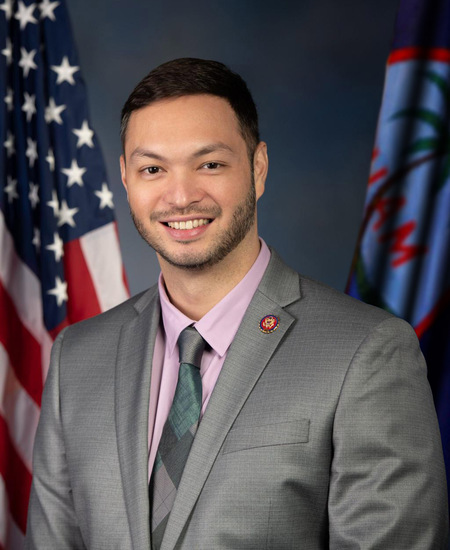
Rep. Michael F. Q. San Nicolas
Sponsored bills
National Heritage Area Act of 2021 This bill establishes a National Heritage Areas System to recognize certain areas of the United States that tell nationally significant stories and to conserve, enhance, and interpret the areas' natural, historic, scenic, and cultural resources that illustrate significant aspects of U.S. heritage, and authorizes appropriations through FY2034 for each National Heritage Area. Through such system, the Department of the Interior may provide technical and financial assistance to local coordinating entities to support the establishment, development, and continuity of such areas. The bill extends the authority for the Erie Canalway National Heritage Corridor Commission and the Gullah/Geechee Cultural Heritage Corridor Commission until September 30, 2034. The local coordinating entity of a National Heritage Area, not later than three years after the area is included in the National Heritage Area System, shall submit to Interior a management plan for approval. Interior, not later than one year before the authorization for federal funding expires for a National Heritage Area, shall (1) conduct an evaluation of the accomplishments of that area, and (2) submit a report detailing the evaluation to specified congressional committees. Based upon the evaluation, Interior shall prepare a report with recommendations for the National Park Service's continued role, if any, with respect to the area. Interior may carry out or certify a study to assess the suitability and feasibility of designating a specific geographic area as a National Heritage Area to be included in the National Heritage Area System.

Making FHA Work for Borrowers with Student Debt Act of 2021 This bill requires the Federal Housing Administration (FHA) to modify its treatment of student loan debt for purposes of determining eligibility for federally insured mortgages for single-family homes. Specifically, the FHA must calculate a borrower's student loan debt obligation as the monthly payment required in connection with the loan or, if no monthly payment is required, 0.5% of the outstanding balance of the loan. Currently, the FHA calculates a borrower's student loan debt obligation as 1% of the outstanding balance of the loan.
Basic Assistance for Students In College Act or the BASIC Act This bill directs the Department of Education (ED) to award planning and implementation grants to institutions of higher education in order to identify and meet the basic needs of students, including food, housing, transportation, and health care. ED must also implement an agreement to (1) share data with other federal agencies in order to identify students who may be eligible for certain federal benefits; and (2) coordinate efforts to enroll those students in federal benefits programs, including Medicaid and the Supplemental Nutrition Assistance Program.
Locality-based Social Security Benefits Act of 2021 This bill directs the Social Security Administration to increase an individual's monthly Social Security benefit amount in accordance with the locality-based comparability payment rate applicable to the federal locality-pay area in which the individual resides.
Notch Fairness Act of 2021 This bill increases Social Security retirement benefits for certain individuals born between 1917 and 1921, referred to as the Notch years. Currently, these individuals receive lower cost-of-living increases than individuals born in 1916 or earlier, as a result of legislative changes to Social Security benefits enacted in 1977. Under the bill, eligible individuals may elect to (1) recompute and increase their current primary insurance amount according to a specified schedule, or (2) receive lump sum payments over four years totaling $5,000.
Supplemental Security Income Restoration Act of 2021 This bill modifies eligibility for, and other components of, the Supplemental Security Income (SSI) program, including by (1) increasing applicable income and resource limits used to determine SSI eligibility, (2) equalizing treatment of married couples when both spouses receive SSI as compared to two unmarried individuals, and (3) eliminating the penalty on SSI applicants or recipients who transfer resources to another individual for less than fair market value.
Parity Implementation Assistance Act This bill provides grants to assist states with the implementation of the federal mental health parity requirements. States receiving the grants must request and review from private health insurance plans their required comparative analysis of nonquantitative treatment limitations (NQTLs) with respect to mental health or substance use disorder benefits. (NQTLs are limitations on the scope or duration of benefits for treatment, such as preauthorization requirements.)
STEM Educator Awards Equity Act This bill increases from 108 to 110 the number of Presidential Awards for Excellence in Mathematics and Science Teaching the President must award each year. The awards are given to kindergarten through grade 12 school teachers of mathematics and science who have demonstrated outstanding teaching ability. In selecting teachers for an award, the President shall select at least one teacher each from the Commonwealth of the Northern Mariana Islands, American Samoa, the U.S. Virgin Islands, and Guam.
FAIR Leave Act or the Fair Access for Individuals to Receive Leave Act This bill repeals the limit on the aggregate number of workweeks of family and medical leave that spouses employed by the same employer may be entitled to during any 12-month period. The current limit is 12 aggregate workweeks.