

Maddy summaryHR 7378, the Frederick Douglass Congressional Gold Medal Act, authorizes Congress to posthumously award a gold medal to honor Frederick Douglass's legacy as a pivotal abolitionist, writer, and advocate for civil rights. The medal, designed by the Treasury Secretary, will be presented to the National Museum of African American History and Culture for display, with bronze duplicates available for sale to cover costs. This ceremonial bill does not create new laws or affect current policies - it solely commemorates Douglass's historical contributions to ending slavery and advancing equality.
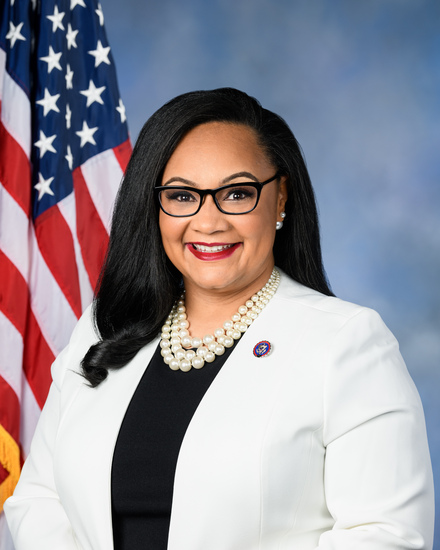
Rep. Nikema Williams
Sponsored bills
Maddy summaryHRES 966 is a symbolic resolution condemning alleged sexual violence committed by Hamas during its October 7, 2023, attack on Israel. It specifically references eyewitness accounts, forensic evidence, and Hamas fighters' admissions of ordering gang rape, sexual mutilation, and assault against Israeli civilians. The resolution calls for international condemnation of such acts as weapons of war, urges nations to criminalize sexual violence, and supports investigations into Hamas' actions. As a non-binding resolution, it does not create new laws or directly affect any individuals but formally expresses the House's position on the issue.
Maddy summaryThis bill requires the Consumer Financial Protection Bureau (CFPB) and the Department of Education to share student loan complaint data and coordinate oversight. It mandates that each agency transfer complaints about federal student loans (title IV) or private student loans to the other agency within 10 days of receipt. The agencies must collaborate on resolving complaints involving both federal and private loans, including creating a process for handling issues with defaulted federal loans and private collection agencies. This improves transparency for borrowers by ensuring both agencies work together to address concerns about student loan servicing and origination.
Maddy summaryThis bill prevents states from banning or discouraging the use of specific financial industry codes (merchant category codes) that identify firearm and ammunition merchants. It directly affects financial institutions and payment processors that use these standardized codes for transaction tracking. The law requires states to allow the use of these codes, and the Attorney General can enforce this through civil lawsuits. The bill does not change gun laws or affect gun owners; it only addresses financial coding standards.
Maddy summaryHR 7329, the Election Day Holiday Act of 2024, would designate November 5, 2024 (and subsequent general elections) as a federal public holiday. This change would require federal offices to close and provide federal employees a paid day off on Election Day. The bill amends Title 5 of the U.S. Code to add "Election Day" to the list of designated federal holidays, following Columbus Day. This directly affects federal employees and operations, ensuring they have a day off during general elections.
Maddy summaryHRES 1007 would amend House Rules to limit privileged status for specific resolutions. It requires that resolutions seeking to impeach officials, censure, reprimand, expel members, or create leadership vacancies can only be prioritized if either: (1) a relevant committee investigated the conduct and issued a report recommending the sanction, or (2) the resolution is offered by a party caucus or conference. This change directly affects how quickly such serious actions can move through the House process. The bill does not alter the sanctions themselves but modifies the procedural pathway for bringing them to the floor.
Maddy summaryHRES 1003 is a symbolic resolution recognizing the contributions of Vietnamese Americans. It acknowledges that approximately 800,000 Vietnamese refugees resettled in the U.S. after the Vietnam War and that over 1.7 million Vietnamese Americans now live in the U.S., forming the fourth largest Asian American group. The resolution highlights their achievements in fields like business, education, the military, and public service, as well as their support for democracy and cultural diversity. As a non-binding resolution, it has no legal effect or direct impact on policy or individuals.
Maddy summaryHRES 1002 is a symbolic House resolution recognizing the cultural and historical significance of Lunar New Year (celebrated as the Year of the Dragon in 2024). It acknowledges the holiday's 4,000-year history in China, its celebration across Asia (including Seollal and Tết), and its significance to Asian Americans and others in the U.S. The resolution expresses respect for those observing the holiday and wishes them a happy new year, but it does not create new laws, policies, or funding. As a ceremonial resolution, it has no direct effect on legislation or constituents.
Maddy summaryThis bill restricts how credit reporting companies share homebuyers' credit reports during mortgage applications. It prevents companies from sending these reports to third parties (like marketers) just because a lender requested them for a mortgage. Only specific entities can receive the reports: the mortgage lender who originated the loan, the company servicing the loan, or the bank holding the homebuyer's account. This directly protects homebuyers' privacy by limiting unauthorized sharing of their financial data.
Maddy summaryHR 7272, the Shining a Spotlight on Safer Communities Act, requires the Attorney General to submit annual reports to Congress starting in 2024, detailing how the Bipartisan Safer Communities Act's provisions (specifically sections 932 and 933 of title 18) are being implemented. These reports must include data on investigations, prosecutions, demographic information of defendants, and seized firearms or assets related to gun trafficking and straw purchasing. The bill mandates these reports for fiscal years 2024 through 2027, with a funding limit of $2 million annually for this reporting. It is a procedural bill focused solely on transparency and accountability for existing gun safety measures, not creating new policies.