

Maddy summaryThis bill amends federal law (Section 1983) to eliminate qualified immunity as a defense in civil rights lawsuits. It would prevent government officials from avoiding liability by claiming they acted in good faith, believed their actions were lawful, or didn't know a right was clearly established at the time. This directly affects individuals who sue police, law enforcement, or other officials for violating constitutional rights. The change would apply to lawsuits filed after the bill's enactment, requiring officials to face liability under the original standard of Section 1983.
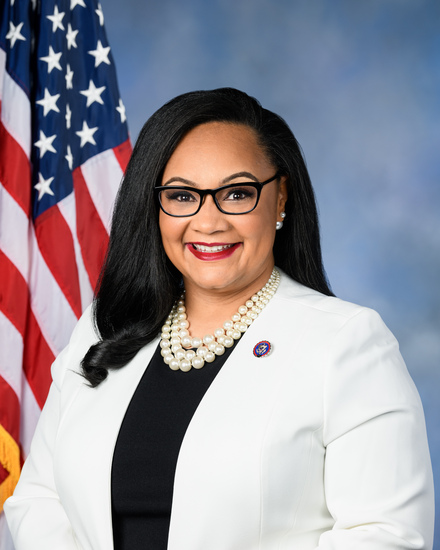
Rep. Nikema Williams
Sponsored bills
Maddy summaryThe Strength in Diversity Act of 2025 provides federal grants to schools and districts with racial or socioeconomic isolation to develop and implement strategies increasing diversity. It authorizes planning grants (up to 2 years) for assessments and community engagement, and implementation grants (up to 3 years) for activities like transportation plans, teacher recruitment, innovative school assignments, and equitable enrollment systems. Recipients must track measurable progress on academic outcomes (e.g., graduation rates, achievement gaps) and diversity metrics, including reducing isolation in covered schools (public K-12 schools and publicly-funded early childhood programs). The bill requires robust community input, data-driven evaluation, and plans for sustainability beyond the grant period, with funding authorized for fiscal years 2025-2029.
Maddy summaryHRES 441 is a symbolic House resolution expressing support for designating May 2025 as "Mental Health Awareness Month." It does not create new laws, allocate funding, or change existing policies - it solely aims to raise public awareness about mental health challenges. The resolution cites statistics on rising mental health issues (including youth depression, suicide rates, and disparities in care access) to underscore the need for greater attention. It encourages the public, schools, and organizations to use the month to promote mental well-being and reduce stigma, but contains no concrete policy changes or mandates.
Maddy summaryThis bill prohibits the U.S. military from discriminating against service members or applicants based on gender identity. It bans policies that would deny service, involuntarily separate members, deny medically necessary healthcare, or require service in a gender different from one's identity. The law defines "gender identity" broadly to include a person's internal sense of gender, appearance, and mannerisms, regardless of sex assigned at birth. It directly affects transgender and gender-diverse individuals currently serving or seeking to serve in the Armed Forces.
Maddy summaryThis bill amends federal education law to require K-12 schools to include Asian American, Native Hawaiian, and Pacific Islander (AANHPI) history in American history and civics education. It directs the Department of Education to update curriculum standards, teacher training programs, and national assessments to ensure AANHPI contributions and experiences are integrated into existing history lessons. The policy affects all public schools receiving federal education funding by mandating specific inclusion of AANHPI history alongside traditional American history content. This change aims to address historical gaps in curricula that have excluded these communities' diverse roles and experiences.
Maddy summaryThis bill prohibits the President, Vice President, Members of Congress, and their immediate family members from engaging in specific digital asset activities. It bans them from owning digital assets where they could unilaterally alter them, serving as officers for crypto issuers, receiving compensation for crypto sales/marketing, or trading with non-public information while in office. The law also prevents these individuals from using trusts, companies, or other entities to secretly participate in digital asset markets, requiring full disclosure of indirect ownership. Violations could trigger criminal penalties under existing federal law, mirroring restrictions on other financial conflicts of interest.
Maddy summaryThe College for All Act of 2025 would eliminate tuition and required fees for eligible students at public community colleges and 4-year institutions through a federal-state partnership. The federal government would cover 100% of costs in the first year (2026-2027), gradually decreasing to 80% by 2030-2031, while states would start with 0% and increase to 20% by 2030-2031. Eligible students would include those with family income below $150,000 for single parents or $300,000 for married parents, regardless of immigration status. The bill also includes requirements to maintain instruction funding, improve transfer pathways between community colleges and 4-year institutions, and provide additional support for students after tuition elimination.
Maddy summaryHR 3532, the Striking and Locked Out Workers Healthcare Protection Act, prohibits employers from terminating or altering an employee’s employer-sponsored health coverage during a lawful strike or a lockout (when an employer withholds work to influence bargaining). It directly affects workers participating in strikes or facing lockouts, ensuring continued healthcare access during these labor disputes. The bill adds penalties: $75,000 per violation for lockout-related coverage termination (up to $150,000 for repeat offenses), and $50,000 per violation for strike-related termination (up to $100,000 for repeat offenses), with penalties applied alongside other remedies. These provisions amend the National Labor Relations Act to protect workers’ healthcare rights during collective bargaining actions.
Maddy summaryThis bill establishes a code of conduct for Supreme Court justices, requiring them to disclose gifts, income, and potential conflicts of interest. It creates a formal process for handling complaints about justices, including a judicial investigation panel to review allegations. The bill adds specific circumstances requiring recusal, such as when a justice or family member has financial ties to a party in a case. Additionally, it mandates that parties and amicus briefs disclose any gifts given to justices and lobbying activities related to their nomination. These provisions aim to increase transparency and accountability in the Supreme Court's operations.
Maddy summaryHR 3505, the Barriers to Suicide Act of 2025, creates a federal grant program administered by the Department of Transportation to fund the installation of proven safety barriers and nets on specific high-risk structures. The program provides competitive grants (up to 80% federal funding) to states, local governments, or other eligible entities for projects installing suicide deterrents on bridges, buildings, parking garages, highway-rail crossings, or rail stations. It prioritizes areas with high suicide rates and mandates a study by the Comptroller General to evaluate effective deterrents for non-bridge structures and their costs, with a report due within one year of enactment. The bill authorizes $10 million annually from 2026-2030 for this initiative.