

Maddy summaryThis bill directs the National Oceanic and Atmospheric Administration (NOAA) to conduct a study on the financial costs of extreme heat events. The study will quantify economic impacts including health costs (emergency care, hospitalizations), property damage, insurance claims, labor productivity losses, infrastructure disruptions, energy expenses, and agricultural losses. NOAA must coordinate with multiple federal agencies (like Health, Agriculture, and Energy Departments) and publish findings on HEAT.gov within 4 years. The bill does not create new regulations or directly affect citizens; it solely authorizes a data-gathering study to inform future policy.
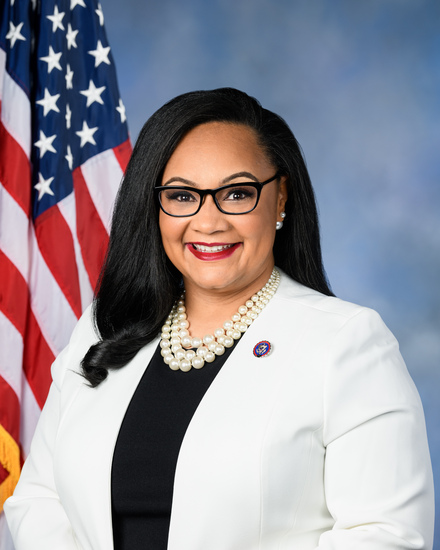
Rep. Nikema Williams
Sponsored bills
Maddy summaryThis bill establishes a federal interagency committee within NOAA to coordinate heat-health response across 15+ departments (including HHS, EPA, and FEMA) and requires a 5-year strategic plan to improve data sharing, research, and public communication about extreme heat. It creates the National Integrated Heat Health Information System (NIHHIS) to centralize heat-related data and forecasts, making it openly available for public use. The law mandates $5 million annually for 2025-2029 to fund these efforts, directly affecting federal agencies, state/local governments, Tribal nations, and communities facing heat risks. Key provisions include standardizing heat definitions, requiring agency coordination, and building public health preparedness tools to reduce heat-related illness and death.
Maddy summaryThe Excess Urban Heat Mitigation Act of 2025 creates a federal grant program to fund heat-reduction projects in communities most affected by urban heat islands, primarily low-income neighborhoods (defined as census tracts with ≥20% poverty rate) and areas with higher heat exposure for communities of color. It authorizes $30 million annually for grants to states, cities, tribes, or nonprofits for projects like planting native trees, installing cool roofs/pavements, building shaded transit stops, and creating community cooling centers. Grants require community engagement plans to ensure equitable participation and prioritize projects in underserved areas (75% of funds must target "covered census tracts"). The program mandates annual reporting to Congress and includes oversight to evaluate project success in reducing heat impacts.
Maddy summaryThis resolution (HRES 457) is a symbolic measure expressing congressional support for designating June 6, 2025, as "National Gun Violence Awareness Day" and June 2025 as "National Gun Violence Awareness Month." It does not create new laws or policies but encourages public awareness through specific actions: wearing orange on June 6, focusing on gun safety during summer months, and holding community discussions. The resolution references statistics on gun violence deaths and honors Hadiya Pendleton, a teen victim killed in 2013. It directly affects the public by calling for voluntary observance and community engagement, not government mandates.
Maddy summaryHR 3694, the VALID Act of 2025, requires lenders to include specific information about VA loans in mortgage disclosures. It amends the National Housing Act to mandate that disclosures state the loan-to-value ratio and clarify that VA loans are available under Chapter 37 of Title 38 (veterans' benefits law), assuming prevailing interest rates. The bill also requires the Federal Housing Finance Agency to add a military service question to the Uniform Residential Loan Application form, placing it above the signature line within six months of enactment. This directly affects veterans and active-duty service members applying for VA-guaranteed mortgages, as well as the lenders processing those applications.
Maddy summaryHR 3665, the Medicare Economic Security Solutions Act, modifies Medicare Part B late enrollment penalties. It increases the penalty rate from 10% to 15% of the monthly premium but limits the penalty period to twice the original 12-month intervals. The bill also excludes months with COBRA, retiree, or VA coverage from counting toward the penalty and creates a special enrollment period for people whose COBRA or retiree coverage ends. These changes directly affect Medicare Part B enrollees who had gaps in coverage due to employment transitions or other qualifying circumstances.
Maddy summaryThe Menstrual Equity For All Act of 2025 requires schools, colleges, correctional facilities, and federal buildings to provide free menstrual products to those who need them. It makes menstrual products covered by Medicaid, prohibits states from taxing these products, and creates grant programs to support low-income individuals. Key provisions include mandating free products in educational settings, requiring employers with 100+ employees to provide them, and expanding Medicaid coverage for these items. The bill directly affects students, incarcerated individuals, homeless people, Medicaid beneficiaries, and low-income families by addressing period poverty through concrete access requirements.
Maddy summaryThis bill requires colleges and universities to include suicide prevention contact information on student identification cards or their websites. Specifically, institutions must list the 988 Suicide and Crisis Lifeline, Crisis Text Line, and their campus mental health center on student IDs (or post the info online if IDs aren't issued). The requirement applies to all higher education institutions creating student ID cards after the bill's enactment, with a one-year implementation period. It directly affects students by ensuring immediate access to critical mental health resources through a routine campus tool.
Maddy summaryThis bill reorganizes collective bargaining rules for Veterans Health Administration (VHA) employees by removing existing subsections (b), (c), and (d) from Section 7422 of Title 38 and redesignating the current subsection (e) as (b). It directly affects VA health care employees by altering the structure of their collective bargaining framework. The bill explicitly states it does not change the Secretary of Veterans Affairs' existing authorities over incentive pay or expedited hiring under Section 706 of Title 38. The change is purely procedural, focusing on the internal organization of bargaining rules without introducing new employee benefits or obligations.
Maddy summaryHR 3606, the Equity and Inclusion Enforcement Act of 2025, restores private lawsuits to challenge policies causing unintentional discrimination in federally funded education programs. It allows individuals to sue when schools or programs violate existing Title VI regulations (which prohibit discrimination based on race, color, or national origin) as if the violation were intentional. The bill requires education programs receiving federal funds to name a staff member to handle compliance and notify students/employees of this contact. It also creates a new Department of Education position, the Special Assistant for Equity and Inclusion, to coordinate compliance with Title VI and inform the public about their rights under the law. This directly affects schools and educational institutions receiving federal funding.