

Maddy summaryThe Barriers to Suicide Act of 2023 establishes a federal grant program to fund evidence-based suicide deterrents on bridges. The Transportation Secretary will award competitive grants to states or local governments for installing proven safety measures like nets or barriers, prioritizing areas with high suicide rates, with federal funding covering up to 80% of project costs. The bill also mandates a study by the Comptroller General to assess effective deterrents for non-bridge structures (e.g., buildings) and report findings within one year. It authorizes $10 million annually for 2024-2028 to support these initiatives. The law directly affects bridge safety planning for state and local agencies seeking federal assistance.
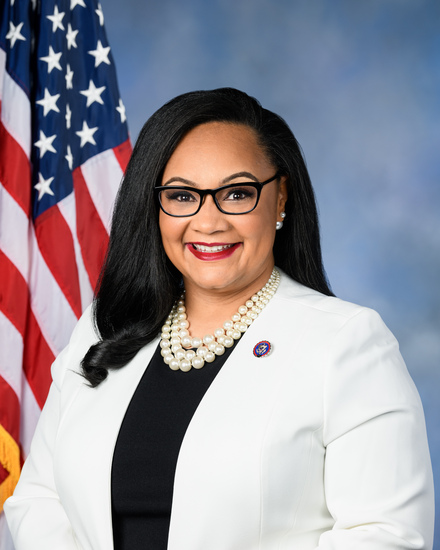
Rep. Nikema Williams
Sponsored bills
Maddy summaryThe Universal School Meals Program Act of 2023 would establish a universal school meals program providing free breakfast and lunch to all children enrolled in participating schools, regardless of family income. Key provisions include eliminating income-based eligibility requirements for school breakfast and lunch programs, setting specific reimbursement rates ($2.80 for breakfast and $4.63 for lunch with annual inflation adjustments), and prohibiting schools from collecting debt for unpaid meals or "shaming" students. The bill also replaces references to "free or reduced price" with "economically disadvantaged students" in related laws and establishes new methods for identifying children from low-income backgrounds. This legislation would directly affect all public schools participating in the National School Lunch Program and School Breakfast Program.
Maddy summaryThis bill removes a barrier for college students seeking food assistance by amending the SNAP program rules. It directly affects students enrolled at least half-time in recognized colleges or training programs, who were previously automatically ineligible unless they met separate requirements. The key change eliminates the prior restriction (in section 6(e)) that barred most higher education students from SNAP, allowing them to qualify under the new provision in section 3(m)(5)(F). The changes take effect January 2, 2024.
Maddy summaryThe Closing the Meal Gap Act of 2023 amends the Food and Nutrition Act to update how SNAP (Supplemental Nutrition Assistance Program) benefits are calculated. It replaces the "thrifty food plan" with a "low-cost food plan" based on a specific 4-person family diet, requiring the government to reevaluate this plan by 2029 and every 5 years after. The bill also updates medical expense deductions, eliminates time limits on benefits, and allows Puerto Rico to join SNAP with specific transition requirements. These changes directly affect SNAP recipients, particularly in Puerto Rico, Hawaii, and Alaska, by adjusting benefit calculations to better reflect current food costs.
Maddy summaryHRES 459 is a resolution expressing the House of Representatives' support for designating June 2, 2023, as "National Gun Violence Awareness Day" and June 2023 as "National Gun Violence Awareness Month." It encourages the public to wear orange, promote gun safety awareness, and discuss community safety measures during this time, particularly highlighting the summer months when gun violence often increases. The resolution references statistics on gun violence deaths and pays tribute to victims like Hadiya Pendleton, but does not create new laws or impose requirements.
Maddy summaryHRES 455 is a symbolic House resolution expressing support for Black service members who died protecting the U.S. during military conflicts while facing racism in the Armed Forces and systemic inequities. It acknowledges their historical contributions and struggles, citing examples from the Revolutionary War through the Global War on Terror. The resolution has no legislative effect - it solely affirms recognition on Memorial Day without proposing policy changes or requiring action. As a non-binding resolution, it directly affects public acknowledgment of this group but does not alter military policies or address systemic issues.
Maddy summaryHRES 432 is a non-binding House resolution designating May as "Sex Ed For All Month" to promote inclusive, comprehensive sex education. It encourages schools, governments, and health organizations to adopt evidence-based programs that are medically accurate, culturally responsive, and inclusive of LGBTQ+ youth and racial/ethnic minorities. The resolution specifically recommends curricula covering consent, sexual health, and equity while discouraging programs that withhold critical information or perpetuate stereotypes. As a symbolic resolution, it does not create new laws but aims to influence policy discussions around youth sexual health access.
Maddy summaryHR 3713 creates federal grants to fund comprehensive school-based mental health programs for students in grades K-12, including those in Bureau of Indian Education schools. It requires partnerships between schools and community mental health providers to deliver trauma-informed, culturally appropriate services addressing suicide risk, grief, violence, and trauma exposure. The bill authorizes $300 million annually (2024-2027) for these programs, mandating privacy protections under HIPAA and FERPA, and requires annual reporting on program effectiveness.
Maddy summaryHR 3660, the BOSS and SWIFT ACT of 2023, requires all ticket sellers (both primary sellers like venues and secondary marketplaces) to clearly display the total ticket cost - including base price and all mandatory fees - before purchase. It mandates itemized pricing showing base price separately from fees, prohibits hidden price changes during checkout, and ensures refunds for non-delivery (with options for full refund or replacement). The law also bans deceptive website designs that obscure pricing choices and restricts secondary marketplaces from using misleading domain names or hiding ticket ownership details. These rules apply to all ticket sales for events like concerts and sports, aiming to increase transparency for consumers.
Maddy summaryHR 3619, the Toxic-Free Beauty Act of 2023, bans the intentional addition of specific chemicals - including formaldehyde, certain parabens, phthalates, mercury, and two dyes - to cosmetic products sold across state lines. It directly affects cosmetic manufacturers and retailers, requiring them to reformulate products to remove these substances. The ban prohibits these chemicals in cosmetics introduced into interstate commerce starting January 1, 2025. This policy change updates federal safety standards under the Federal Food, Drug, and Cosmetic Act to restrict the use of identified chemicals in beauty products.