

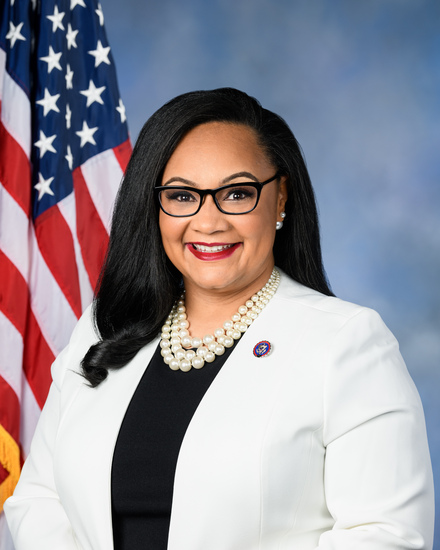
Photo of Nikema Williams
D United States House · District 5 · Georgia On the 2026 ballot

Rep. Nikema Williams

Compare
Total votes
2,837
all sessions
Attendance
99%
32 missed
Near the chamber average
With party
97%
of cast votes
Near the chamber average
Bipartisan score
1%
crosses aisle rarely
Near the chamber average
Sponsored
2,182
bills & resolutions
Higher than 85% of chamber peers
Committees
3
assignments
2,182 bills and resolutions

Sponsored bills

Total
2,182
Primary
162
Co-sponsor
2,020
This page
2,182
matching current filters
Co-sponsor HRES 483
In committee · United States House · Co-sponsor
Recognizing the month of June 2023 as "Immigrant Heritage Month", a celebration of the accomplishments and contributions of immigrants and their children in making the United States a healthier, safer, more diverse, prosperous country, and acknowledging the importance of immigrants and their children to the future successes of the United States.

Maddy summaryHRES 483 is a symbolic resolution recognizing June 2023 as "Immigrant Heritage Month" to celebrate immigrants and their children for their contributions to U.S. health, safety, diversity, and prosperity. It highlights immigrants' roles in critical sectors like healthcare (including 27% of physicians) and the economy (e.g., 44% of Fortune 500 companies founded by immigrants or their descendants). The resolution urges the House to celebrate immigrant contributions, welcome immigrants, and work toward "smart and just immigration policy." As a non-binding resolution, it does not change laws but formally acknowledges immigrants' historical and ongoing impact on U.S. society.

In committee Jun 7, 2023 1 co-sponsor
Co-sponsor HR 3923
In committee · United States House · Co-sponsor
Debt-Free College Act of 2023

Maddy summaryThe Debt-Free College Act of 2023 establishes a State-Federal partnership program to provide debt-free college for eligible students at in-state public institutions of higher education. Participating states would cover students' unmet financial need (the difference between cost of attendance and available aid), while maintaining or increasing their investment in public higher education. The bill requires states to cap tuition increases (based on inflation), maintain need-based aid programs, and implement student success initiatives to support low-income and underserved students. It also creates a separate grant program for HBCUs and MSIs to provide similar debt-free college opportunities, and expands federal financial aid eligibility to include "Dreamer students" (DACA recipients).

In committee Jun 7, 2023 1 co-sponsor
Co-sponsor HR 3907
In committee · United States House · Co-sponsor
United States-Israel International Development Cooperation Act of 2023

Maddy summaryHR 3907 increases annual funding for U.S.-Israel development cooperation from $2 million to $4 million, extending support through 2026 instead of 2023. It requires USAID to report within 180 days on expanding projects to include multilateral partnerships with Arab countries, particularly in Africa, and assesses the need for additional resources. The bill directly affects USAID, Israel's MASHAV agency, and developing nations in Africa, Eastern Europe, and Latin America where joint projects focus on water, agriculture, education, and health. Key provisions adjust funding levels and mandate a formal review of expanding cooperative development efforts. The legislation aims to strengthen existing U.S.-Israel collaboration on global development initiatives.

In committee Jun 7, 2023 1 co-sponsor
Co-sponsor HR 3899
In committee · United States House · Co-sponsor
American Family Act

Maddy summaryThe American Family Act establishes a monthly child tax credit of $250 per month for each child under age 6 and $300 per month for each child aged 6-18, with income limits of $150,000 for joint filers and $112,500 for other filers. The credit is refundable, meaning it can be paid even if the taxpayer owes no income tax, and will be adjusted annually for inflation. The bill includes detailed rules for determining eligibility, including requirements that the child resides with the taxpayer for more than half the month and provisions to prevent fraud through recapture of improperly received payments. The credit will be paid monthly in advance rather than as a single annual payment, with specific mechanisms for calculating and distributing the payments.

In committee Jun 7, 2023 1 co-sponsor
Co-sponsor HR 3854
In committee · United States House · Co-sponsor
Manufacturing Partnership Improvement Act

Maddy summaryHR 3854, the Manufacturing Partnership Improvement Act, amends the National Institute of Standards and Technology Act to strengthen support for small manufacturers and exporters. It requires the Manufacturing Extension Partnership Advisory Board to include at least one labor organization representative focused on manufacturing production workers or apprenticeship programs, and mandates new partnerships between Manufacturing Extension Centers and federal agencies. Specifically, centers must collaborate with Small Business Administration offices (for loan guidance), Economic Development Administration offices (for federal assistance), Department of Labor offices (for workforce development), and U.S. Export Assistance Centers (for export support). These changes aim to improve coordination and access to resources for small manufacturers seeking loans, training, or export opportunities. The bill does not create new programs but refines existing structures to better serve the manufacturing sector.

In committee Jun 6, 2023 1 co-sponsor
Co-sponsor HR 3808
In committee · United States House · Co-sponsor
Afghan Allies Protection Act of 2023

Maddy summaryHR 3808 extends the visa cap for Afghan allies from 38,500 to 58,500, covering Afghan nationals who worked with U.S. forces or international missions in Afghanistan (e.g., interpreters, translators) under the 2009 Afghan Allies Protection Act. It requires the State Department to create a strategy within 180 days to improve processing efficiency, including reviewing staffing, data collection, and appeal procedures for pending applications. The bill also adds provisions for reimbursing applicants' medical exam costs, allowing virtual interviews for visa applications, and ensuring denials include appeal options. These changes directly affect Afghan allies awaiting visas and aim to accelerate their resettlement in the U.S.

In committee Jun 5, 2023 1 co-sponsor
Co-sponsor HR 698
In committee · United States House · Co-sponsor
Assault Weapons Ban of 2023

Maddy summaryHR 698, the Assault Weapons Ban of 2023, prohibits the sale, manufacture, transfer, and possession of specific firearms and ammunition devices commonly referred to as "assault weapons" and "large capacity magazines" in interstate commerce. The bill defines "semiautomatic assault weapons" to include rifles like AR-15s and AK-47s, as well as firearms with specific features such as folding stocks, pistol grips, threaded barrels, and detachable magazines holding more than 15 rounds. It exempts law enforcement, military, antique firearms, and weapons already lawfully owned before the law's enactment (known as "grandfathered" weapons). The bill also requires new identification markings on these weapons and large capacity magazines, and adds background check requirements for transfers of grandfathered weapons.

In committee Jun 5, 2023 1 co-sponsor
Co-sponsor HR 3760
In committee · United States House · Co-sponsor
To amend title VII of the Public Health Service Act to strengthen the mental health workforce, and for other purposes.

This bill establishes a student loan deferment and forgiveness program for physicians who provide mental and behavioral health services (including substance abuse prevention and treatment services) to racial and ethnic minority groups and low-income individuals. To carry out the program, the Department of Health and Human Services must pay the outstanding principal and interest (up to a maximum limit) on specified federal student loans for eligible physicians who work in qualifying employment. While participating in the program, physicians do not need to pay the principal of their loans but must pay any interest that accrues. To be eligible, physicians must complete a mental or behavioral health professions degree or certificate at a minority-serving institution of higher education. Physicians must also provide mental and behavioral health services for five consecutive years while working either (1) as solo practitioners where at least 30% of patients receive Medicaid and at least 50% of patients are members of racial and ethnic minority groups; or (2) at institutions that accept Medicaid and where at least 50% of patients served by the institution are members of racial and ethnic minority groups.

In committee Jun 2, 2023 1 co-sponsor
Co-sponsor HRES 382
Passed · United States House · Co-sponsor
Recognizing the significance of Jewish American Heritage Month as a time to celebrate the contributions of Jewish Americans to the society and culture of the United States.

Maddy summaryThis House resolution symbolically recognizes May as Jewish American Heritage Month, celebrating Jewish Americans' historical contributions to U.S. society and culture. It references rising antisemitism in 2022 (including ADL data showing a 36% increase in incidents) and includes a non-binding call for leaders to combat antisemitism. As a purely symbolic resolution, it does not create new policies or legal requirements.

Passed Jun 1, 2023 1 co-sponsor
Co-sponsor HR 3792
In committee · United States House · Co-sponsor
U.S.-Israel Partnership and Abraham Accords Enhancement Act of 2023

Maddy summaryHR 3792 extends U.S. security funding for Israel through 2028 (Section 3) and expands energy cooperation to include advanced nuclear technologies and carbon capture (Section 5). It requires annual reports on regional security partnerships involving Israel (Section 6) and ensures countries in the Abraham Accords can access U.S. development programs (Section 8). The bill also mandates reports on diplomatic efforts against ICC investigations targeting the U.S. and Israel (Section 10) and encourages people-to-people programs to strengthen the Abraham Accords (Sections 7, 9). These provisions directly affect Israel’s diplomatic engagement, security partnerships, and economic cooperation in the Middle East.

In committee Jun 1, 2023 1 co-sponsor
Showing 1,041 to 1,050 of 2,182 bills