This bill authorizes the Department of Justice (DOJ) to establish a pilot program to determine the effectiveness of body-worn camera continuous training programs in improving policing, including community relations with law enforcement. It allows DOJ to award grants to states and local governments for carrying out these training programs.
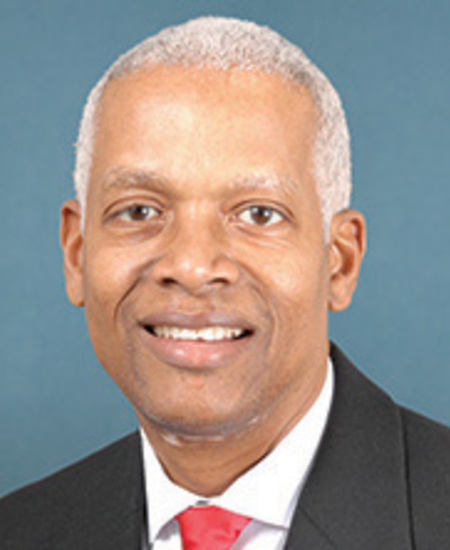
Rep. Henry C. "Hank" Johnson, Jr.
Sponsored bills
This bill requires states to prioritize additional groups (i.e., victims of firearm violence or the family members of victims of homicide) for state victim assistance formula grants.
Strengthen and Tackle Opportunities to Prevent Violence Act of 2022 or the STOP Violence Act of 2022 This bill allows funds under the Antiterrorism and Emergency Assistance Program to be used for efforts to prepare against mass violence and protect public assembly facilities.
21st Century Courts Act of 2022 This bill provides for the establishment of a code of conduct for Supreme Court Justices, judges of the courts of appeals, judges of the district courts, and judges of the Court of International Trade. The bill also requires court proceedings to be recorded and published on the internet.
Jumpstart Our Legal Immigration System Act or the Jumpstart Act This bill makes unused employment-based and family-based immigrant visas from FY1992 through FY2021 available in subsequent fiscal years. It also makes diversity immigrant visas available to individuals who were selected for such a visa between FY2017-FY2021 but were unable to receive the visa due to certain (1) executive actions, or (2) limitations related to COVID-19. The bill also establishes supplemental fees for certain immigration-related applications.
Access to Justice Act of 2022 This bill requires a federal judicial district (or two adjacent districts or parts of districts) to establish a defender organization (i.e., a federal public defender organization or community defender organization). Currently, a federal judicial district (or part of a district or two adjacent districts) may establish a defender organization if at least 200 persons annually require the appointment of counsel.
Open App Markets Act This bill establishes rules related to the operation of an app store by a covered company (i.e., the owner or controller of an app store with more than 50 million U.S. users). An app is a software application or electronic service that may be run or directed by a user on a computer or mobile device. An app store is a publicly available website, software application, or other electronic service that distributes apps from third-party developers to users. The bill prohibits a covered company from (1) requiring developers to use an in-app payment system owned or controlled by the company as a condition of distribution or accessibility, (2) requiring that pricing or conditions of sale be equal to or more favorable on its app store than another app store, or (3) taking punitive action against a developer for using or offering different pricing terms or conditions of sale through another in-app payment system or on another app store. A covered company may not interfere with legitimate business communications between developers and users, use non-public business information from a third-party app to compete with the app, or unreasonably prefer or rank its own apps (or those of its business partners) over other apps. The bill provides for enforcement of its provisions by the Federal Trade Commission and the Department of Justice, as well as through suits brought by developers that are injured by reason of anything prohibited by this bill.
Stopping the Fraudulent Sales of Firearms Act This bill makes it unlawful to import, manufacture, or sell a firearm or ammunition by fraudulent means (e.g., false representations). Further, it makes it unlawful to transmit a wire, radio, or television communication in interstate or foreign commerce related to such a fraudulent importation, manufacture, or sale. A violator is subject to criminal penalties—a fine, a prison term of up to five years, or both.
Amir Locke End Deadly No-Knock Warrants Act This bill establishes requirements and restrictions related to the authorization and execution of warrants at the federal, state, and local levels.
Latonya Reeves Freedom Act of 2022 This bill prohibits government entities and insurance providers from denying community-based services to individuals with disabilities that require long-term service or support that would enable such individuals to live in the community and lead an independent life. Specifically, these entities may not discriminate against such individuals in the provision of community-based services by such actions as imposing prohibited eligibility criteria, cost caps, or waiting lists or failing to provide a specific community-based service. Additionally, community-based services must be offered to individuals with such disabilities prior to institutionalization. Institutionalized individuals must be notified regularly of community-based alternatives. The bill requires the Department of Justice to issue regulations requiring government entities and insurance providers to offer community-based long-term services to individuals with such disabilities who would otherwise qualify for institutional placement. Government entities must ensure sufficient availability of affordable, accessible, and integrated housing that is not a disability-specific residential setting or a setting where services are tied to tenancy. Regulations shall also (1) require government entities and insurance providers to perform self-evaluation on current services, policies, and practices and concerning compliance with requirements of this bill; and (2) require government entities to submit a transition plan. The bill provides funds for FY2022 for the Department of Health and Human Services to provide technical assistance with respect to transition plans. The bill allows civil actions by individuals subjected to, or about to be subjected to, a violation of its requirements.