

Justice is Beneficial Limitation on Investments and Necessary Disclosure Act of 2023 or the Justice is BLIND Act of 2023 This bill requires a federal judge, as well as any spouse or dependent child of a federal judge, to place specified investments into a qualified blind trust (i.e., an arrangement in which certain financial holdings are placed in someone else's control to avoid a possible conflict of interest) until 180 days after the end of their tenure as a federal judge.
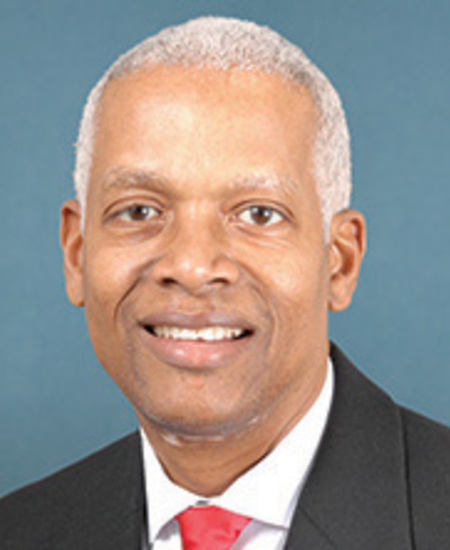
Rep. Henry C. "Hank" Johnson, Jr.
Sponsored bills
Maddy summaryThis bill establishes federal standards for labor-management cooperation between public safety employers (state and local governments) and public safety workers (law enforcement officers, firefighters, and emergency medical services personnel). It requires the Federal Labor Relations Authority to determine if states substantially provide rights like collective bargaining, union representation, and binding arbitration for these workers. States found lacking would need to follow federal bargaining procedures after a two-year transition period or following the next legislative session. The bill explicitly respects existing state laws that provide comparable or better rights to public safety workers. It also prohibits strikes or work stoppages that would disrupt emergency services.
Maddy summaryHR 3537 authorizes the minting of commemorative coins to mark the 100th anniversary of the U.S. Foreign Service, established by the 1924 Rogers Act. The bill specifies three coin types ($5 gold, $1 silver, and half-dollar clad) with limited mintage (50,000 gold, 400,000 silver, 750,000 half-dollars) to be issued in 2025, featuring designs honoring diplomatic history. A surcharge on each coin sale ($35 for gold, $10 for silver, $5 for half-dollars) will fund the Association for Diplomatic Studies and Training (ADST) to support its oral history program and diplomatic preservation efforts. The coins will be legal tender, sold at cost-plus-surcharge, with all revenue directed to ADST per the bill's provisions.
This bill requires the Federal Bureau of Investigation and the Department of State to report to Congress on the death of Shireen Abu Akleh. The report shall also be made available to the public on the State Department's website. (Abu Akleh was a U.S. citizen and journalist who was shot and killed in the city of Jenin in the West Bank in May 2022. At the time of her shooting, Israeli security forces and Palestinians were trading fire in the area.)
Maddy summaryHCONRES 44 is a non-binding congressional resolution urging the creation of a U.S. Commission on Truth, Racial Healing, and Transformation. It does not establish the commission itself but calls for its formation to acknowledge historical injustices against Black, Indigenous, and other people of color - including systemic discrimination in housing, Social Security, the GI Bill, and land policies - and to address ongoing racial inequities. The resolution emphasizes the need to dismantle the "belief in a hierarchy of human value" and promote racial healing as a national priority. It complements ongoing efforts like H.R. 40 (a bill to study reparations) but does not create new legal requirements or funding.
This resolution condemns the great replacement theory, which it describes as a white supremacist conspiracy theory that has been used to falsely justify racially motivated, violent acts of terrorism domestically and internationally.
Maddy summaryHR 3409, the Healthy Families Act, requires most employers to provide employees with paid sick leave. Employees earn 1 hour of paid sick time for every 30 hours worked, up to a maximum of 56 hours per year, which can be used for their own illness, caring for family members, or addressing domestic violence, sexual assault, or stalking situations. Smaller employers with fewer than 15 employees can provide unpaid sick leave instead of paid leave. The bill includes protections against retaliation for using sick leave and requires employers to inform employees about their rights under this law.
Maddy summaryHR 3442, the America’s CHILDREN Act of 2023, creates a pathway to permanent residency for certain college graduates who entered the U.S. as children on specific work visas. It directly affects individuals who were lawfully present as dependents of nonimmigrant visa holders (like H-4 or L-2) for at least 8 years, graduated from a U.S. college, and have lived in the U.S. for 10+ years total. Key provisions include protecting applicants from "aging out" of eligibility by basing age calculations on when their parent’s visa petition was filed (not current age), and allowing them to retain their original visa application date ("priority date") if they later switch to a different visa category. The bill aims to provide stability for young adults who grew up in the U.S. but face immigration barriers due to visa status.
Maddy summaryHR 3422, the Judiciary Act of 2023, would amend the structure of the U.S. Supreme Court by increasing the number of associate justices from eight to twelve. It would also raise the required quorum for court proceedings from six to eight justices. This bill directly affects the Supreme Court's operational structure and composition. The change is purely procedural, altering the Court's size and voting requirements without impacting other legal processes or specific groups of people.
Safe Access to Cash Act of 2023 This bill establishes a new federal statutory framework to govern robbery offenses involving ATMs and related conduct. Currently, the federal bank robbery statute makes it a federal crime to take or attempt to take by force and violence or by intimidation, money or other property from any bank, credit union, or savings and loan association. A violation is punishable by a statutory maximum prison term of 20 years (or 25 years, if the offense includes assault or use of a dangerous weapon). However, federal circuit courts have split on whether forcing someone to withdraw money from an ATM qualifies as an offense under the federal bank robbery statute. In United States v. Chavez, the Fifth Circuit Court of Appeals held that the bank customer, rather than the bank, had possession of the funds when the robbery occurred, so a necessary element of the federal bank robbery statute--that the money belonged to the bank--was not satisfied. In contrast, the Tenth, Seventh, and Fourth Circuits have held that directly forcing a bank customer to withdraw money from an ATM constitutes a federal bank robbery because the funds belonged to the bank when the withdrawal occurred. This bill establishes new statutory criminal offenses for ATM robbery and related offenses such as ATM theft. A violation is subject to the same criminal penalties as an offense under the federal bank robbery statute--a statutory maximum prison term of 20 years (or 25 years, if the offense includes assault or use of a dangerous weapon).