

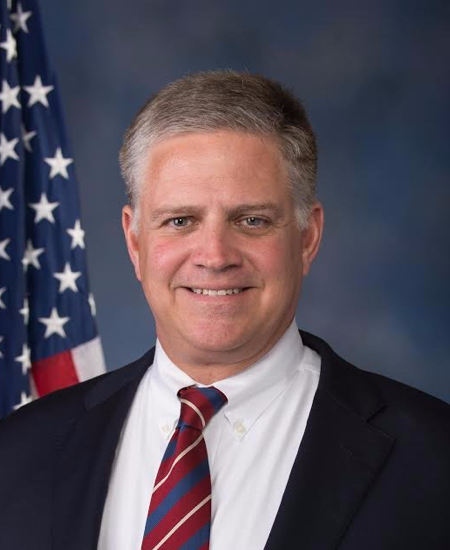
Maddy summaryH.J.Res. 65 designates November 9th each year as "Gold Star Father's Day" to honor fathers who have lost children serving in the U.S. Armed Forces. The resolution recognizes these fathers' sacrifice, aligns with existing recognition of Gold Star Mothers (since 1936), and supports efforts to honor military families. It does not create new benefits or legal requirements but formally designates a day for national recognition of fathers who lost children in military service. This symbolic resolution follows Georgia's 2017 designation of November 9 as "Georgia Gold Star Father's Day."
Rep. A. Drew Ferguson IV
Sponsored bills
Maddy summaryHR 3678, the Pay Less at the Pump Act, terminates the Hazardous Substance Superfund financing rate effective January 1, 2023, and changes how advances from the Superfund are repaid. Specifically, it ends the requirement to apply a specific financing rate to the Superfund after 2022 and modifies repayment rules to require quarterly payments from unobligated funds until fully repaid. The bill directly affects the Superfund program and entities receiving advances from it, altering its financial structure. Note: The bill’s title is misleading - the legislation does not address fuel prices or gasoline costs at the pump. It focuses solely on Superfund financing terms, with effective dates specified in the text.
Maddy summaryThis bill requires the Treasury Secretary to report quarterly on foreign countries imposing "extraterritorial" or "discriminatory" taxes targeting U.S. businesses. It mandates progressively higher tax rates (starting at 5% and increasing to 20% over time) on income and payments from foreign individuals and corporations in those countries. The U.S. government can also restrict federal procurement from such entities and consider these taxes in trade negotiations. These measures directly affect foreign businesses operating in the U.S. or conducting transactions with U.S. entities. The policy aims to counter foreign tax policies that the U.S. views as unfair under international tax norms.
Small Business Growth Act This bill increases from $1 million to $2 million to the limitation on expensing of depreciable business assets. It also increases the asset threshold amount used to reduce the expensing limitation.
Maddy summaryThis bill requires that AM radio receivers be included as standard equipment in all new motor vehicles (such as cars and trucks) sold in the United States, with a rule to be issued by the Department of Transportation within one year. The rule must ensure AM radio is easily accessible on the dashboard and allows manufacturers to use digital AM radio technology instead of traditional AM. During the one-year period between the bill's enactment and the rule's effective date, manufacturers must clearly label vehicles without AM radio. The bill also directs a study to evaluate whether an alternative system could deliver emergency alerts as reliably as AM radio across the country, especially during crises.
National Law Enforcement Officers Remembrance, Support and Community Outreach Act This bill directs the Department of Justice (DOJ) to establish a National Law Enforcement Officers Remembrance, Support, and Community Outreach Program. The bill further directs DOJ to award a grant under the program to the National Law Enforcement Officers Memorial Fund for the expenses associated with community outreach, public education, and officer safety and wellness programs operated by the of the National Law Enforcement Officers Memorial Fund and National Law Enforcement Museum.
Maddy summaryThe FIGHT Act (HR 2742) amends the Animal Welfare Act to specifically target animal fighting events, such as cockfighting, by defining "rooster" as any male chicken over six months old and banning the live broadcasting (simulcasting) of such events. It prohibits using the postal service or interstate transport to move roosters for animal fighting purposes and adds civil enforcement tools allowing citizens to sue violators after a 60-day notice period. Fines up to $5,000 per violation may be imposed, and property used in animal fighting ventures can be seized. These changes strengthen enforcement against animal fighting by expanding legal remedies for the public and authorities.
Permanent Tax Cuts for American Families Act of 2023 This bill permanently increases the standard tax deduction for nonitemizing taxpayers. It also requires an inflation adjustment to the increased deduction amounts.
Maddy summaryHR 3238, the Affordable Housing Credit Improvement Act of 2023, updates the Low-Income Housing Tax Credit (LIHTC) program to increase the availability of affordable housing across the United States. The bill makes several key changes including increasing state funding formulas, modifying tenant eligibility rules to better serve vulnerable populations (such as domestic violence victims and students), and expanding credit eligibility for projects in rural and Native American communities. Specific provisions raise the credit for properties serving extremely low-income households, clarify rules around tenant income increases, and require housing providers to protect victims of domestic violence. The bill also updates terminology from "low-income" to "affordable" throughout the tax code and enhances program transparency through data sharing requirements. These changes aim to make the LIHTC program more effective at creating and preserving affordable housing units for low-income households nationwide.
Direct Capital Access Act of 2023 or the DCA Act of 2023 This bill increases the number of daily round-trip flights allowed at Ronald Reagan Washington National Airport (DCA). Specifically, this bill adds 56 new slots at DCA to allow for 28 additional daily round-trip flights. (Airlines flying to and from DCA are subject to slot and perimeter rules set by federal law and regulation. The slot rules determine the total number of flight slots that can be handled in a given time period. In addition, a statutory perimeter rule limits nonstop flights to a 1,250-mile radius unless they are granted an exemption in law.) Current law limits DCA to a maximum of 67 hourly slots for flights both within- and beyond-perimeter; a round-trip flight serving DCA requires two slots (or a slot pair). Of those slots, 40 daily slots are exempt from the perimeter rule. Under the bill's slot increase, operations at DCA may not increase by more than eight flights per hour.