

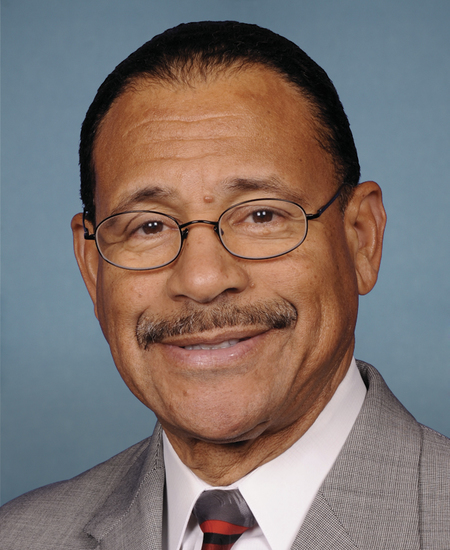
Photo of Sanford D. Bishop, Jr.
D United States House · District 2 · Georgia On the 2026 ballot

Rep. Sanford D. Bishop, Jr.

Compare
Total votes
2,837
all sessions
Attendance
99%
34 missed
Near the chamber average
With party
97%
of cast votes
Lower than 79% of chamber peers
Bipartisan score
2%
crosses aisle rarely
Higher than 78% of chamber peers
Sponsored
1,335
bills & resolutions
Near the chamber average
Committees
4
assignments
1,335 bills and resolutions

Sponsored bills

Total
1,335
Primary
27
Co-sponsor
1,308
This page
1,335
matching current filters
Co-sponsor HR 703
In committee · United States House · Co-sponsor
Main Street Tax Certainty Act

Maddy summaryHR 703, the Main Street Tax Certainty Act, makes a key tax deduction permanent for small business owners. It removes the temporary sunset provision (subsection (i)) from Section 199A of the tax code, ensuring the qualified business income deduction remains available for eligible small businesses. This change directly affects pass-through business owners (like S-corps, partnerships, and sole proprietorships) who currently qualify for this deduction. The permanent change takes effect for tax years starting after December 31, 2025.

In committee Jan 23, 2025 1 co-sponsor
Co-sponsor HR 648
In committee · United States House · Co-sponsor
Strengthening our Servicemembers with Milk Act

Maddy summaryHR 648, the Strengthening our Servicemembers with Milk Act, requires the Secretary of Defense to provide a variety of milk options - including unflavored, organic, lactose-free, and different fat levels - to all members of the Armed Forces at military dining facilities. The bill mandates that installations offer these choices to support servicemember nutrition and dietary needs. It also prohibits purchasing milk from entities owned or controlled by foreign adversaries, as defined by Commerce Department regulations. This policy directly affects military personnel dining at on-base facilities nationwide.

In committee Jan 23, 2025 1 co-sponsor
Co-sponsor HR 612
In committee · United States House · Co-sponsor
Health Care Providers Safety Act of 2025

Maddy summaryHR 612, the Health Care Providers Safety Act of 2025, provides federal funding to help health care facilities improve safety. It authorizes the Secretary to award grants to hospitals, clinics, and other health care providers to cover costs for physical security (like structural improvements) and cyber security (such as data privacy tools and video surveillance systems). These grants directly help health care providers protect their facilities, staff, and patients from security threats. The bill creates a new funding mechanism under the Public Health Service Act, making specific security upgrades eligible for federal support.

In committee Jan 22, 2025 1 co-sponsor
Co-sponsor HR 601
In committee · United States House · Co-sponsor
Estate Tax Rate Reduction Act

Maddy summaryThe Estate Tax Rate Reduction Act lowers the federal estate tax rate to 20% for taxable estates, gifts, and generation-skipping transfers. This change replaces the previous progressive rate schedule with a flat 20% rate, applying to estates of decedents dying, gifts, and certain transfers after December 31, 2024. The bill affects individuals with estates exceeding the current tax exemption threshold, as it reduces the tax rate on the taxable portion of those estates. It does not alter the exemption amount, meaning only estates above the threshold are subject to this rate reduction.

In committee Jan 22, 2025 1 co-sponsor
Co-sponsor HR 608
In committee · United States House · Co-sponsor
COVER Now Act

Maddy summaryThe COVER Now Act allows cities, counties, or other local governments in states that have not expanded Medicaid to provide health coverage to Medicaid-eligible residents. Local governments in non-expansion states can apply for a federal demonstration project to cover these residents, with the federal government paying 90-100% of costs over seven years (starting at 100% for the first three years). The bill prohibits states from retaliating against localities that participate, such as by shifting costs, reducing funding, or blocking healthcare provider participation. This directly affects uninsured residents in non-expansion states and local governments seeking to fill coverage gaps.

In committee Jan 22, 2025 1 co-sponsor
Co-sponsor HR 610
In committee · United States House · Co-sponsor
Close the Medigap Act of 2025

Maddy summaryThe Close the Medigap Act of 2025 would prohibit Medigap insurance issuers from denying coverage or charging higher premiums based on health status, pre-existing conditions, genetic information, or other factors. It requires insurers to spend a minimum percentage of premiums on health care claims and improves the Medicare Plan Finder website to provide clearer information about coverage options, out-of-pocket costs, and guaranteed issue requirements. The bill applies to Medigap policies effective January 1, 2026, with full implementation by 2031, and requires Medigap brokers to disclose payments they receive from insurers. These changes would directly affect Medicare beneficiaries, particularly those with pre-existing conditions who have historically faced barriers to obtaining affordable supplemental coverage.

In committee Jan 22, 2025 1 co-sponsor
Co-sponsor HRES 48
In committee · United States House · Co-sponsor
Honoring Reverend Dr. Martin Luther King, Jr., by celebrating diversity, promoting tolerance, and condemning hate.

Maddy summaryHRES 48 is a ceremonial resolution honoring Dr. Martin Luther King, Jr., by commemorating his 96th birthday on January 20, 2025. The resolution affirms his teachings on diversity, equality, and nonviolence, and specifically condemns hate, discrimination, and harassment targeting Black Americans, Indigenous peoples, Jewish communities, Asian-American/Pacific Islander groups, Muslim communities, Hispanic/Latino communities, LGBTQ+ individuals, and others. It calls on all people to uphold Dr. King’s values of justice, tolerance, and peace. As a symbolic gesture, this resolution has no legal effect but expresses the House’s commitment to these principles.

In committee Jan 16, 2025 1 co-sponsor
Co-sponsor HRES 51
In committee · United States House · Co-sponsor
Honoring Zeta Phi Beta Sorority, Inc., on reaching the historic milestone of 105 years of scholarship, service, sisterhood, and finer womanhood.

Maddy summaryHRES 51 is a ceremonial resolution passed by the U.S. House of Representatives to honor Zeta Phi Beta Sorority, Inc. on its 105th anniversary. The resolution commends the sorority for its founding in 1920 at Howard University and its decades of work in scholarship, service, and community leadership. It recognizes the organization's global membership (over 100,000 members across 875 chapters) and its historic milestones, including being the first National Pan-Hellenic Council organization to centralize operations and charter chapters in Africa. This resolution has no policy impact - it is purely symbolic recognition of the sorority's legacy.

In committee Jan 16, 2025 1 co-sponsor
Co-sponsor HR 539
In committee · United States House · Co-sponsor
Chiropractic Medicare Coverage Modernization Act of 2025

Chiropractic Medicare Coverage Modernization Act of 2025 This bill expands Medicare coverage of chiropractic services to include all services provided by chiropractors, rather than only subluxation corrections through manual manipulation of the spine.

In committee Jan 16, 2025 1 co-sponsor
Co-sponsor HR 516
In committee · United States House · Co-sponsor
To amend the Internal Revenue Code of 1986 to modify the railroad track maintenance credit.

This bill increases the annual limit on the tax credit for qualified railroad track maintenance expenses (also referred to as the short line railroad tax credit) and expands eligibility for claiming the credit. Under current law, the tax credit is limited each tax year to $3,500 multiplied by the sum of the number of miles of railroad track owned or leased by the taxpayer (miles owned or leased) and the number of railroad track miles assigned to the taxpayer by a Class II or III railroad (miles assigned). This bill increases the annual limit to $6,100 multiplied by the sum of miles owned or leased and miles assigned. The $6,100 amount used in the calculation of the tax credit limit is adjusted for inflation for tax years beginning after 2025. The bill also expands eligibility for the tax credit to include gross expenses for maintaining railroad tracks owned or leased as of January 1, 2024. Under current law, the tax credit is limited to gross expenses for maintaining railroad tracks owned or leased as of January 1, 2015.

In committee Jan 16, 2025 1 co-sponsor
Showing 381 to 390 of 1,335 bills
Previous 1 … 38 39 40 … 134 Next