

Maddy summaryThis resolution formally censures Representative Al Green (D-TX) for disrupting President Trump's address during a joint session of Congress on March 4, 2025. It requires him to appear in the House chamber for the public reading of the censure resolution, which states his actions violated decorum rules and brought disrepute to Congress. As a procedural resolution, it does not enact policy changes but serves as a formal reprimand for conduct during a congressional session.
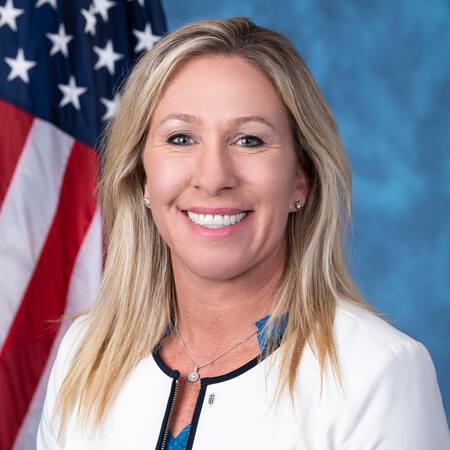
Rep. Marjorie Taylor Greene
Sponsored bills
Maddy summaryHR 1862, the English Language Unity Act of 2025, designates English as the official language of the U.S. federal government. It requires all official government functions - such as laws, regulations, and public proceedings - to be conducted in English, with key exceptions including language teaching, disability education, national security, public health, census activities, and victim rights. The bill also mandates that naturalization applicants demonstrate English reading comprehension of foundational U.S. documents like the Declaration of Independence and Constitution, with ceremonies conducted in English. These provisions apply to federal operations, not state governments or private sector policies, and explicitly preserve existing protections for Native American languages and the right to learn other languages.
Maddy summaryHR 1846, the Federal Reserve Board Abolition Act, would end the Federal Reserve System by abolishing its Board of Governors and all 12 Federal Reserve banks after a one-year transition period following enactment. The bill requires liquidating the Fed's assets through the Office of Management and Budget, transferring all liabilities (including employee benefits) to the Treasury Secretary, and depositing net proceeds into the Treasury's General Fund. This bill directly affects the Federal Reserve's structure and operations, transferring its responsibilities to the Treasury without altering current monetary policy functions.
Maddy summaryThis resolution impeaches Judge Amir Hatem Mahdy Ali of the U.S. District Court for the District of Columbia, alleging he violated constitutional principles by blocking a 2024 executive order (EO 14169) that paused foreign aid funding. The resolution claims Judge Ali issued a restraining order requiring immediate fund disbursement without considering USAID's history of funding terrorism-linked activities, citing a 2021 GAO report and a 2024 incident involving al-Qaida-affiliated fighters. It asserts his actions disregarded presidential authority under Article II and compromised national interests. The resolution concludes he is unfit to serve as a federal judge due to "lacking intellectual honesty and basic integrity."
Maddy summaryThis bill amends federal law to require that individuals purchasing handguns from licensed dealers be at least 21 years old, removing previous exceptions that allowed sales to those under 21 for certain firearms. It directly affects anyone seeking to buy handguns from federally licensed gun sellers, raising the minimum age from 18 to 21 for these transactions. The bill also removes an existing age verification statement (requiring buyers to confirm they are 21 or older) for handgun purchases, aligning the requirement with the new age standard. Rifles and shotguns remain unaffected by this provision, as the amendment specifically targets handguns only. The bill's title referencing "voter" is unrelated to its actual provisions on firearm sales.
Maddy summaryHRES 157 is a resolution introduced by Representative Ogles to impeach Judge John Deacon Bates of the U.S. District Court for the District of Columbia. The resolution alleges Judge Bates committed high crimes and misdemeanors by ordering the CDC, HHS, and FDA to restore government webpages containing LGBTQI+ health content, which the resolution claims violated Executive Order 14168 and reflected a flawed legal analysis. The article of impeachment states this conduct was incompatible with a federal judge's role, as it allegedly failed to properly consider the agencies' actions. If passed by the House, this resolution would send the impeachment charges to the Senate for trial.
Maddy summaryHRES 145 is a resolution by the U.S. House of Representatives to impeach Judge Paul Adam Engelmayer of the Southern District of New York for high crimes and misdemeanors. The resolution's Article I alleges Judge Engelmayer abused his judicial authority by improperly restricting President Trump and Secretary Bessent from accessing Treasury Department records containing personally identifiable and confidential financial data. This action, according to the resolution, violated his oath of impartiality and duty to the public. The resolution does not enact policy but initiates the impeachment process, which would require Senate trial for removal from office.
Maddy summaryThe DEFUND Act of 2025 would terminate U.S. membership in the United Nations and all its affiliated bodies, including the World Health Organization, by repealing the legal foundations for U.S. participation. It requires the closure of the U.S. Mission to the UN, withdrawal from UN headquarters agreements, and the cessation of all U.S. financial contributions to the UN (except for termination costs). The bill also mandates that UN entities vacate U.S. government properties, revokes diplomatic immunity for UN officials in the U.S., and prohibits U.S. involvement in UN peacekeeping operations. Future U.S. re-entry into the UN would require Senate approval and a reservation allowing for immediate withdrawal.
Maddy summaryHR 1488 repeals two laws that authorized U.S. military force against Iraq: the 1991 Gulf War authorization and the 2002 Iraq War authorization. This bill removes the legal basis for military operations under these specific resolutions, directly affecting how future U.S. military actions in Iraq could be justified. The key provision is the direct repeal of both resolutions from federal law, eliminating their continued legal effect. As a result, any new military action in Iraq would require fresh congressional authorization rather than relying on these repealed laws.
Maddy summaryHRES 143 is a procedural resolution introduced by the U.S. House of Representatives to impeach Judge Paul Engelmayer of the U.S. District Court for the Southern District of New York. The resolution cites two articles of impeachment: judicial misconduct for halting a presidential executive order on political grounds and abuse of judicial power to favor personal or political interests. This resolution does not create new laws or policies but initiates the formal impeachment process, which would be sent to the Senate for trial. It directly affects Judge Engelmayer and the federal judiciary's procedural standing, not the public or legislation.