

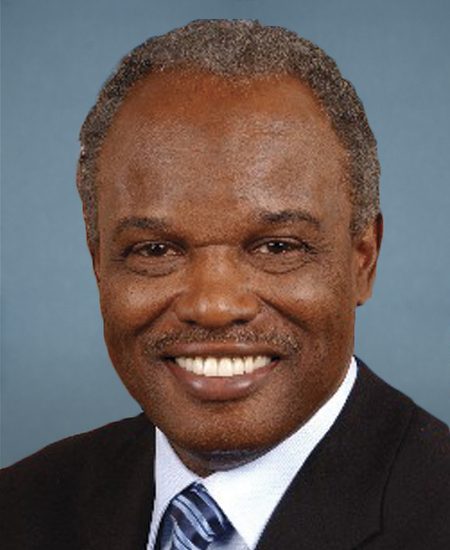
Photo of David Scott
D United States House · District 13 · Georgia

Rep. David Scott

Compare
Total votes
2,654
all sessions
Attendance
98%
58 missed
Near the chamber average
With party
97%
of cast votes
Higher than 78% of chamber peers
Bipartisan score
2%
crosses aisle rarely
Lower than 88% of chamber peers
Sponsored
838
bills & resolutions
Near the chamber average
Committees
0
assignments
838 bills and resolutions

Sponsored bills

Total
838
Primary
57
Co-sponsor
781
This page
838
matching current filters
Co-sponsor HR 783
In committee · United States House · Co-sponsor
Sustainable Cardiopulmonary Rehabilitation Services in the Home Act

Sustainable Cardiopulmonary Rehabilitation Services in the Home Act This bill permanently allows services relating to cardiac rehabilitation programs, intensive cardiac rehabilitation programs, and pulmonary rehabilitation programs to be furnished via telehealth at a beneficiary's home under Medicare.

In committee Jan 28, 2025 1 co-sponsor
Primary HR 812
In committee · United States House · Lead sponsor
MAKERS Act

Maddy summaryThe MAKERS Act (HR 812) establishes a National Science Foundation grant program to fund research and development of makerspaces at colleges and community organizations. It prioritizes funding for projects partnering with community colleges, historically Black colleges, minority-serving institutions, rural communities, and workforce training programs. Grants support equipment, research on makerspace effectiveness in teaching STEM skills, and sharing best practices - without funding new building construction. The bill directly affects higher education institutions and community groups seeking to build STEM skills through hands-on learning spaces.

In committee Jan 28, 2025 0 co-sponsors
Co-sponsor HR 738
In committee · United States House · Co-sponsor
Universal Right To Vote by Mail Act of 2025

Maddy summaryHR 738, the Universal Right To Vote by Mail Act of 2025, would require all states to allow any voter to request and cast a mail-in ballot for federal elections without needing to provide a reason, directly affecting all voters in states holding federal elections. The bill prohibits states from adding extra conditions beyond ballot request and return deadlines, and mandates that election officials must notify voters of signature discrepancies or missing information within one business day, giving them three days to correct errors before ballots are rejected. It explicitly preserves states' ability to maintain in-person polling places and applies to federal elections starting in 2026. The bill cites findings that universal mail-in voting increases participation, reduces poll wait times, and has no proven fraud risk, while eliminating requirements for personal justification or notarization.

In committee Jan 24, 2025 1 co-sponsor
Co-sponsor HR 608
In committee · United States House · Co-sponsor
COVER Now Act

Maddy summaryThe COVER Now Act allows cities, counties, or other local governments in states that have not expanded Medicaid to provide health coverage to Medicaid-eligible residents. Local governments in non-expansion states can apply for a federal demonstration project to cover these residents, with the federal government paying 90-100% of costs over seven years (starting at 100% for the first three years). The bill prohibits states from retaliating against localities that participate, such as by shifting costs, reducing funding, or blocking healthcare provider participation. This directly affects uninsured residents in non-expansion states and local governments seeking to fill coverage gaps.

In committee Jan 22, 2025 1 co-sponsor
Co-sponsor HR 485
In committee · United States House · Co-sponsor
Muhammad Ali Congressional Gold Medal Act

Maddy summaryHR 485, the Muhammad Ali Congressional Gold Medal Act, authorizes Congress to award a gold medal in recognition of Muhammad Ali's lifetime contributions to sports, civil rights, and humanitarian causes. The bill directs the Treasury Secretary to strike the medal and present it to Ali's widow, Lonnie Ali, following his death in 2016. It also permits the sale of bronze duplicates to cover costs, with proceeds going to the U.S. Mint. This is a commemorative measure with no policy impact, solely honoring Ali's legacy through a symbolic medal.

In committee Jan 16, 2025 1 co-sponsor
Co-sponsor HR 507
In committee · United States House · Co-sponsor
Veterans Member Business Loan Act

Maddy summaryHR 507, the Veterans Member Business Loan Act, amends the Federal Credit Union Act to explicitly include loans made to veterans as qualifying "member business loans" under credit unions. This change directly affects veterans seeking business financing through federal credit unions, allowing them to access these loans under the same framework as other small business borrowers. The key mechanism is adding a new definition category ("made to a veteran") to the existing eligibility criteria for business loans, using the standard military definition of "veteran" from Title 38, U.S. Code. The bill does not create new funding or programs but expands existing credit union lending options to include veterans. This definition change takes effect six months after the bill's enactment.

In committee Jan 16, 2025 1 co-sponsor
Co-sponsor HR 429
In committee · United States House · Co-sponsor
Rosie the Riveter Commemorative Coin Act

Maddy summaryHR 429, the Rosie the Riveter Commemorative Coin Act, authorizes the U.S. Treasury to mint and sell three types of commemorative coins ($5 gold, $1 silver, and half-dollar) to honor women who worked on the U.S. home front during World War II. The coins will be sold at face value plus surcharges ($35 for gold, $10 for silver, $5 for half-dollar), with all surcharge revenue directed to the Rosie the Riveter Trust to support the Rosie the Riveter WWII Home Front National Historical Park and related educational programs. The coins must be issued between January 1, 2028, and December 31, 2028, in specified quantities (50,000 gold, 400,000 silver, 750,000 half-dollar), with all costs covered by the sales revenue to avoid net government expense.

In committee Jan 15, 2025 1 co-sponsor
Co-sponsor HRES 23
In committee · United States House · Co-sponsor
Proxy Voting for New Parents Resolution

Maddy summaryThe Proxy Voting for New Parents Resolution (HRES 23) would allow U.S. House Members who have given birth or whose spouse has given birth to appoint another Member as a proxy to cast their vote or record their presence in the House and committees for up to 12 weeks after childbirth. To use this, the new parent must submit a signed letter to the Clerk detailing the birth or medical condition and naming the proxy; the proxy must vote exactly as instructed and announce the vote as "by proxy." The proxy vote does not count toward quorum, and the new parent can revoke the proxy at any time by submitting a new letter or casting their own vote. This resolution applies to all House Members, including Delegates and the Resident Commissioner, though they cannot cast votes for the House itself.

In committee Jan 9, 2025 1 co-sponsor
Co-sponsor HRES 30
In committee · United States House · Co-sponsor
Honoring the life, achievements, legacy, and public service of former President James Earl "Jimmy" Carter, Jr.

This resolution honors the life, achievements, legacy, and distinguished public service of former President Jimmy Carter. The resolution also (1) acknowledges President Carter's contributions to the state of Georgia, the United States, and the world; and (2) establishes his legacy as one of the great leaders and statesmen of the United States.

In committee Jan 9, 2025 1 co-sponsor
Co-sponsor HR 247
In committee · United States House · Co-sponsor
Health Care Affordability Act of 2025

Maddy summaryThis bill increases healthcare affordability for low- and middle-income people by expanding eligibility for premium tax credits under the Affordable Care Act. It removes the previous 400% of poverty level cap for subsidy eligibility and replaces it with a new sliding scale based on income tiers, ranging from 0% to 8.5% of household income for coverage costs. The scale adjusts linearly across income levels, with households earning 300-400% of poverty paying 6.0%-8.5% of income (up from the prior fixed 400% cap), while lower-income households pay progressively less. These changes apply to tax years beginning after December 31, 2025, directly affecting individuals purchasing health insurance through marketplace plans.

In committee Jan 9, 2025 1 co-sponsor
Showing 201 to 210 of 838 bills
Previous 1 … 20 21 22 … 84 Next