

Maddy summaryThis bill creates new federal crimes for killing or assaulting law enforcement officers and public safety personnel while they're on duty or because of their status as officers. It establishes mandatory minimum sentences of 10 years for murder of officers, with higher penalties for assaults causing serious injury or using deadly weapons. The bill also creates a new offense for fleeing to avoid prosecution for killing officers and limits federal habeas corpus relief for those convicted of killing officers. Additionally, it expands law enforcement officers' authority to carry firearms in certain locations. The bill directly affects law enforcement officers, public safety personnel, and individuals who commit violent acts against them.
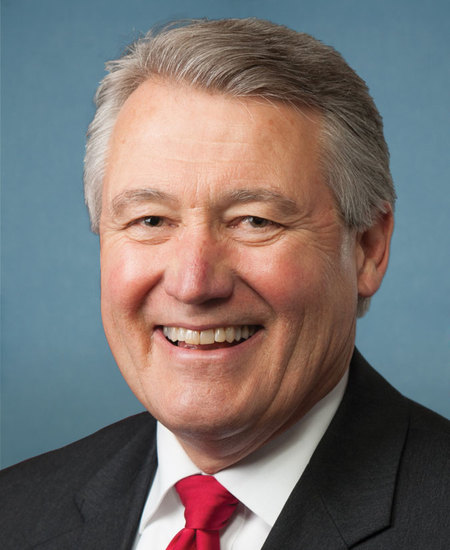
Rep. Rick W. Allen
Sponsored bills
Maddy summaryHRES 358 is a symbolic resolution commemorating the 50th anniversary of the National Wild Turkey Federation (NWTF). It recognizes the NWTF's 50 years of work, including conserving over 22 million acres of habitat, investing $500 million in conservation, and recruiting over 1.5 million hunters since 2012. The resolution celebrates the NWTF's role as a key partner in wildlife conservation and hunting heritage efforts. As a non-binding resolution, it does not create new laws or funding but formally honors the organization's contributions to habitat conservation and outdoor traditions.
Maddy summaryThis bill directs the Federal Communications Commission (FCC) to review its satellite communication rules to identify potential changes that could better support precision agriculture. It specifically requires the FCC, with input from a designated agricultural technology task force, to examine rules for fixed, mobile, and earth exploration satellite services. The FCC must then submit a report within 15 months to Congress with recommendations for implementing any rule changes. This bill does not enact new rules itself but initiates a review process to improve satellite connectivity for farmers using precision agriculture technology.
This resolution expresses U.S. support for Israel and its efforts to defend its right to existence. The resolution also declares that the United States and international community must prevent Iran from acquiring or building nuclear weapons.
Maddy summaryThis bill protects living organ donors from insurance discrimination by prohibiting life, disability, and long-term care insurers from denying coverage, raising premiums, or altering policy terms solely because someone donated an organ while alive. It also updates the Family and Medical Leave Act to include recovery from organ donation surgery as a qualifying health condition, allowing donors to take protected leave for this purpose. Additionally, the bill requires the Health and Human Services Secretary to update public educational materials about living donation benefits, risks, and insurance protections within six months of enactment. These changes directly affect living organ donors, insurers, employers, and healthcare systems by ensuring fair access to insurance and workplace leave.
Maddy summaryThe Employee Rights Act (HR 2700) amends key labor laws to strengthen employee rights in collective bargaining and privacy. It requires employers to use secret ballot elections for selecting bargaining representatives and to provide labor organizations with voter lists containing employee names and one form of contact information (chosen by the employee) within two business days of an election. The bill prohibits employers from using employee personal information for non-organizing purposes and mandates written authorization for using union dues on non-bargaining activities, with authorizations expiring after one year. Additionally, it clarifies joint employment standards to prevent misclassification and adds tribal sovereignty protections to labor law definitions.
This joint resolution nullifies a Department of Labor final rule entitled Adverse Effect Wage Rate Methodology for the Temporary Employment of H-2A Nonimmigrants in Non-Range Occupations in the United States and published on February 28, 2023. This rule makes changes to the methodology used to set adverse effect wage rates for H-2A workers (temporary agricultural workers), including by using Bureau of Labor Statistics wage surveys in certain instances. (Generally, the minimum wage for an H-2A worker is the highest of the adverse effect wage rate, the applicable minimum wage, the prevailing wage for that occupation in that area, or any agreed-upon collective bargaining wage.)
Maddy summaryHR 2826, the Save Local Business Act, clarifies when multiple businesses can be held jointly responsible for labor laws. It amends the National Labor Relations Act and Fair Labor Standards Act to state that a business is only a joint employer if it directly controls key employment terms like hiring, pay, schedules, or discipline for another business's workers. This directly affects franchisors, contractors, and similar business models that might previously have been deemed joint employers under broader interpretations. The bill aims to limit joint employer liability to cases where one business has clear, day-to-day control over essential worker conditions.
Maddy summaryHR 2808, the Arnold Daniel Palmer Commemorative Coin Act, authorizes the U.S. Mint to produce three commemorative coins in 2029 honoring golfer Arnold Palmer: $5 gold coins (50,000 max), $1 silver coins (400,000 max), and half-dollar clad coins (750,000 max). The bill requires coin designs to feature Palmer's image and includes surcharges ($35 for gold, $10 for silver, $5 for half-dollar) that fund the Arnold & Winnie Palmer Foundation. All surcharge revenue must support the Foundation's work in youth health, character development through golf, and nature wellness programs. The coins are legal tender but will only be issued in 2029, with all funds covering minting costs before surcharges are directed to the Foundation.
Maddy summaryHR 2743 prohibits large financial institutions (over $100 billion in assets) from denying banking services to lawful businesses based on subjective political reasons, industry type, or reputational concerns. It requires these institutions to use objective, risk-based assessments for service decisions and provide written justifications for denials. The law applies to banks, credit unions, and payment networks, with civil penalties for violations including fines up to $10,000 per incident. It specifically ensures businesses operating legally under federal law receive fair access to financial services without discrimination. The bill mandates that denials be based on documented risk factors, not political bias or category-based exclusion.