

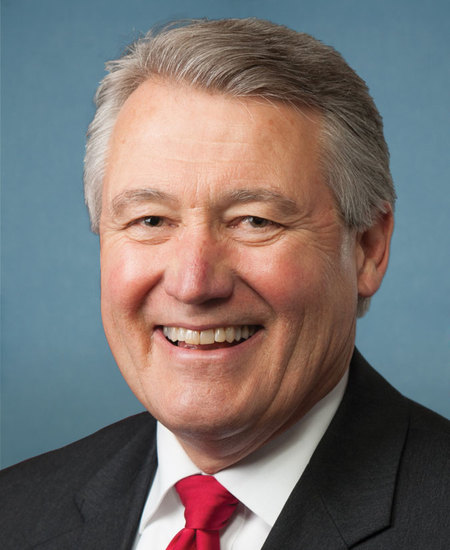
Photo of Rick W. Allen
R United States House · District 12 · Georgia On the 2026 ballot

Rep. Rick W. Allen

Compare
Total votes
2,837
all sessions
Attendance
98%
44 missed
Near the chamber average
With party
94%
of cast votes
Higher than 90% of chamber peers
Bipartisan score
3%
crosses aisle rarely
Lower than 91% of chamber peers
Sponsored
717
bills & resolutions
Lower than 83% of chamber peers
Committees
6
assignments
717 bills and resolutions

Sponsored bills

Total
717
Primary
49
Co-sponsor
668
This page
717
matching current filters
Primary HR 1446
In committee · United States House · Lead sponsor
Validate Prior Learning to Accelerate Employment Act

Validate Prior Learning to Accelerate Employment Act This bill incorporates assessments that measure an individual's prior knowledge, skills, competencies, and experiences into specified state and local employment training activities under the Workforce Innovation and Opportunity Act. An assessment may be used, for example, to award a recognized postsecondary credential that employers use for recruitment, hiring, retention, or advancement purposes.

In committee Feb 21, 2025 0 co-sponsors
Co-sponsor HR 1492
In committee · United States House · Co-sponsor
To amend title XI of the Social Security Act to equalize the negotiation period between small-molecule and biologic candidates under the Drug Price Negotiation Program.

Maddy summaryHR 1492 amends the Social Security Act to extend the negotiation period for standard drug manufacturers under the federal drug pricing program. Specifically, it changes the timeframe from 7 years to 11 years for small-molecule drugs (like traditional pills) to negotiate prices with the government, aligning it with the existing 12-year period for complex biologic drugs (like insulin or monoclonal antibodies). This adjustment directly affects pharmaceutical companies that produce small-molecule drugs, giving them a longer window to negotiate pricing terms. The bill makes this change effective as if it had been part of the 2022 law that established the program.

In committee Feb 21, 2025 1 co-sponsor
Co-sponsor HCONRES 12
In committee · United States House · Co-sponsor
Supporting the Local Radio Freedom Act.

This concurrent resolution declares that Congress should not impose any new performance fee, tax, royalty, or other charge relating to the public performance of sound recordings on a local radio station for broadcasting sound recordings over the air, or on any business for such public performance of sound recordings.

In committee Feb 13, 2025 1 co-sponsor
Co-sponsor HR 1301
In committee · United States House · Co-sponsor
Death Tax Repeal Act

Maddy summaryHR 1301, the Death Tax Repeal Act, would eliminate the federal estate tax and generation-skipping transfer tax for estates of individuals dying on or after its enactment date. It directly affects individuals inheriting significant assets, as it removes taxes on estates exceeding $10 million (adjusted for inflation) and repeals taxes on large transfers between generations. The bill modifies the gift tax by establishing a $10 million lifetime exemption with annual inflation adjustments, replacing previous tax brackets. It applies to estates, gifts, and transfers occurring on or after the bill's effective date.

In committee Feb 13, 2025 1 co-sponsor
Co-sponsor HR 1232
In committee · United States House · Co-sponsor
National Right-to-Work Act

Maddy summaryHR 1232, the National Right-to-Work Act, would make union membership voluntary for workers in most private-sector jobs by removing legal requirements for employees to join a union or pay dues as a condition of employment. It directly affects workers in unionized workplaces covered by the National Labor Relations Act (including most private employers) and railroad workers covered by the Railway Labor Act. The key change eliminates provisions that allowed "union security agreements" (requiring dues or membership), meaning workers could no longer be forced to pay union fees to keep their jobs. This bill does not change other labor rights or create new programs - it only modifies existing laws to allow workers to opt out of union membership and financial obligations.

In committee Feb 12, 2025 1 co-sponsor
Co-sponsor HR 1268
In committee · United States House · Co-sponsor
Extending Limits of U.S. Customs Waters Act

Maddy summaryHR 1268 updates the legal definition of U.S. customs waters in two key laws (the Tariff Act of 1930 and the Anti-Smuggling Act) to align with current international maritime standards. It replaces the outdated "four leagues from the coast" language with specific references to the U.S. territorial sea (per Presidential Proclamation 5928, 1988) and contiguous zone (per Presidential Proclamation 7219, 1999). This change directly affects U.S. Customs and Border Protection enforcement activities in coastal waters. The bill makes no new policy or tax changes - it only clarifies existing legal boundaries for customs jurisdiction. The update takes effect upon the bill's enactment.

In committee Feb 12, 2025 1 co-sponsor
Co-sponsor HR 29
Passed · United States House · Co-sponsor
Laken Riley Act

Maddy summaryThe Laken Riley Act expands mandatory detention for immigrants convicted of certain property crimes like burglary, theft, or shoplifting by adding these offenses to existing immigration detention criteria. It requires the federal government to issue detainers for such individuals and take custody if not detained by local authorities. The bill also grants state attorneys general standing to sue federal officials in federal court if they believe immigration enforcement actions (like releasing detained immigrants) cause the state financial harm exceeding $100. This creates new legal pathways for states to challenge federal immigration decisions through expedited lawsuits.

Passed Feb 10, 2025 1 co-sponsor
Co-sponsor HR 987
In committee · United States House · Co-sponsor
Fair Access to Banking Act

Fair Access to Banking Act This bill places restrictions on certain banks, credit unions, and payment card networks if they refuse to do business with a person who complies with the law. Restrictions include prohibiting the use of electronic funds transfer systems and lending programs, termination of an institution's depository insurance, and specified civil penalties. Banks and other specified financial institutions are allowed to deny financial services to a person only if the denial is justified by a documented failure of that person to meet quantitative, impartial, risk-based standards established in advance by the institution. This justification may not be based upon reputational risks to the institution. The bill establishes the right for a person to bring a civil action for a violation of this bill.

In committee Feb 5, 2025 1 co-sponsor
Co-sponsor HR 1007
In committee · United States House · Co-sponsor
Antisemitism Awareness Act of 2025

Maddy summaryHR 1007, the Antisemitism Awareness Act of 2025, clarifies how the Department of Education enforces Title VI of the Civil Rights Act of 1964 to address discrimination against Jewish individuals. It requires the Department to consider the International Holocaust Remembrance Alliance (IHRA) definition of antisemitism when investigating complaints involving discrimination based on actual or perceived Jewish ancestry or ethnic characteristics. This affects Jewish students and communities in K-12 schools and colleges receiving federal funding, as it ensures antisemitism is assessed under existing civil rights protections. The bill does not create new laws but specifies that the IHRA definition - already used by the Department since 2018 - must be applied in Title VI enforcement cases.

In committee Feb 5, 2025 1 co-sponsor
Co-sponsor HR 925
In committee · United States House · Co-sponsor
Dismantle DEI Act of 2025

Maddy summaryHR 925, the "Dismantle DEI Act of 2025," would eliminate diversity, equity, and inclusion (DEI) programs across federal government operations. The bill requires federal agencies to close DEI offices, rescind related executive orders, and prohibit the use of federal funds for DEI training, offices, or initiatives. It defines "prohibited diversity, equity, or inclusion practice" as any activity that discriminates based on race, ethnicity, religion, biological sex, or national origin, or requires employees to complete training asserting that certain groups are inherently superior or inferior. The legislation also prohibits requiring employees to sign statements about race, ethnicity, or gender, and establishes private lawsuits for violations with potential damages of $1,000 per violation per day. This bill would directly affect federal agencies, contractors, grantees, and advisory committees receiving federal funding.

In committee Feb 4, 2025 1 co-sponsor
Showing 131 to 140 of 717 bills
Previous 1 … 13 14 15 … 72 Next