

Maddy summaryThe Free Speech Fairness Act (HR 2501) would amend tax law to allow 501(c)(3) organizations, such as charities and educational nonprofits, to make political campaign statements as part of their regular activities without risking their tax-exempt status. The bill specifies that these statements must be made in the ordinary course of the organization's exempt purpose and result in only minimal additional costs. This change clarifies that routine political commentary by these groups does not violate their tax-exempt status under current rules. The provision would apply to tax years beginning after the bill's enactment.
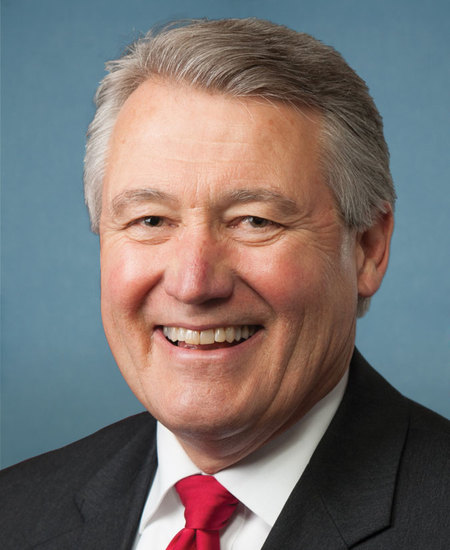
Rep. Rick W. Allen
Sponsored bills
Maddy summaryThe DETERRENT Act requires higher education institutions receiving federal funding to disclose foreign gifts and contracts meeting certain value thresholds ($50,000 or more for regular foreign sources, all for "foreign countries of concern" or "foreign entities of concern"). Institutions must report details including the foreign source's identity, purpose, and financial value, with all disclosures made public through a searchable database. The bill prohibits contracts with designated "foreign countries of concern" or "foreign entities of concern" without a specific waiver, and includes enforcement mechanisms with fines for non-compliance. Institutions must also maintain policies requiring faculty and staff to disclose foreign connections that meet certain criteria.
Maddy summaryHJRES 79 is a congressional resolution seeking to disapprove an Environmental Protection Agency (EPA) rule that would have reclassified certain large industrial facilities emitting hazardous air pollutants as "area sources" under the Clean Air Act. The rule, published in the Federal Register on September 10, 2024, aimed to shift these facilities from stricter regulatory requirements for "major sources" to less stringent standards for "area sources." If approved, the resolution would block the rule from taking effect, preserving current regulatory obligations for affected industrial facilities. This bill directly impacts the EPA's authority to regulate air pollution and the specific facilities subject to the proposed reclassification.
Maddy summaryHR 2403, the TELL Act, requires companies operating websites or mobile apps that store U.S. user data in China to clearly disclose two specific facts to users: (1) that their data is stored in China, and (2) whether the Chinese Communist Party or Chinese state-owned entities have access to it. It prohibits companies from knowingly providing false information about these points. Violations would be enforced as unfair or deceptive practices under the Federal Trade Commission Act, with the FTC handling enforcement and penalties. The law directly affects U.S. technology companies that collect user data and store it in China.
Maddy summaryHR 2165, the Choice in Automobile Retail Sales Act of 2025, amends the Clean Air Act to prevent the Environmental Protection Agency (EPA) from writing future tailpipe emissions regulations that mandate specific vehicle technologies (like electric or hydrogen systems) or limit the availability of new vehicles based on engine type (e.g., gasoline vs. electric). The bill requires the EPA to update its regulations within 24 months to ensure new rules comply with these restrictions. This directly affects the EPA’s regulatory authority and automakers, as it limits how emissions standards can be structured. The law aims to preserve consumer choice in vehicle types by preventing regulations from favoring one engine technology over others.
Maddy summaryThe PHIT Act of 2025 allows taxpayers to deduct certain fitness-related expenses as medical costs on their federal tax returns. It directly affects individuals and families who pay for qualifying physical activity programs, such as gym memberships, fitness classes, or approved equipment. Key provisions include setting annual limits ($1,000 per person or $2,000 for joint returns), defining eligible fitness facilities (excluding golf courses or private clubs), and specifying that equipment must be used exclusively for physical activity. The bill amends the Internal Revenue Code to treat these expenses as deductible medical costs, effective for taxable years after its enactment.
Maddy summaryThis bill redesignates the existing Ocmulgee Mounds National Historical Park as Ocmulgee Mounds National Park and establishes a separate Ocmulgee Mounds National Preserve in Georgia. It allows voluntary land acquisition (via purchase, donation, or exchange) for both areas without eminent domain, and requires the Secretary of the Interior to develop a management plan prioritizing cultural resource preservation for the Muscogee (Creek) Nation. The bill mandates tribal consultation, provides hiring preferences for tribal members, and ensures protection of sacred sites. It also places 126 acres of tribal land into federal trust for the Muscogee (Creek) Nation.
Maddy summaryThe Secret Ballot Protection Act requires that workers choose their labor union representative through a secret ballot election conducted by the National Labor Relations Board (NLRB), replacing private agreements between employers and unions. It amends the National Labor Relations Act to mandate secret ballot elections for both initial union recognition and decertification (removing a union as representative), ensuring workers' choices remain free from employer influence. The law applies only to new or changed representation relationships after its enactment, leaving existing union contracts unaffected. The NLRB must update its regulations within six months to implement these changes.
Maddy summaryHR 1596 renames the U.S. National Poultry Research Center in Athens, Georgia, as the "Abit Massey Poultry Research Center" for all official government references. This naming bill updates the facility's official designation without changing its operations, funding, or policies. It directly affects the center's administrative and legal documentation but does not alter its research activities or impact any individuals or groups.
Maddy summaryThis bill prohibits pharmacy benefit managers (PBMs) from receiving payments tied to prescription drug prices or rebates starting January 1, 2027. Instead, PBMs may only charge flat, itemized fees for actual services performed (e.g., claim processing), not based on drug costs or discounts. It directly affects PBMs and health insurance plans by requiring compensation to be decoupled from drug pricing, while allowing rebates to be passed through to lower net drug costs. The law aims to reduce conflicts of interest in PBM operations without changing drug pricing itself.