

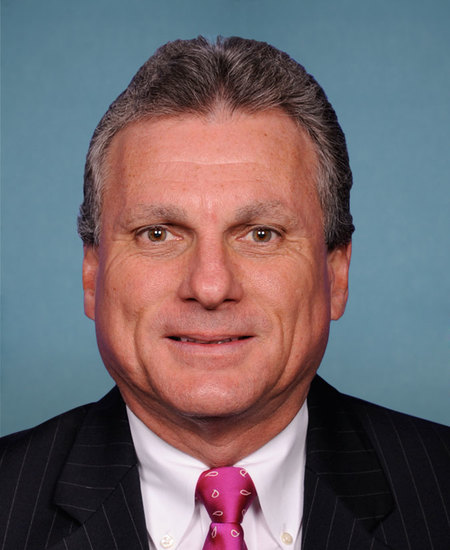
Photo of Earl L. "Buddy" Carter
R United States House · District 1 · Georgia

Rep. Earl L. "Buddy" Carter

Compare
Total votes
2,837
all sessions
Attendance
96%
104 missed
Lower than 83% of chamber peers
With party
96%
of cast votes
Higher than 92% of chamber peers
Bipartisan score
2%
crosses aisle rarely
Lower than 93% of chamber peers
Sponsored
1,351
bills & resolutions
Higher than 78% of chamber peers
Committees
5
assignments
1,351 bills and resolutions

Sponsored bills

Total
1,351
Primary
159
Co-sponsor
1,192
This page
1,351
matching current filters
Co-sponsor HR 1453
In committee · United States House · Co-sponsor
Customs Business Fairness Act of 2023

Maddy summaryThis bill, titled misleadingly as the "Customs Business Fairness Act," is actually a narrow amendment to bankruptcy law, not customs policy. It modifies Section 507(d) of the Bankruptcy Code to exclude "subparagraph (F)" from certain debt treatment rules, affecting businesses filing for bankruptcy under Title 11 after the law's enactment. The amendment applies only to bankruptcy cases commenced after the bill becomes law, not to cases filed before it was enacted. This is a procedural change with no direct impact on customs operations or import/export regulations.

In committee Mar 8, 2023 1 co-sponsor
Co-sponsor HR 1394
In committee · United States House · Co-sponsor
American SAFER Act of 2023

American Safety And Fairness through Expedited Removal Act of 2023 or the American SAFER Act of 202 3 This bill expands the classes of non-U.S. nationals ( aliens under federal law) who are subject to expedited removal (i.e., removal from the United States without further hearing or review). Specifically, the bill nullifies a 2004 Department of Homeland Security (DHS) rule  that generally limits expedited removal to certain situations, such as for non-U.S. nationals encountered within 14 days of entry into the United States without inspection and within 100 miles of a U.S. international land border. The bill also (1) prohibits DHS from implementing a rule that limits expedited removal based on how far a non-U.S. national was from the border when encountered or apprehended, and (2) modifies the relevant statute to state that expedited removal authority applies regardless of where the non-U.S. national was encountered or apprehended.

In committee Mar 7, 2023 1 co-sponsor
Co-sponsor HR 1382
In committee · United States House · Co-sponsor
TABS Act of 2023

Maddy summaryThe TABS Act of 2023 would rename the Consumer Financial Protection Bureau (CFPB) to the Consumer Financial Empowerment Agency (CFEA) throughout U.S. federal law. This bill would change the agency's name in the Consumer Financial Protection Act of 2010 and over 25 other federal statutes, including the Dodd-Frank Act and Truth in Lending Act. The bill does not alter the agency's responsibilities, authority, or budget structure - only its name. This is a procedural change affecting all federal documents, regulations, and references to the agency.

In committee Mar 7, 2023 1 co-sponsor
Co-sponsor HR 1388
In committee · United States House · Co-sponsor
Sultana Steamboat Disaster Commemorative Coin Act of 2023

Maddy summaryHR 1388 authorizes the minting of commemorative coins to honor the 1865 Sultana steamboat disaster, the deadliest maritime tragedy in U.S. history. It specifies three coin types ($5 gold, $1 silver, and half-dollar) with defined weights and compositions, to be sold at face value plus surcharges ($35, $10, and $5 per coin, respectively). All surcharges collected will fund the Sultana Historical Preservation Society for museum development, including exhibits, artifact preservation, and facility construction. The coins are legal tender but intended for collectors, with sales limited to a one-year period starting January 2023.

In committee Mar 7, 2023 1 co-sponsor
Co-sponsor HR 347
Passed · United States House · Co-sponsor
Reduce Exacerbated Inflation Negatively Impacting the Nation Act

Maddy summaryThis bill requires the President to assess the inflation impact of major executive orders before issuing them. For any executive order projected to cost at least $1 billion annually in budget effects (excluding emergency relief, national security actions, or treaty implementation), the President must prepare a statement estimating its effect on inflation - whether it has no impact, quantifiable impact, or significant but undeterminable impact. Federal agencies must provide necessary data to support this assessment, and the President must submit an annual report to Congress detailing all such assessments. The bill does not change inflation policy but mandates a new procedural review for major executive actions.

Passed Mar 6, 2023 1 co-sponsor
Primary HR 1173
In committee · United States House · Lead sponsor
Patients’ Right to Know Their Medication Act of 2023

Patients' Right to Know Their Medication Act of 2023 This bill establishes requirements relating to the form, content, and distribution of patient safety labels for prescription drugs. Specifically, the Food and Drug Administration must issue regulations with requirements relating to the authorship, content, format, color, printing, and dissemination of such patient safety information. The regulations must require labels to include the drug's approved uses, known interactions with other drugs or substances, contact information for the drug's manufacturer, and other specified information relating to patient safety. The information must be in plain, neutral language and must be given in printed form with each prescription.

In committee Mar 3, 2023 0 co-sponsors
Co-sponsor HR 1259
In committee · United States House · Co-sponsor
HITS Act

Maddy summaryThe HITS Act changes tax rules to help independent music producers by allowing them to deduct costs for creating sound recordings as immediate business expenses, rather than spreading costs over time. It specifically applies to U.S.-produced sound recordings (like albums or podcasts) by qualifying independent producers, with a $150,000 annual cap on deductible costs. The bill also enables bonus depreciation for equipment used in these productions, treating them similarly to film or theater projects for tax purposes. This aims to improve cash flow for smaller music businesses by reducing upfront tax burdens on recording costs.

In committee Feb 28, 2023 1 co-sponsor
Co-sponsor HR 1200
In committee · United States House · Co-sponsor
National Right-to-Work Act

Maddy summaryHR 1200, the National Right-to-Work Act, prohibits requiring workers to join a union or pay dues as a condition of employment in both private-sector workplaces (covered by the National Labor Relations Act) and railroad industries (covered by the Railway Labor Act). The bill amends key sections of these laws to eliminate provisions that allowed union security agreements, meaning workers in unionized settings would no longer be forced to pay dues to retain their jobs. This directly affects employees in unionized workplaces across the U.S., particularly those in industries with existing union contracts that included mandatory dues. The law changes the legal framework to ensure union membership and dues payment remain voluntary for all workers.

In committee Feb 27, 2023 1 co-sponsor
Co-sponsor HRES 124
In committee · United States House · Co-sponsor
Expressing the sense of the House of Representatives that the United States should support the expansion of domestic nuclear energy and advanced nuclear technology as a viable source of power in order to promote United States nuclear energy leadership and global energy independence.

Maddy summaryHRES 124 is a non-binding House resolution expressing congressional support for expanding domestic nuclear energy and advanced nuclear technology. It states the House believes the U.S. should promote nuclear energy as a reliable, low-carbon power source to enhance energy leadership and independence, citing its high reliability (92% operation rate), carbon reduction benefits (482 million metric tons avoided in 2021), and economic contributions (475,000 jobs supported). The resolution urges actions like streamlining regulations for advanced reactors, securing domestic uranium supply chains, and addressing misinformation about nuclear safety - though it does not create new laws or funding. It serves solely as a statement of policy preference, not a legislative mandate.

In committee Feb 24, 2023 1 co-sponsor
Co-sponsor HR 1007
In committee · United States House · Co-sponsor
Nuclear Assistance for America’s Small Businesses Act

Maddy summaryHR 1007, the Nuclear Assistance for America’s Small Businesses Act, delays collection of nuclear regulatory fees for small businesses applying for permits to build or operate advanced nuclear reactors. It allows eligible small businesses (defined as those with NAICS code 221113 that responded to NRC's RIS-20-02) to delay up to 50% of pre-application fees and 35% of post-application fees. The delayed fees must be repaid over 10 years at 10% annually, or accelerated to 25% if the business fails to submit a covered application within 5 years, withdraws it, or faces denial. This applies specifically to applications for construction permits, operating licenses, or combined licenses for advanced nuclear reactors under NRC oversight.

In committee Feb 24, 2023 1 co-sponsor
Showing 841 to 850 of 1,351 bills
Previous 1 … 84 85 86 … 136 Next